
CONTEMPORARY
Dress and shawl by Janice Kissinger.
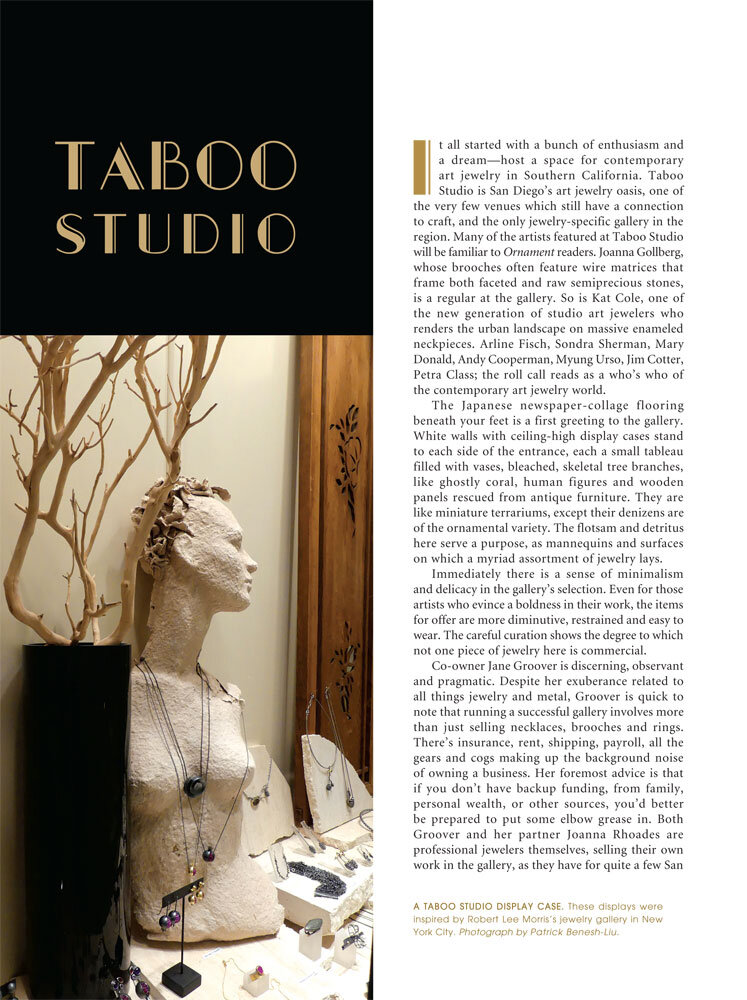
It all started with a bunch of enthusiasm and a dream—host a space for contemporary art jewelry in Southern California. Taboo Studio is San Diego’s art jewelry oasis, one of the very few venues which still have a connection to craft, and the only jewelry-specific gallery in the region.

Margaret Zinser Hunt feels that art glass is a technically based medium, where the physics and chemistry of this craft both appeal to the scientifically inclined. Each piece of glass art is an experiment that takes hours. Solutions to problems in art glass do not come from the traditional liberal arts. During this period she started to make stylized butterflies, including Monarchs, an iconic symbol of the insect world and also a hallmark of the worldwide extinction of insects.
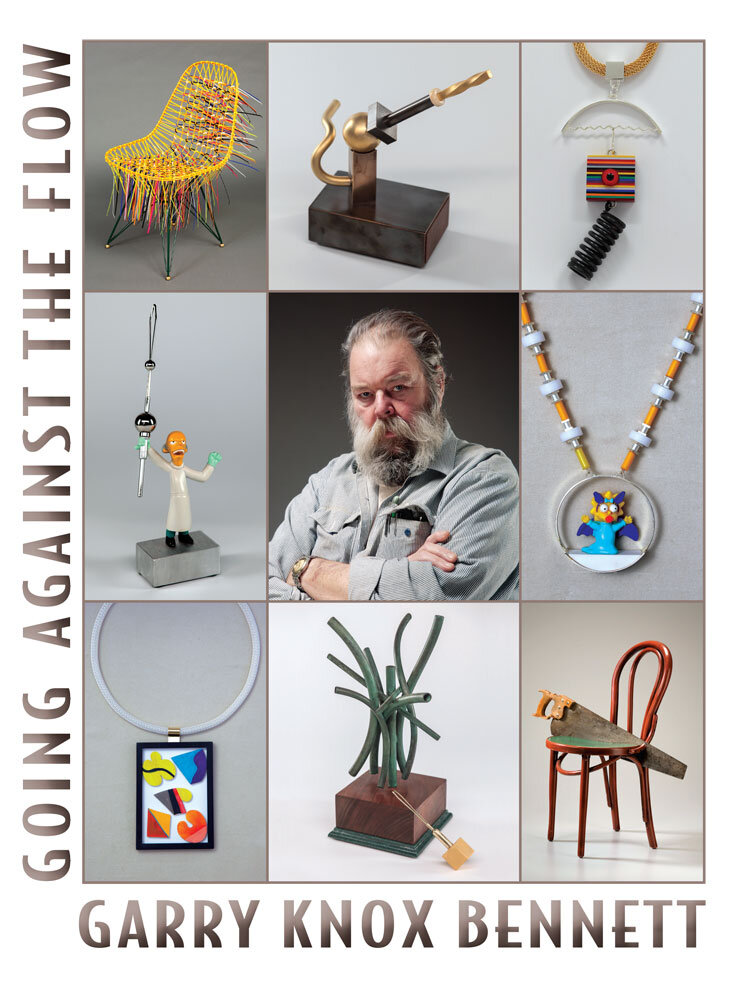
Glen R. Brown interviews Garry Knox Bennett, jeweler, furniture maker, painter, and sculptor, who makes his art in a very intuitive manner. (In)Famous in the craft community for putting a protruding spike in a piece of fine wood furniture, many would not know that his early career was as a successful manufacturer of roach clips. His jewelry, which makes extensive use of found objects and industrial materials, reflects his sense of composition, and great sense of humor.
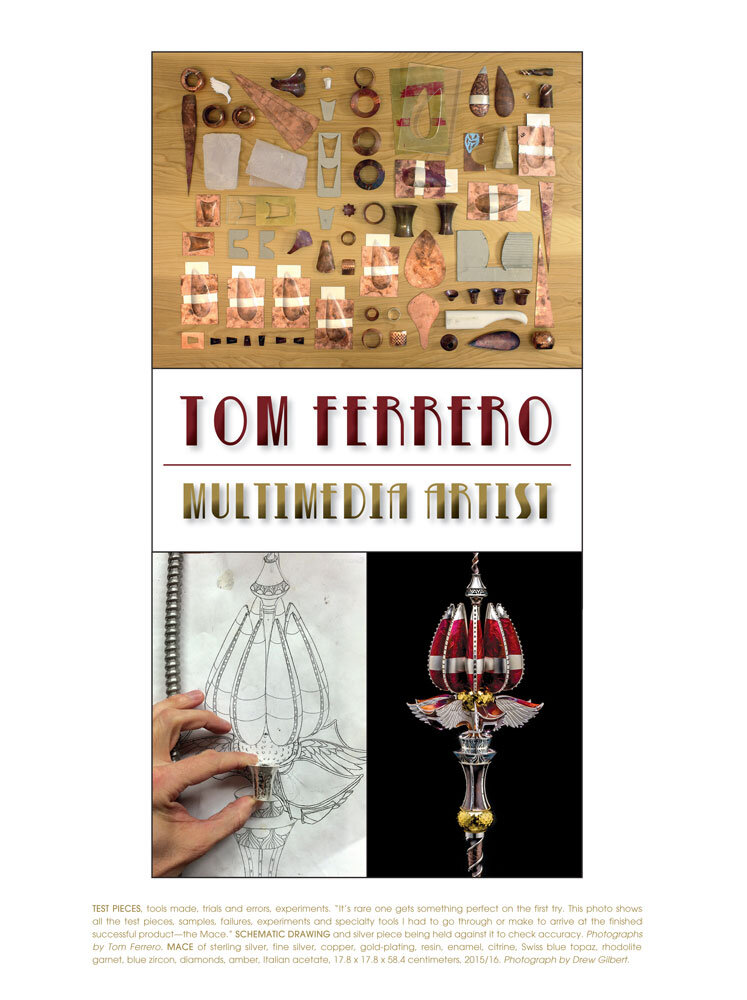
Carl Little chronicles the work of metalsmith, painter and teacher Tom Ferrero, a resident of Maine, whose metalwork is often characterized by a dazzling array of techniques, materials and complexity. Only in his thirties, Ferrero has already won prestigious prizes. Taking inspiration from a variety of sources, including science fiction, space exploration and nature, he has found his personal balance between teaching, metalsmithing and painting.
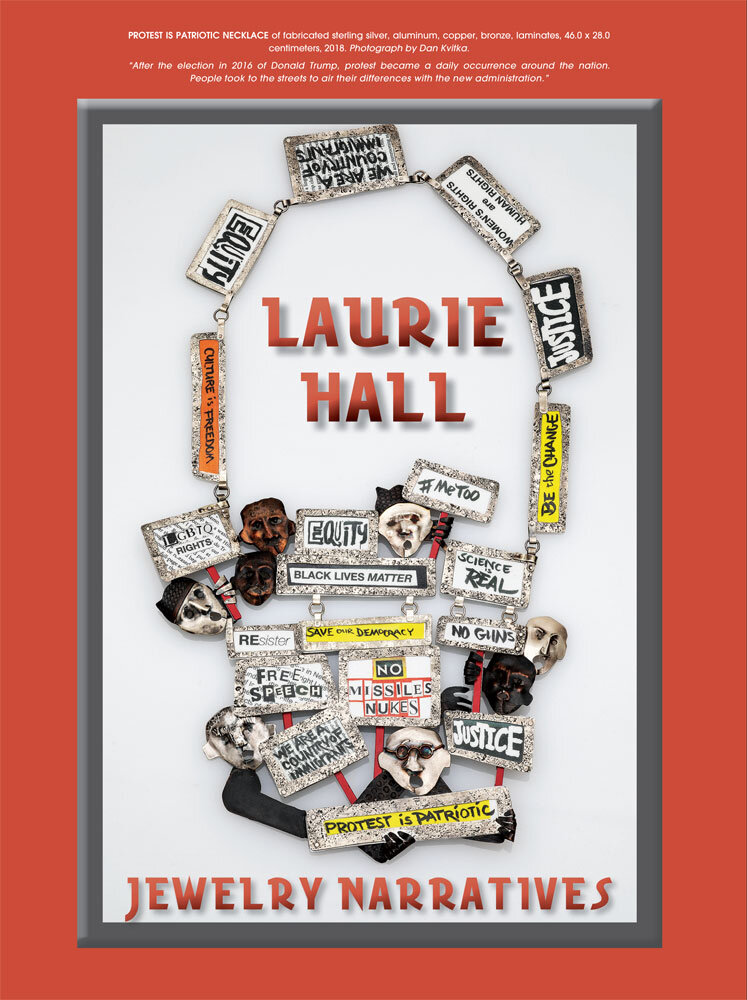
Robin Updike chronicles the career of Laurie Hall, a much-admired jeweler belonging to a unique group of Northwest artists influenced by the legendary Ramona Solberg. A career art teacher, who earned a master’s degree with Solberg, Hall’s work often contains political commentary, also strong in art jewelers from the Pacific Northwest.

There is a certain weightiness in attending the Philadelphia Museum of Art Contemporary Craft Show which goes beyond its venue. While coziness and a red carpet entrance helps describe its comfortable space, this is one of those rare events where the focus is not the show itself, but the performers who inhabit it and breathe life into it.

In 1968, nine jewelers and metal artists met in the Windy City, where a conversation took place regarding a society that would serve the needs of metalsmiths. The following year, SNAG was founded. 2019 marks its fiftieth anniversary as an organization, and Chicago was chosen as a return to its spiritual birthplace. The Palmer House, a historic hotel built in 1875 featuring lush decor by Louis Comfort Tiffany, was its venue, a central location in the Chicago Loop both convenient and offering metaphorical associations, a coming full circle that was poetic and appropriate.

Ashley Callahan takes the reader on a deep dive into the art of African-print fashion. A European introduction that has been adopted wholesale by African seamstresses, fashion designers and both men and women, her retelling of the textile’s history, its rich language of symbolism, and its contemporary use lights up the imagination.

Glen R. Brown interviews studio jeweler Linda MacNeil, who is inspired by historical art and is a collector of influences through observation. With a playful curiosity, an eye for assembling contrasting elements, and a flare for color, MacNeil’s careful, successive series in glass amount to a grand visual experiment.
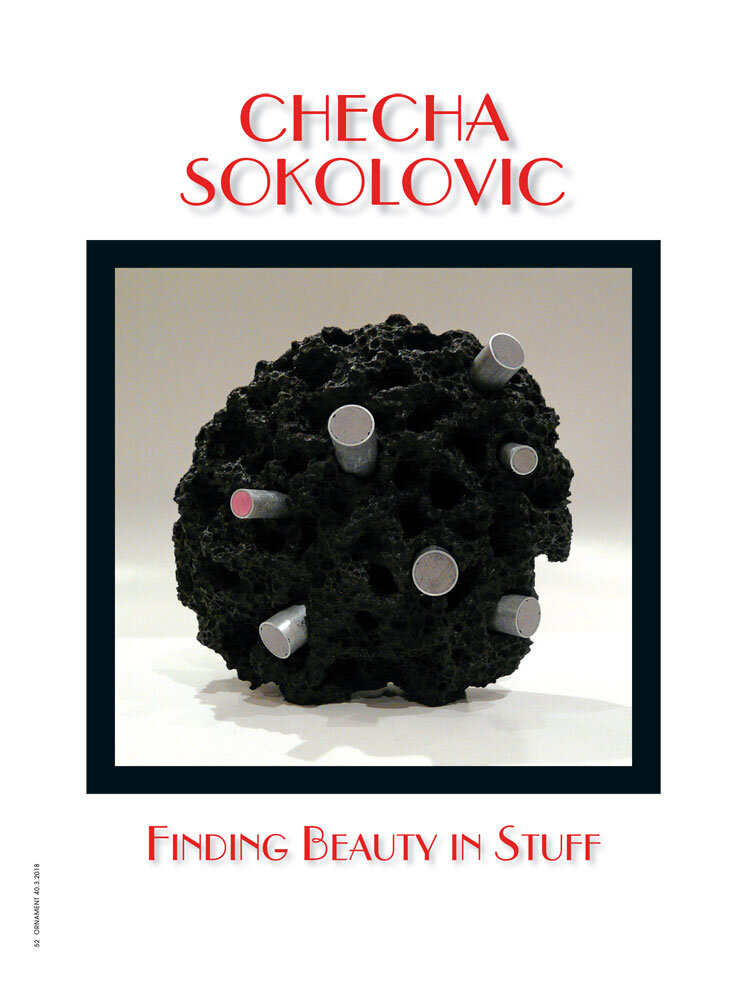
Robin Updike describes how architectural engineer Checha Sokolovic, who only started making jewelry in 2010, uses concrete, stainless steel and polyvinylchloride, as well as charcoal, fur and even egg cartons to create stunning ornaments with a great simplicity of style. She is one of the few to have worked with concrete in jewelry over the last four decades.
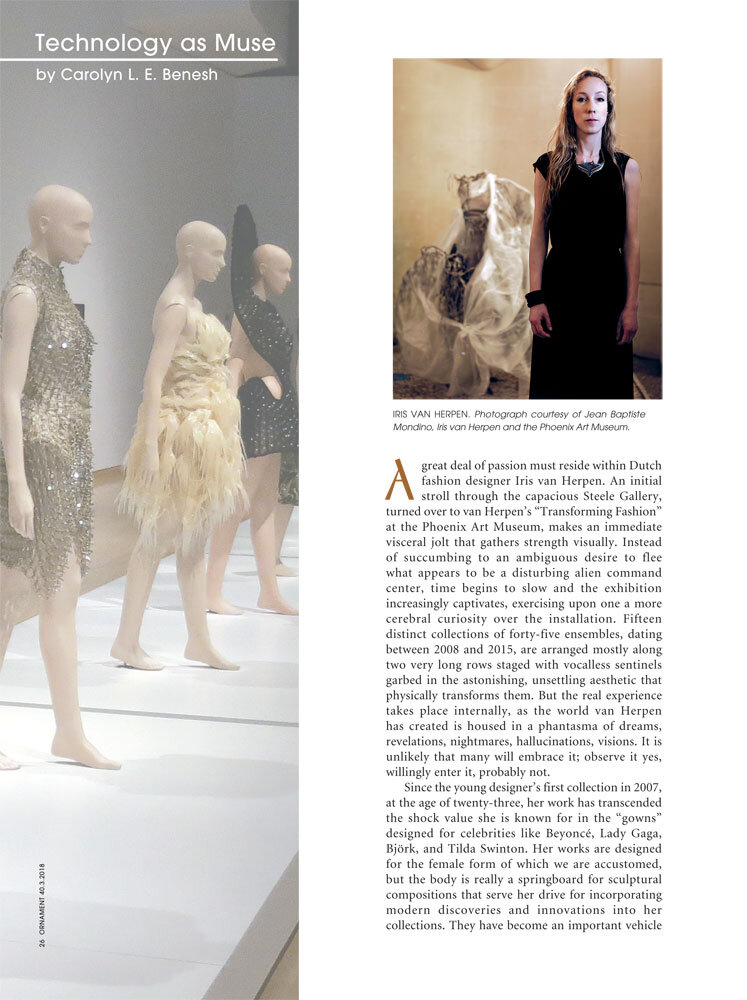
A great deal of passion must reside within Dutch fashion designer Iris van Herpen. An initial stroll through the capacious Steele Gallery, turned over to van Herpen’s “Transforming Fashion” at the Phoenix Art Museum, makes an immediate visceral jolt that gathers strength visually. Instead of succumbing to an ambiguous desire to flee what appears to be a disturbing alien command center, time begins to slow and the exhibition increasingly captivates, exercising upon one a more cerebral curiosity over the installation.

An unassuming storefront along Los Angeles’s bustling West Third Street is a creative way-station for those in the know. Freehand Gallery has been in business since 1980, the carefully stewarded brainchild of Carol Sauvion. Its longevity is a remarkable tribute to the enduring power of craft as an aesthetic and cultural force.
From April 21 through June 2, 2018, this year’s annual jewelry show, entitled “Back Again, Forever,” focused on the way jewelry evokes memories, even imagined ones, of times long past, inducing reflection on possibilities yet to come.

In Moby Dick, Herman Melville bemoaned the ephemerality of tattoos: “These mysteries were therefore destined in the end to moulder away with the living parchment whereon they were inscribed.” How does one display—much less demystify—this “living parchment” in a museum setting? A touring exhibition organized by the Musée du quai Branly in Paris—and most recently seen at the Natural History Museum of Los Angeles (November 19, 2017 - April 15, 2018)—offers a novel solution: silicone torsos, arms and bottoms decorated with tattoos commissioned for the show from prominent contemporary tattoo artists like Chuey Quintanar, who was born in Mexico but moved to Long Beach, California, as a child, and Leo Zulueta, who grew up in Hawaii and draws inspiration from traditional Micronesian tattooing. (Zulueta refuses to copy traditional tribal designs faithfully, however, considering it disrespectful.) The Los Angeles installation highlights the city’s own rich tattooing history and contemporary skin art scene. Today, Southern California is known for the black-and-gray style of finely detailed, single-needle tattoos, which spread from East Los Angeles via the U.S. prison system.

Carl Little chronicles Keri Ataumbi who started as a painter, then went into jewelry in her late twenties. While of Kiowa heritage, her jewelry, often animal themed, does not announce as Native American, but they speak with loving concern and poignancy of her life, family and heritage. Her collaborations with other artists result in an exciting body of work that is diverse, intriguing and contemplative.
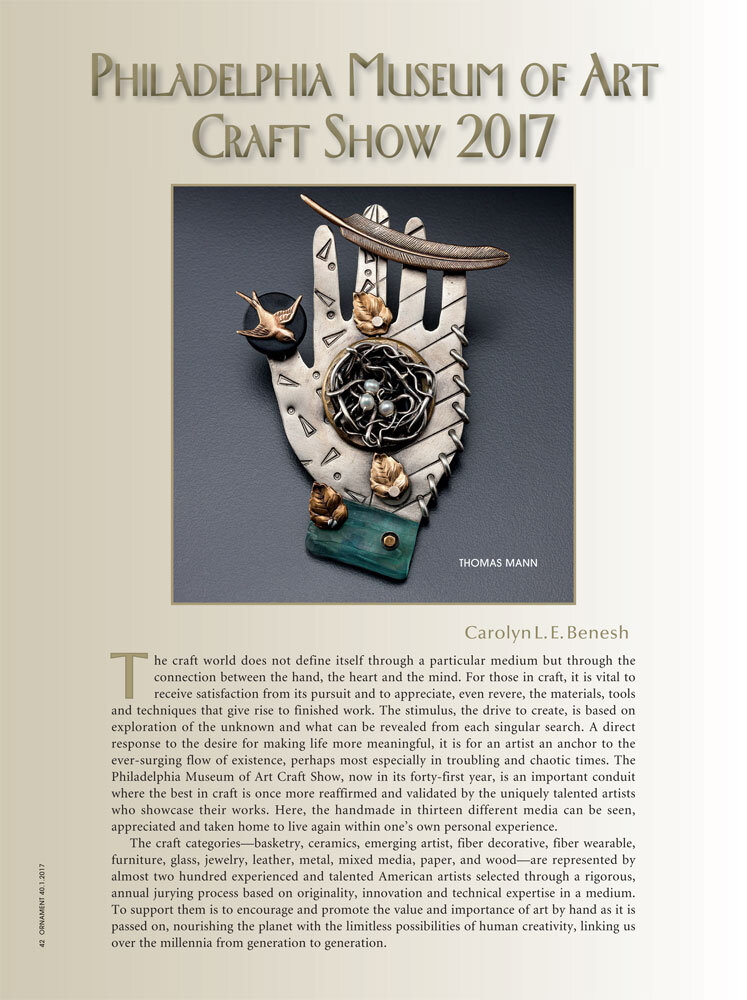
Carolyn L. E. Benesh paints us a picture of the Philadelphia Museum of Art Craft Show for 2017 in which each craftsperson is celebrated. In giving a careful look at ten artists and their work, the nature of this annual show, an institution that has given a platform and a marketplace for craft for now forty-one years, is brought into focus.
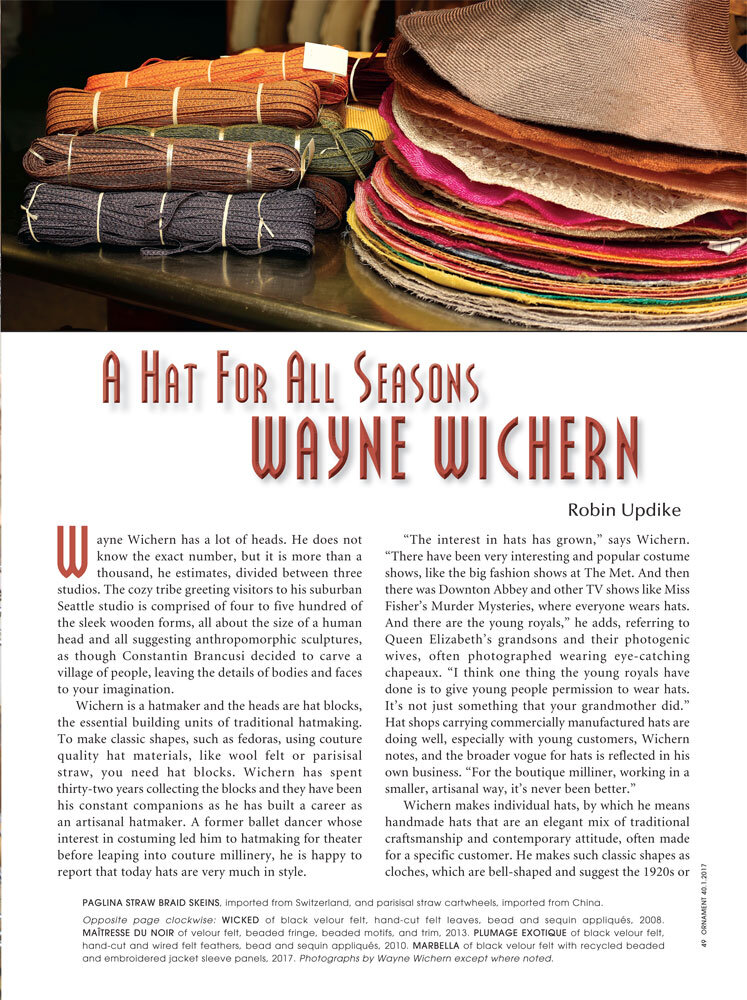
Robin Updike writes that hatmaker Wayne Wichern’s studios are peopled by hundreds of wooden hat blocks, that she likens to Brancusi sculptures without features. As a custom milliner, with studios in Seattle and Burlingame, California, Wichern has a thriving clientele with a sense of style and life experience. Formerly a ballet dancer, Wichern also teaches hatmaking at top craft institutions.

Ashley Callahan notes how the peripatetic life of Kat Cole has influenced her jewelry of steel and enamel. Each of the six places where she has lived has a distinct cityscape that she translates into her work, reflecting their industrial detritus. Using sheet steel and liquid enamel, often applied in an industrial context, her work is highly geometric, yet light, due to the strength of the material.

Descended from Navajo silversmiths and weavers and Picuris Pueblo potters, Connie Tsosie-Gaussoin and her sons Jerry Jr., David and Wayne Nez, and daughter Tazbah share a creative heritage that has profoundly shaped their experiences and perspectives. Like the progeny of the early American painter Charles Wilson Peale or the Duchamp-Villon siblings who played a prominent role in modernism, Connie’s sons and daughter took to art collectively as a consequence of their upbringing but as adults have demonstrated that the creative spirit can be both a unifier, connecting them in communal understanding, and a means toward individualization and personal expression. There is no doubt that their careers as artists have been mutually sustained through familial bonds, but each can be distinguished by a unique personality that gives direction to the style and content of his or her work.
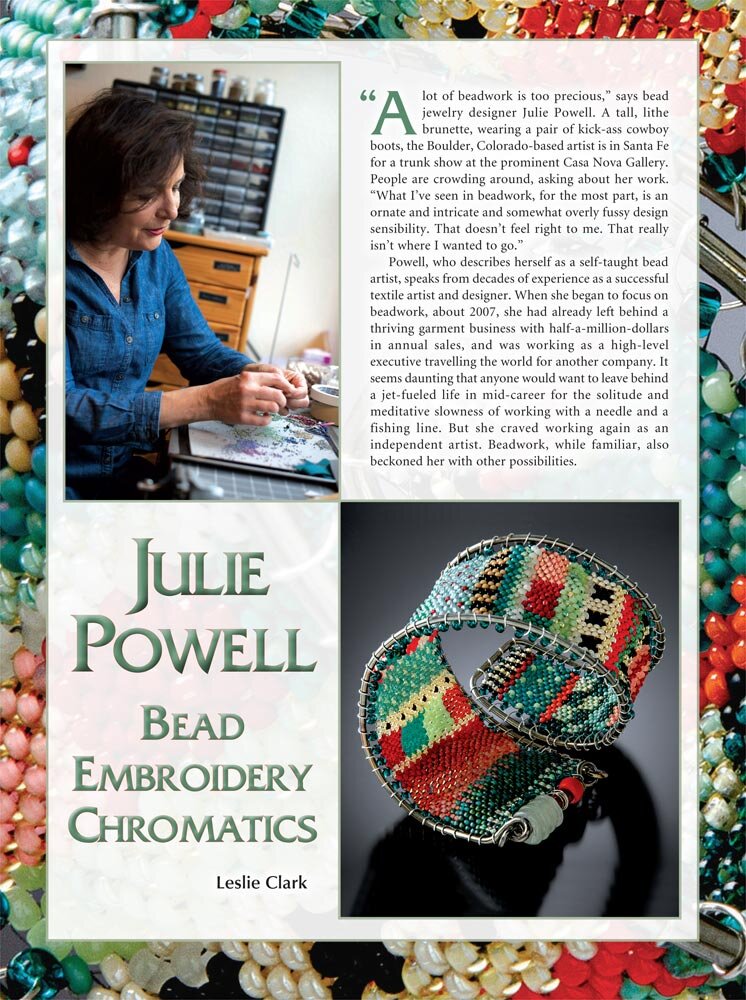
Leslie Clark tells how successful textile artist and designer Julie Powell transitioned into a powerhouse beadwork jeweler. Self-taught, she used her textile background to re-interpret them into beadwork designs, in a wide variety of striking styles and forms of jewelry. While she exhibits at shows, she is also active on the internet with sales of her work.
(Note: This article is a large download.)

Ashley Callahan discusses the jewelry of Barbara Mann, who explores both the macro and the micro as she makes work that interprets cell biology and the cosmos. A graduate of the University of Georgia’s craft programs, Mann uses silver, gold and unusual semiprecious gems as components in forming her narrative pieces. She reads deeply for her research and has also consulted biologists in her search for understanding the intricacies of cell structures.
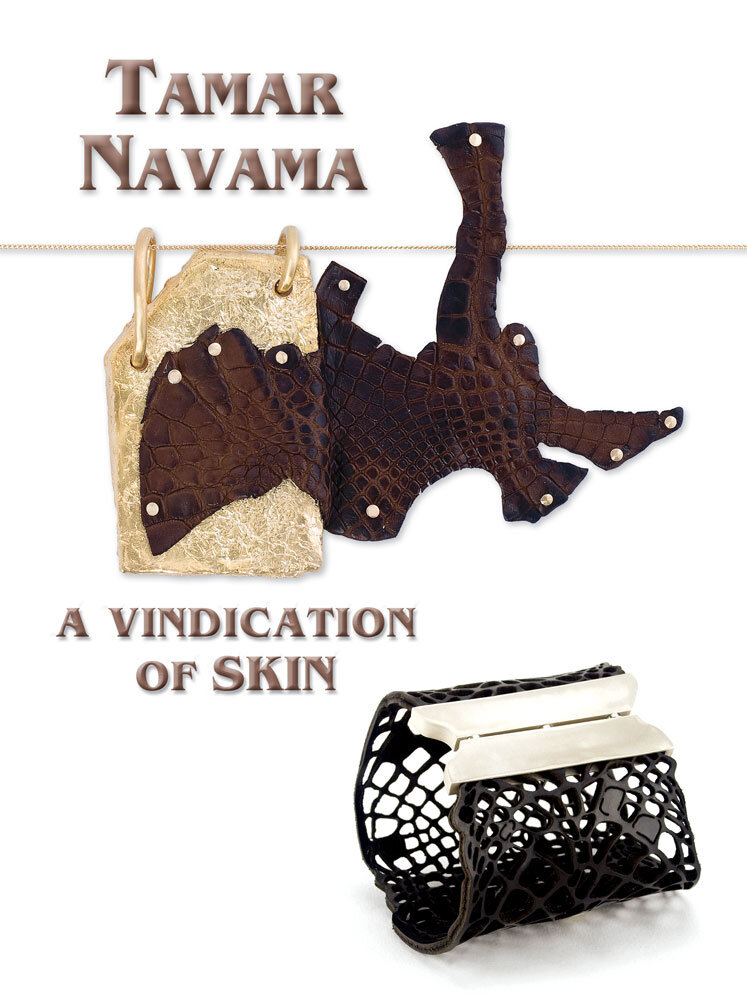
Glen R. Brown illuminates how Dallas, Texas-based Tamar Navama chooses to focus her energies on the challenges and opportunities that a particular substance brings to her ability to create jewelry, in this case, leather. Her solutions are a unique twist on a material that goes back to earliest human use.

It is in that service Andrea Geer dedicates herself, working through processes within processes to turn the ideas that dwell inside into physical objects. From knitwear to digitally-printed fabric and leather cut and sewn into garments, Geer manages a balance between her repertoire of skills and tools, and her capacity to bring forth her thoughts as coherent and functional wearables.

Sandy Swirnoff creates necklaces of intricately knotted nylon thread in colorful hues, embedding them with beads of all kinds, and sometimes with rescued shards of Art Nouveau glass. Thirty of these unique and wearable works of art were on view in Sandy Swirnoff—Knotted Fiber Jewelry, an exhibition presented by Mingei International Museum in San Diego, from January 14 to June 4, 2017.

Vlisco is the Dutch company whose vibrant textiles, based on Indonesian batik wax-resist techniques for printing color on cotton cloth, have for a century and a half enjoyed enormous popularity throughout West Africa. In the hands of local dressmakers, these Dutch Wax (or Wax Hollandaise) prints are transformed into gorgeously designed garments that reflect the tastes, traditions and trends of the region’s various cultures.

Glen R. Brown writes about Chunghie Lee’s adaptation of traditional Korean patchwork cloth or bojagi into dynamic clothing and adornment. Made in the past by nameless Korean women, recycling squares of fabric into wrappings, she honors their sense of design and color with her wearable art, which move with graceful motion when worn, yet function as sculpture when hung.

Robin Updike compares her impression of the 2016 Smithsonian Craft Show to her own experiences at a 1970s southern California craft show, her first exposure to handmade crafts. She interviews with insight a number of the participating artists. Her text is richly accompanied by images of this year’s crafts in many categories and media.

Ashley Callahan chronicles the career of Kate Rothra Fleming, who grew up with ardent naturalist parents who encouraged her study of art. After a short stint as an art teacher, she joined the Peace Corps, teaching art, math and English in Botswana. Eventually she took up flameworking; largely self-trained, she did study with Robert Ebendorf, Robert Mickelsen and Loren Stump. Living now in South Carolina and Costa Rica, her jewelry is still very much influenced by nature.

Kimberly Chrisman-Campbell reviews the enamel ornaments collected by Bernard N. Jazzar and Harold B. Nelson, the subject of a book and traveling exhibition. Established scholars of art history, Jazzar and Nelson began collecting enamel about twenty years ago and their shared passion has led to formation of the Enamel Arts Foundation.
A very interesting project recently emerged as the Racine, a major holder of the S.C. Johnson collection, made the decision to honor an exhibition sponsored by the Johnson company (maker of Johnson’s Wax among other products), and its accompanying publication from fifty years ago. “Objects Redux,” a series of three presentations in the museum’s galleries, showed works from the original “Objects: USA” that have been integrated into RAM’s permanent collection, among others that predate and postdate the show.