
ETHNIC
Tuareg bracelets of silver and abaka wood. Abaka is used by the Tuareg for its black luster, and is often mistaken for ebony.
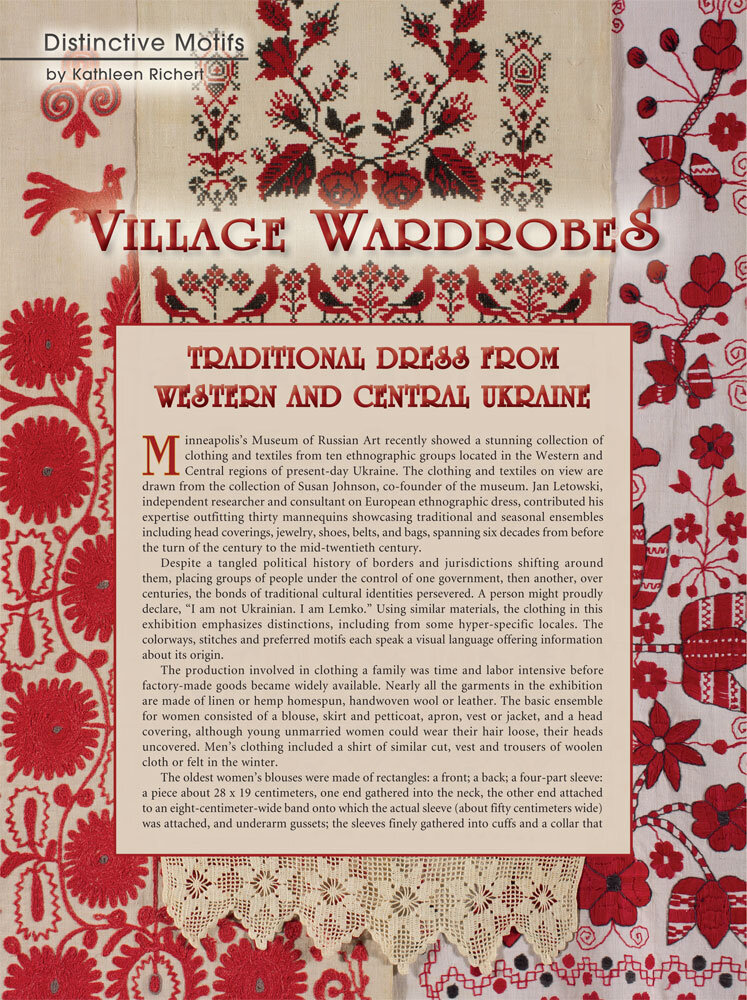
Minneapolis’s Museum of Russian Art recently showed a stunning collection of clothing and textiles from ten ethnographic groups located in the Western and Central regions of present-day Ukraine. The clothing and textiles on view are drawn from the collection of Susan Johnson, co-founder of the museum. Jan Letowski, independent researcher and consultant on European ethnographic dress, contributed his expertise outfitting thirty mannequins showcasing traditional and seasonal ensembles including head coverings, jewelry, shoes, belts, and bags, spanning six decades from before the turn of the century to the mid-twentieth century.

While Spondylus, a marine bivalve greatly valued in prehistoric times for its color, utility as a luxury ornament and ritualistic and religious significance, has been well-studied in Andean cultures, and to a lesser extent in Panamic or Isthmo-Colombian context, it is much less well known in Mesoamerica, especially on the West Coast of Mexico.

Robert K. Liu, with the help of the owners of Ethnic Embellishments, shows the ingenuity and craftsmanship of Tuareg smiths. Despite perhaps the most simple toolkit among North and West African jewelers, they demonstrate great skills in creating with a variety of materials.

Most of us are acquainted with moccasins: think of kids’ Halloween costumes or old movies; “driving mocs” for the car; high-tech mocs for rock climbing. The eye-opening exhibit “Stepping Out: 10,000 Years of Walking the West,” at the Museum of Indian Arts and Culture in Santa Fe through December 31, 2018, tells a much bigger story, that dramatically shifts how to see and appreciate traditional handmade Native American footwear.

In Moby Dick, Herman Melville bemoaned the ephemerality of tattoos: “These mysteries were therefore destined in the end to moulder away with the living parchment whereon they were inscribed.” How does one display—much less demystify—this “living parchment” in a museum setting? A touring exhibition organized by the Musée du quai Branly in Paris—and most recently seen at the Natural History Museum of Los Angeles (November 19, 2017 - April 15, 2018)—offers a novel solution: silicone torsos, arms and bottoms decorated with tattoos commissioned for the show from prominent contemporary tattoo artists like Chuey Quintanar, who was born in Mexico but moved to Long Beach, California, as a child, and Leo Zulueta, who grew up in Hawaii and draws inspiration from traditional Micronesian tattooing. (Zulueta refuses to copy traditional tribal designs faithfully, however, considering it disrespectful.) The Los Angeles installation highlights the city’s own rich tattooing history and contemporary skin art scene. Today, Southern California is known for the black-and-gray style of finely detailed, single-needle tattoos, which spread from East Los Angeles via the U.S. prison system.

The International Folk Art Market (IFAM) in Santa Fe, now in its fourteenth year, is an enormously successful market for one hundred fifty artists or collectives from fifty-four countries.

“Enduring Splendor: Jewelry of India’s Thar Desert” provided a tantalizing window into the five-thousand-year history of jewelrymaking across the Indian Subcontinent. Shown at the Fowler Museum at UCLA (February 19—June 18, 2017), it was the setting for a stunning array of magnificent jeweled objects, part of a promised gift to UCLA from the Ronald and Maxine Linde Collection of Jewelry and Ritual Arts of India. An important aspect, curated by Thomas K. Seligman, was the work of four living metalsmiths (sonis) from the fortress city of Jaisalmer in Rajasthan. Exhibition co-curator Usha R. Balakrishnan authored two of the essays in the accompanying publication.

We live on a planet where the global neighborhood has broadened, with once great distances being traversed daily. The land and sea between continents are not the barriers they once were, even for those who live in small towns and villages. Worlds that were once far apart may meet, as is the case with Rajasthani goldsmith, Bhagwan Das Soni, or B.D. as he is more well known, who graced the Fowler Museum at the University of Los Angeles with his presence and wares one mildly overcast afternoon this past May.

Hair adornments were a vital part of women’s jewelry in many parts of East Asia, recently reinforced during a visit in 2016 to the Asian galleries of the Newark Museum of Art. Metal hairpins were not numerous among the Japanese, Korean and Chinese jewelry on display, although Chinese metal examples have been well documented (Duda 2002, Hang 2005, Lingley 2007, Liu 1999). Perhaps this results from many such ornaments being from the lower classes or general populace, and not from the upper classes, thus not of significant crafting or preciousness to warrant inclusion in museum collections.
Worn as protective amulets as well as for other ritual uses, glass beads were considered a valuable commodity and reused, restrung or made into something else: for example, the goat leather bracelets made from these beads that we sell. Their extraordinarily small size made it possible to make bracelets significantly narrower and more detailed than the more ordinary variety of larger-sized seed beads, common in Mali and other parts of Africa.