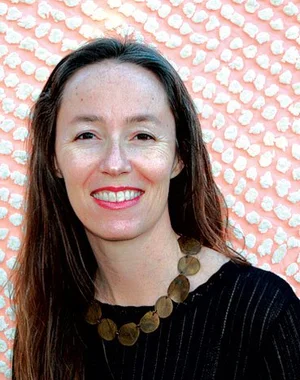
Laura Wood Volume 47.1
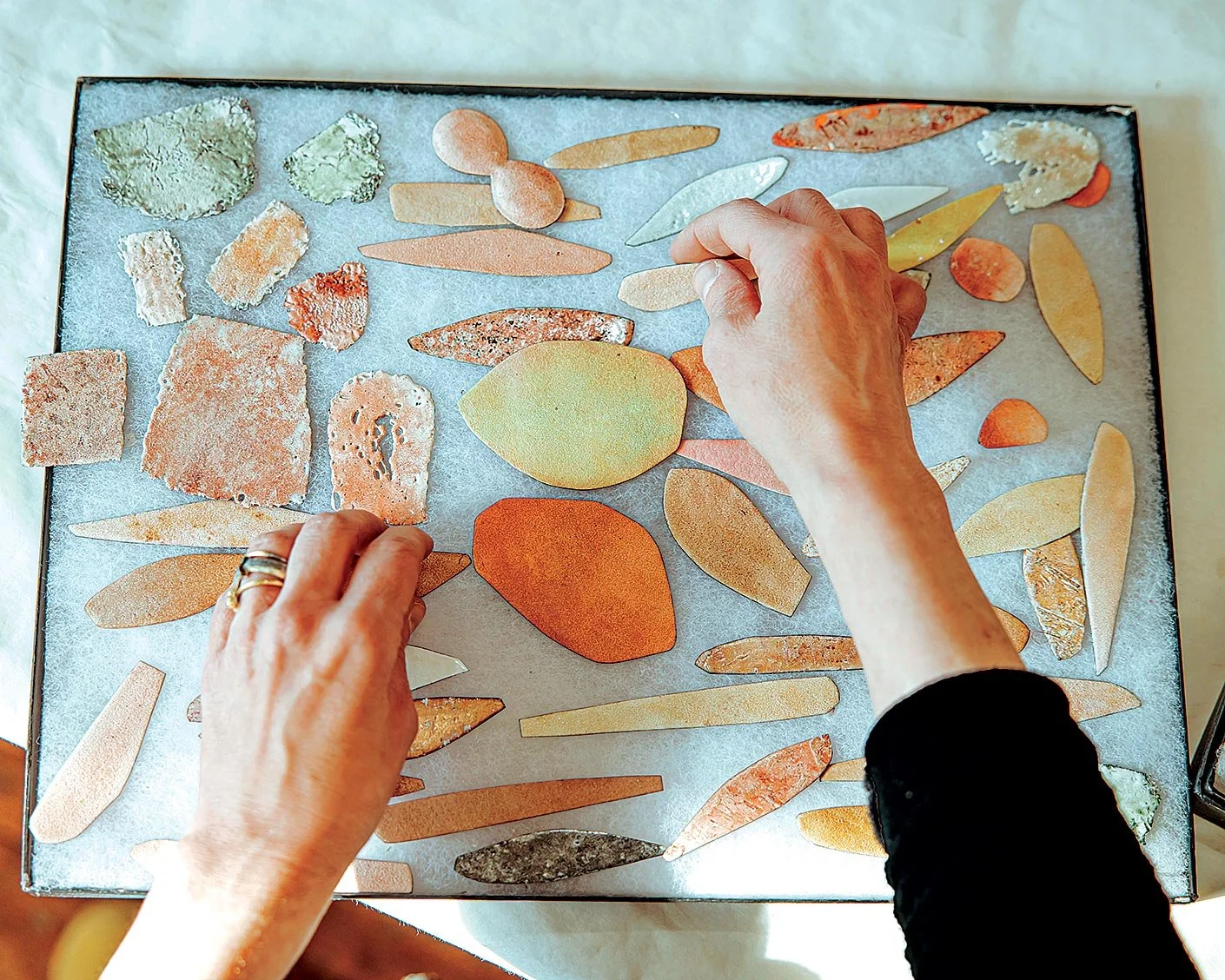
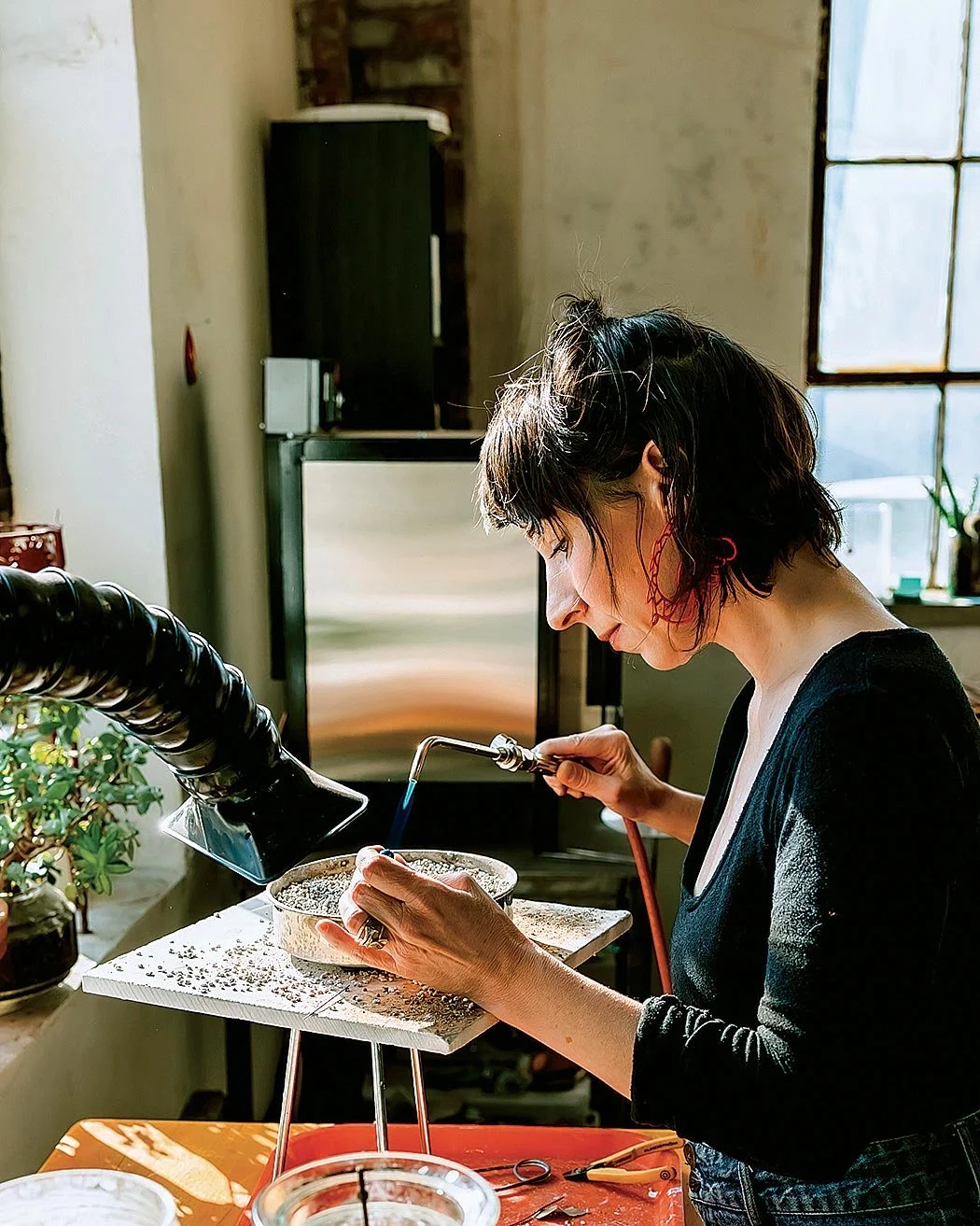
STUDIO SHOT with various enameled elements, 2025. Photograph by Tia Corbin. Prior photograph by Whitney Ott.

DOUBLE LACE EARRINGS of brass, sterling silver, powder coat, 2022. Model: Morgan Diep. Photograph by Lucy Plato Clark.
Laura Wood describes herself as a “color queen” and reveals, “I’m really into cobalt blue right now. That has my heart.” She also relishes neon, “that’s just part of my language at this point. I love having a bright pop of color.” Wood views color as “a celebration,” adding, “when you’re wearing color, when you’re choosing to put it on…you’re kind of choosing to have a positive day.” Her forms often are deceptively simple, like beautiful wispy drawings she just dashed off, but it takes effort and time to find lines that complement the face just so, or a dozen not-quite-circles and not-quite-squares that come together in a balanced necklace.
For Wood, “every finished work holds within it all the hours that preceded it and all of the unseen accumulation of learning, refining, and beginning again.” Wood’s hours began with dance. Starting in kindergarten, she attended a studio down the street from her home in Milledgeville, Georgia, and dance became a constant in her life, a regular part of each day for years. Through this routine, she developed, as she describes it, “a dancer’s brain.” “There’s a foundation of technique and self-discipline that you learn in dance…Once you have the technique and discipline, you start developing choreography. And within choreography, you’re responding to another variable…like the beat, the timing, or the music, or the environment…You move your body in a way that is grounded in technique, but you are elaborating from there with your body to create the art form.”
Though reluctant to attend college, her mother convinced her to go by suggesting that she could major in dance. However, when she arrived on the University of Georgia campus in fall 2003, she quickly realized that dance was not her future (she did not have enough formal ballet training), so she turned to studio art. She started with a basic introductory class that included presentations from a variety of faculty. When jewelry professor Rob Jackson spoke, she was “mesmerized….I didn’t even know that metalsmithing existed!” She had not had much art education in school, so “every art class I took was like a new world… and I wanted to do everything!” In the jewelry and metalwork classes, though, she “felt really at home…. I was getting a lot of feedback. I was having the conversations I wanted to have. I felt seen.”
Jackson encouraged Wood, while an undergraduate, to take a summer class at Penland School of Craft in Western North Carolina. “That was a whole other unlocking of a world that I didn’t know existed.” She loved the area and the nearby city of Asheville. “I always knew that it was a spot where I could see myself putting roots down.” In 2013 she finally moved there. “It’s just everything I ever wanted in a place to live….And it’s just beautiful…I love it.” Now she resides there with her husband and young daughter and has a small retail space (a “micro boutique” that she shares with another jeweler) in the River Arts District.
While her jewelry is often interpreted as an extension of her experience as a dancer in motion, Wood believes that bringing the mindset of a dancer to her work is more important than bringing the body of a dancer. Like with dance, for jewelry she “spent many years learning technique—learning how to solder, how to set stones, or learning how to move metal in a certain way, learning the characteristics of a material.” And now she can enjoy the freedom that knowing the technique allows. New compositions can emerge as she responds to changes in her life or the inspiration she finds in the “piles of curiosities” she has around her studio.
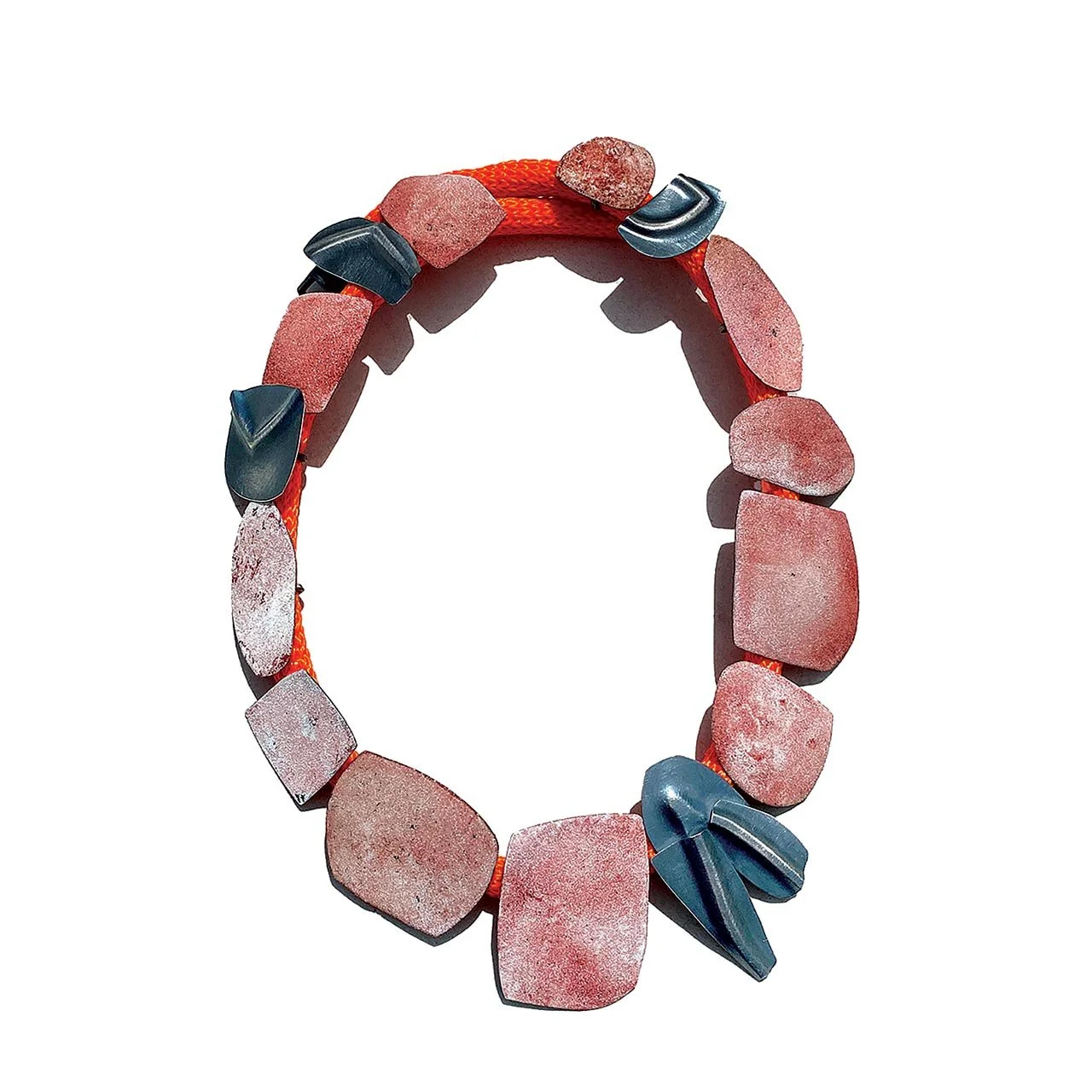
PATHWAYS NECKLACE of enamel on copper, sterling silver, nylon cord, powder coat, 51.0 centimeters diameter, 2023. Photographed by the Artist.
Wood’s longest-running and most recognizable body of work is her LWS (Laura Wood Studio) Collection, which she makes from thin sheets of brass that she cuts, pierces, forms with hammers on anvils, and finishes by powder coating. The LWS Collection works are light—visually airy and physically comfortable to wear. Some suggest lace, floral elements, or the graceful lines traced in the sky by a ballerina’s fingertips, but all are “engineer[ed]… so that they contour the lines of the body.” She seeks “to create something that enhances the silhouette” and considers details like how an earring will relate to a jawline or how a ring will swoop above the hand. The shiny finishes on the loops and curls of this collection create their own intrigue as they reflect light while in motion.
Often she layers the powder coat to create custom hues. This approach involves a lot of trial and error, and sometimes she settles on a favorite color, then has to adapt if the supplier unexpectedly changes the formula. And while she favors bright colors—Poppy and Golden Lux are current darlings—she also likes including more muted tones in the mix, even just oxidized silver, as “a nice grounding component.”
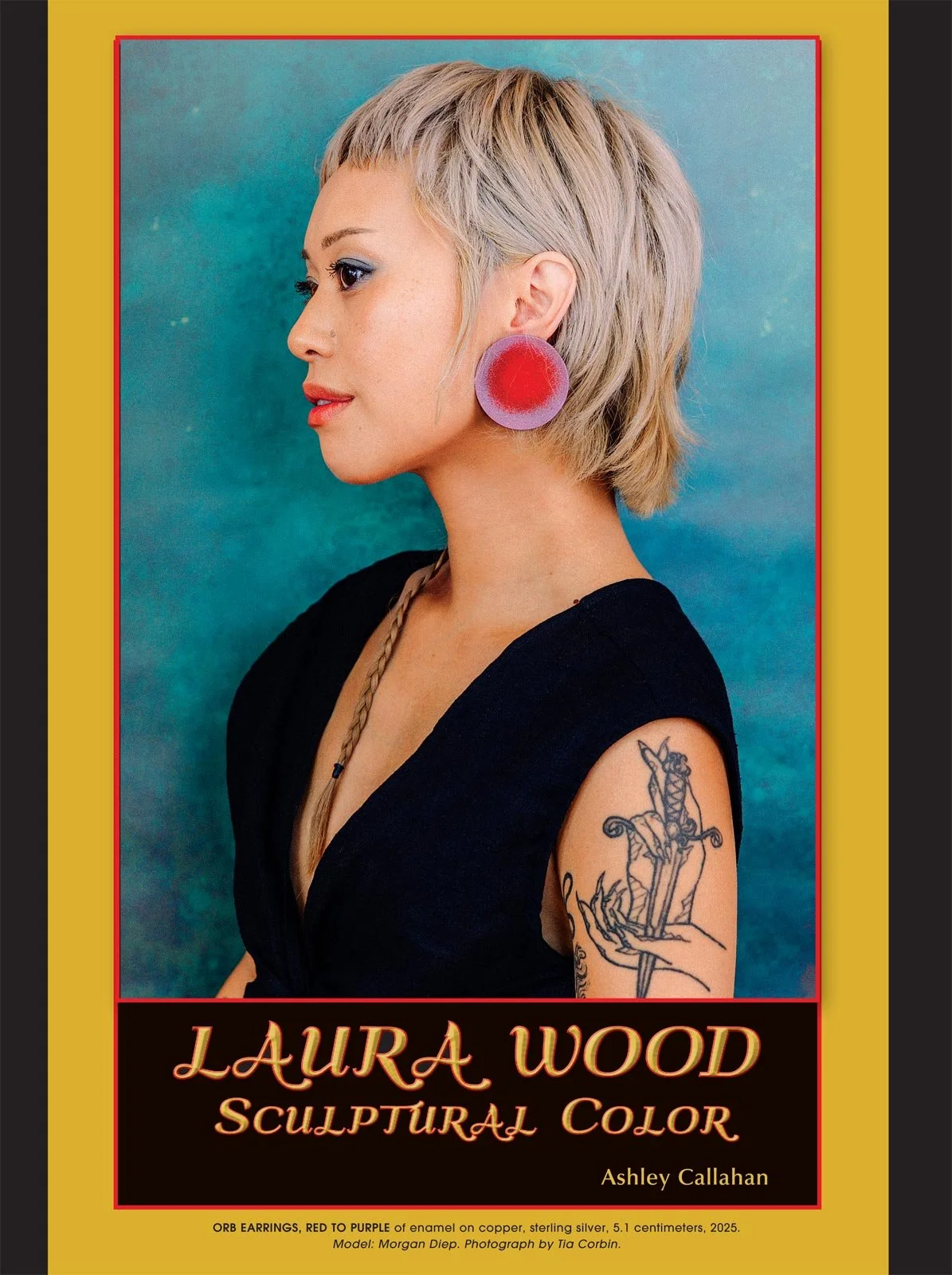
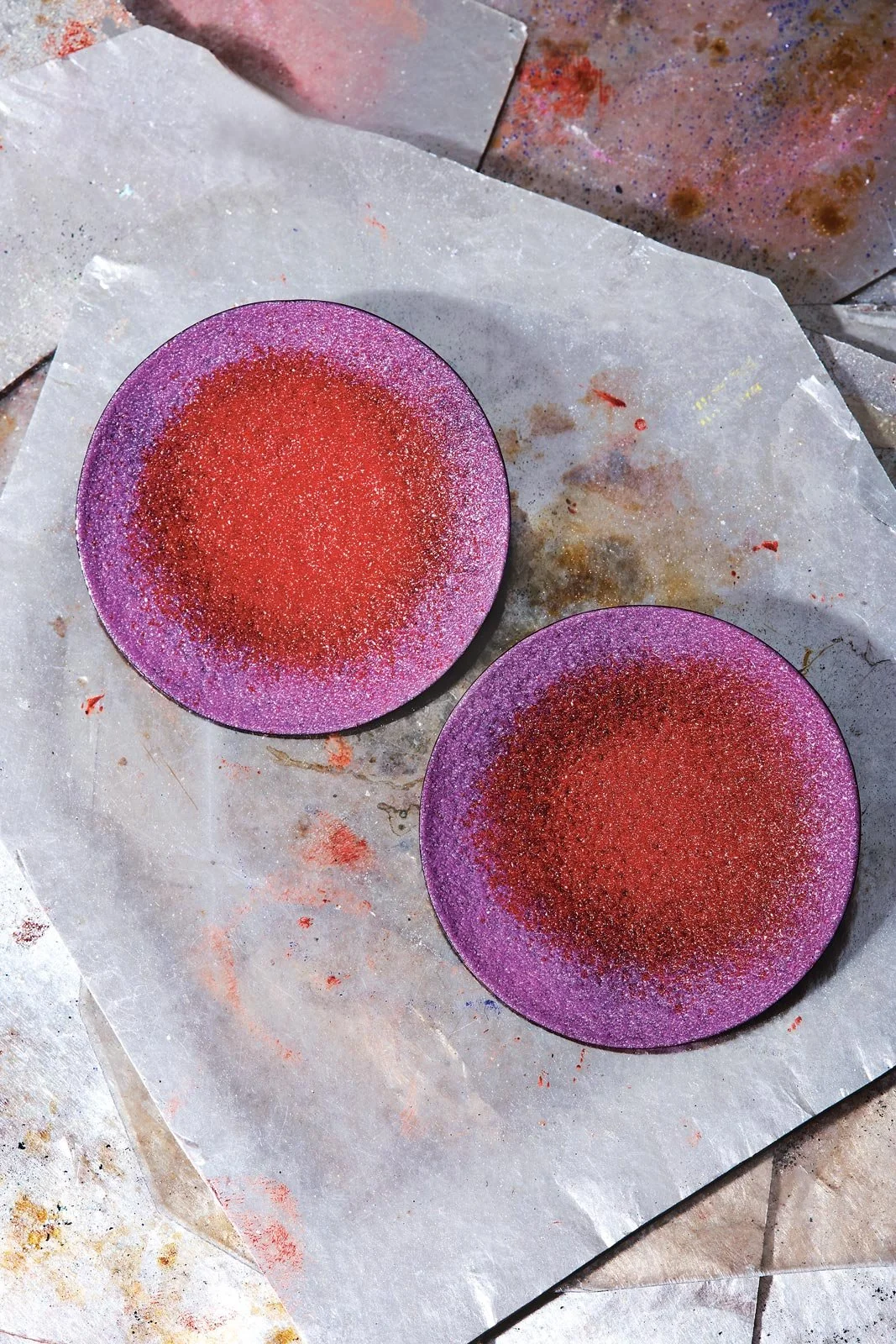
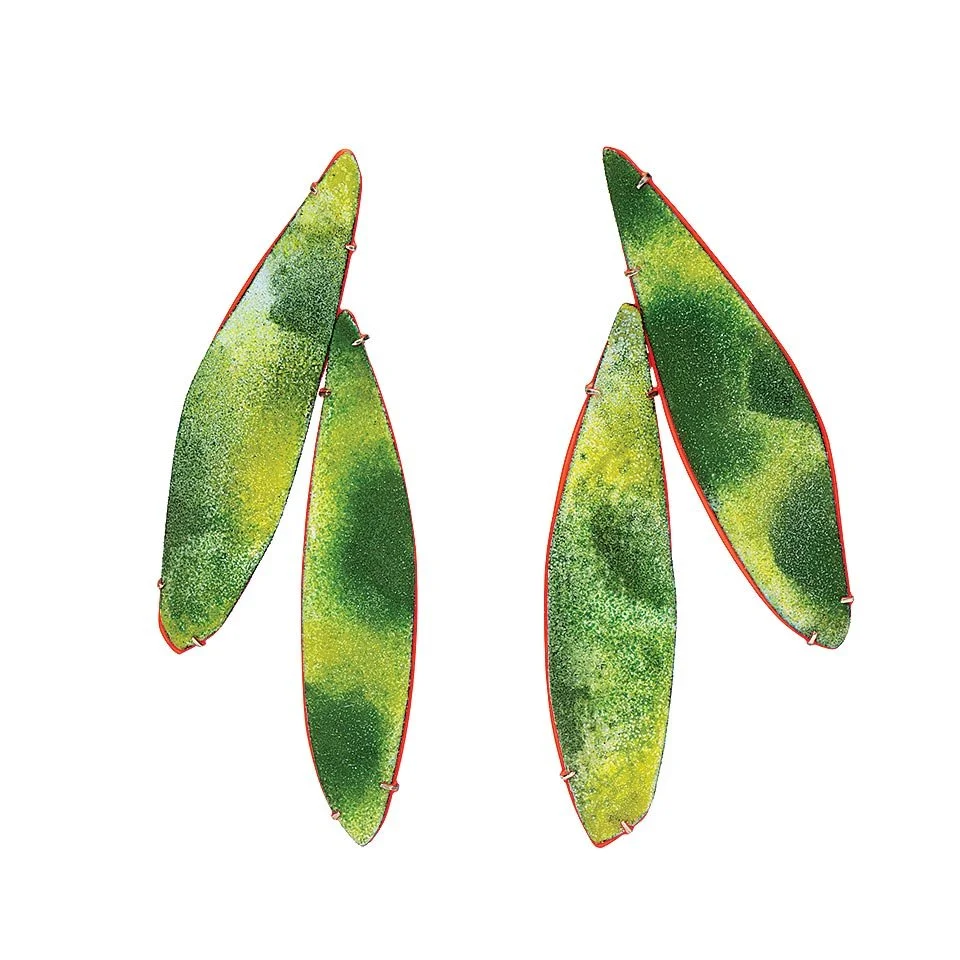
Wood also brings color to her work through enamel. For her Enamel Collection, she works with copper, sifting powdered enamels or adding painting enamels (a technique she learned from Jamie Bennett at Penland) onto flat or domed forms. She embraces the granular quality of the material, building up minutely pebbled surface textures and gradients of colors that “sparkle and shift tone in the light.” This collection is composed of a mix of clean geometrics (including perfect circles with a central burst of ruby red against purple or chartreuse on robin’s egg blue) and more organic forms in soft corals and warm yellows. These abstract shapes start as drawings, then she cuts out the forms in copper, stretches them using a rolling mill, trims them, and keeps working with them until she gets shapes she likes. They do not reflect specific inspirations, just the pleasure of exploring form. Wood sets some of the enameled pieces in frames with prongs, like a pair of double teardrop earrings in a “camouflage-esque” mottled green in neon orange.
Wood’s Pathways Necklace features flat, asymmetrical sandy-textured enameled panels in rusty pinks and whites with oxidized silver sections with embossed bent lines. Each has a ring on the back so that it can slide onto a thick fluorescent orange braided cord. The Mint Museum commissioned this work for a gala celebrating an exhibition of Picasso’s landscapes. Wood used the necklace to reflect the landscape she sees around Asheville, a mix of construction zones with fragments of natural scenes.
“While her jewelry is often interpreted as an extension of her experience as a dancer in motion, Wood believes that bringing the mindset of a dancer to her work is more important than bringing the body of a dancer. Like with dance, for jewelry she “spent many years learning technique—learning how to solder, how to set stones, or learning how to move metal in a certain way, learning the characteristics of a material.” And now she can enjoy the freedom that knowing the technique allows.”
Click For Captions

SCULPTURAL STACK RINGS, POPPY AND AZALEA of brass, powder coat, 2026. Model: Luisa Yen. Photograph by Lucy Plato Clark.
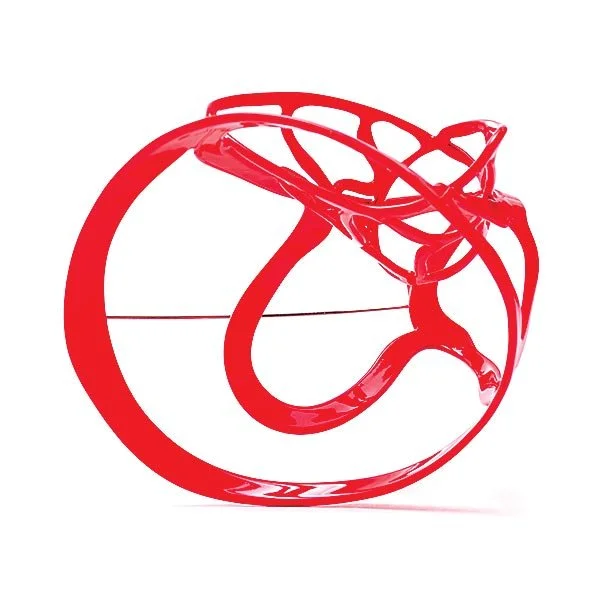
FRUIT BROOCH of enamel on copper, sterling silver, steel, pigment, glass, eighteen karat gold, powder coat, 7.6 x 7.6 x 2.5 centimeters, 2025. Photograph by Brady Connelly.
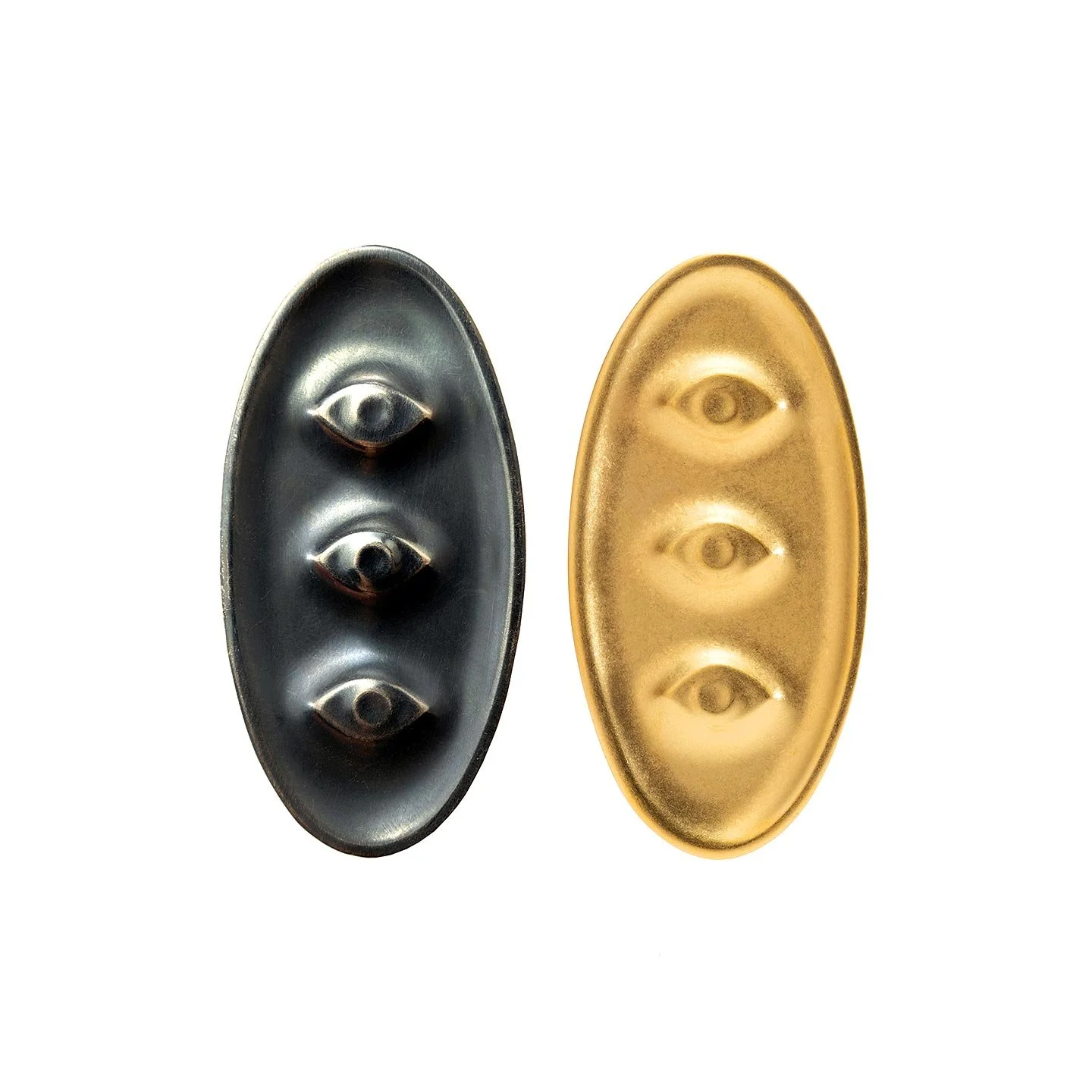
Her Amulet series stands out within her body of work for its limited palette (silver, gold, and occasionally Golden Lux) and representational imagery—eyes. During a residency at Penland School of Craft (2017-2020), her studio was frequently filled with visitors who were seeing unfinished, in-progress work, a big change from the quiet privacy she favored for her studio time and the careful presentation of completed work she preferred; she was feeling vulnerable. Inspired by milagros (religious folk charms popular in Mexico and surrounding areas) that a friend had given her when she lived in San Antonio (for another artist residency, 2011-2012), she decided to use her new hydraulic press to shape metal ovals into personal amulets. These gave her strength and made her feel empowered. Though initially intended for her own use, the Amulet series proved popular, so she makes a limited run each year to sell—but she keeps the originals with her.
A recent work, Fruit Brooch, combines powder coating and enameled elements. For her, this brooch “represents immense joy and deep grief.” It has the bright colors of happiness, but it also has the chaos of multiple fragile elements precariously packed together. She explains, “In 2022, my husband and I welcomed our child into the world, just as the pandemic began to ease and life was opening back up. We entered parenthood with so much hope, only to be met soon after with the devastation of Hurricane Helene, in late September 2024, that left our city reeling with loss. This work carries the tension of those experiences, the sweetness of new life entwined with the grief of unexpected disaster. Fruit honors how joy and sadness often arrive together, shaping us in ways we cannot anticipate.”
Community involvement and service to the studio jewelry field have long been part of Wood’s approach to life. As a graduate student at East Carolina University (she received her MFA there in 2011), she started the Material Topics Symposium, overseeing the first one in 2010. She was frustrated by the options she saw ahead of her as she looked forward to becoming a professional in the field. “It seemed like there was this weird loophole that kept a lot of emerging artists from actually getting these opportunities” like teaching or working in non-profits, because they all required several years of experience that seemed impossible to get without already having those jobs. She wanted the graduate students to have the chance to build networks and gain practical experience that would enhance their résumés. So she conceived the symposium as a way to learn about opportunities in the field and develop connections with other creative people. She and her classmates combined the networks from their various undergraduate experiences, invited artists from other regional schools, and learned how to plan and run a major event. Wood was “overjoyed” that the initial symposium was so successful and set a good model for subsequent years. This highly respected series continues to bring together the metalsmithing community and is still student-run.
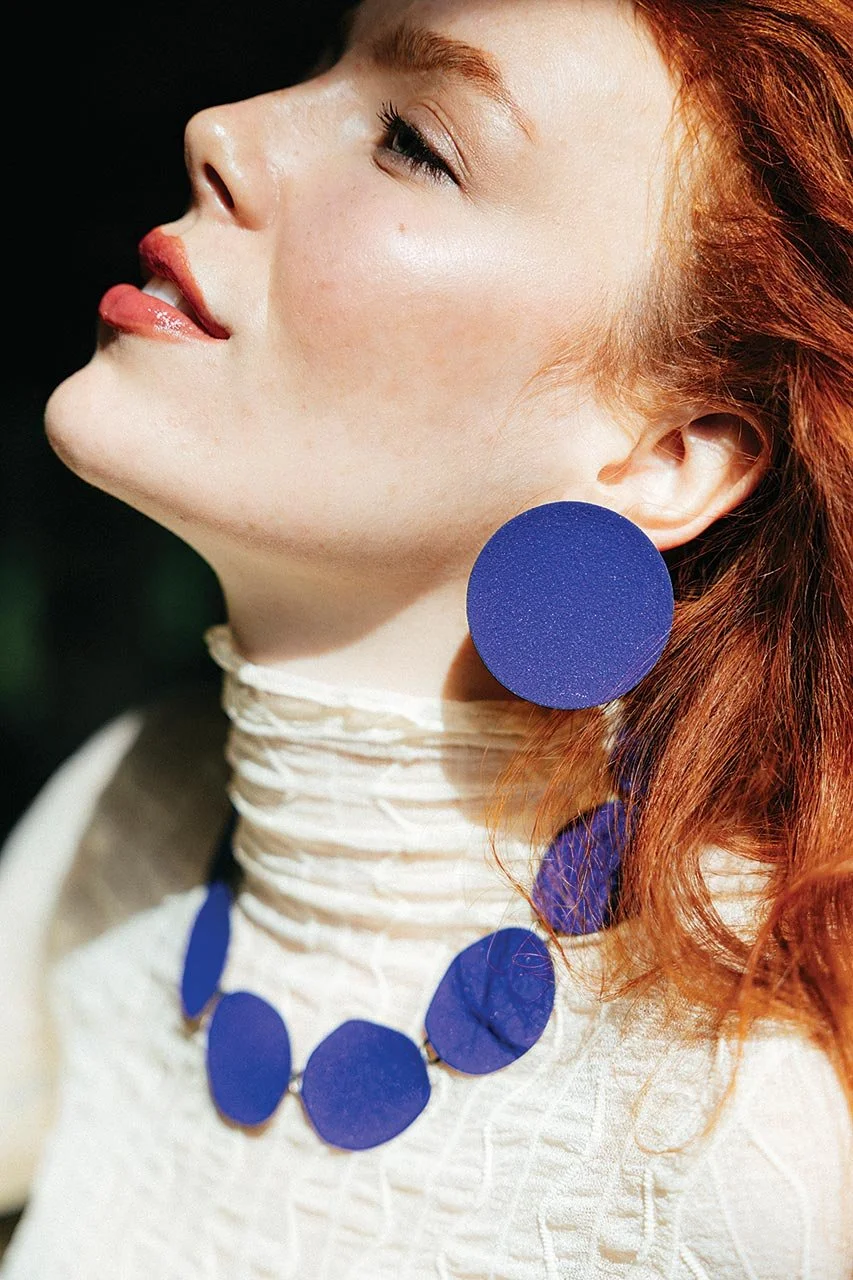
COBALT COLOR FIELD EARRINGS AND COBALT COLOR FIELD COLLAR of enamel on copper, sterling silver, earrings: 5.1 centimeters, collar: 45.2 centimeters, 2025. Model: Madeline Leah. Photograph by Tia Corbin.
Shortly after graduation, Wood and Kat Cole (who graduated from ECU in 2012), started Jewelry Edition. Through this initiative, which lasted from 2012-2021, they periodically highlighted small groups of early-career jewelry artists through pop-up shops and exhibitions. They were both intrigued by the business/full-time studio practice aspects of jewelry making and wanted to focus on this part of the experience rather than just education. They were already networking individually by going to conferences, participating in exhibitions, and showing in galleries, so by working together, formalizing their efforts, and bringing in other artists, they were able to elevate everyone involved. “We just wanted to be part of the growth of the field.”
Today Wood channels her service-to-the-field efforts through Craft Your Commerce (part of Mountain Bizworks in Asheville) as a mentor to other entrepreneurs. She recognizes that the word “business” is not something a lot of artists want to embrace, “but, ultimately, if you’re paying bills and you have a studio to rent and you’ve got to buy materials and you’ve got to pay for an exhibition and all of these things, it’s a business.” She has a lot of insights to share, including practical details like simple bookkeeping and how to participate in a craft show, and she feels passionately about helping other craftspeople find ways to sustain their studio practices.
Wood is good at setting and reaching goals. Her dancer’s brain keeps her disciplined, her technical skills keep her sharp, and her curiosity and creativity result in exciting jewelry. Wood recently participated in the Smithsonian Craft Show and taught at Haystack School of Crafts in Maine this summer. She plans to debut a new body of work in November and hints that Fruit Brooch is a preview of the thoughtful, sculptural, colorful creations to come.
SUGGESTED READING
Arginteanu, Judy. “Best Practices: Craft Shows.” American Craft (February/March 2018), 69.
“Laura Wood,” Enamel Arts Foundation, https://www.enamelarts.org/laura-wood/.
Mountain Bizworks. “Case Study: Laura Wood Studios,” 2025, https://vimeo.com/1146639846.
LWS SELECTION OF EARRINGS, RING, AND BROOCH of brass, steel, powder coat, 2022. Model: Ace Lavilles Baggott. Photograph by Lucy Plato Clark.
Click for Captions
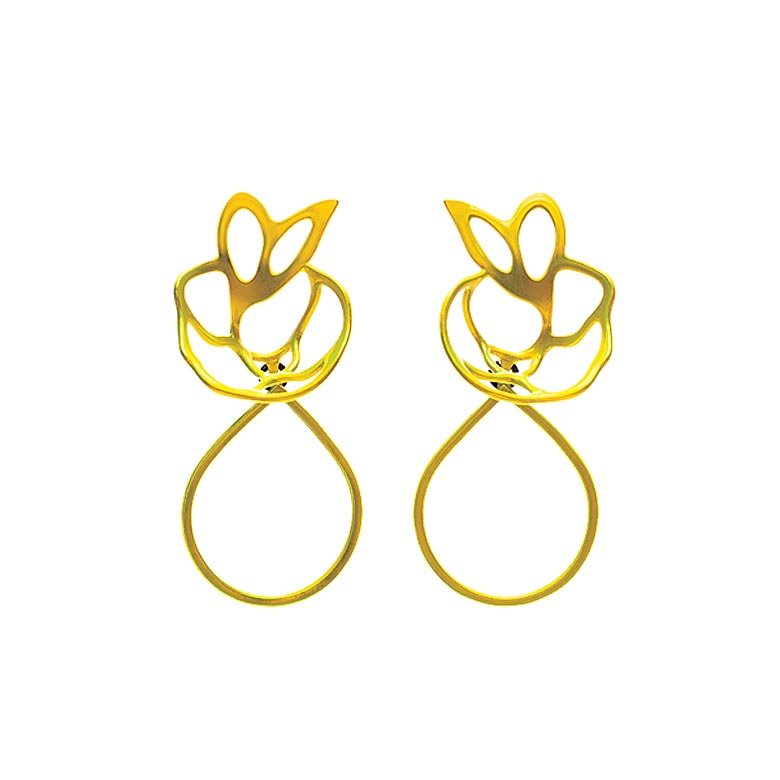

Ashley Callahan is an independent scholar and curator in Athens, Georgia, with a specialty in modern and contemporary American decorative arts. She has an undergraduate degree from Sewanee and a master’s degree in the history of American decorative arts from the Smithsonian and Parsons. She loves writing for Ornament, including about Laura Wood of Asheville, North Carolina, for this issue. The tagline Wood uses on her website is, “Sculptural Jewelry Thoughtfully Engineered for Wear.” When Callahan met with Wood, she was wearing her Double Lace Earrings. They are a large design—almost touching her shoulders—and eminently eye-catching, the looping curved forms intriguing from every angle as Wood chatted and moved her head. And the color! They were Poppy (somewhere between red, pink, and orange) and she paired them with a pink shirt—a little bit of color therapy for the conversation. Wood’s jewelry invites people to engage and reflects the efforts of a thoughtful jewelry engineer.