Constellations Volume 47.1
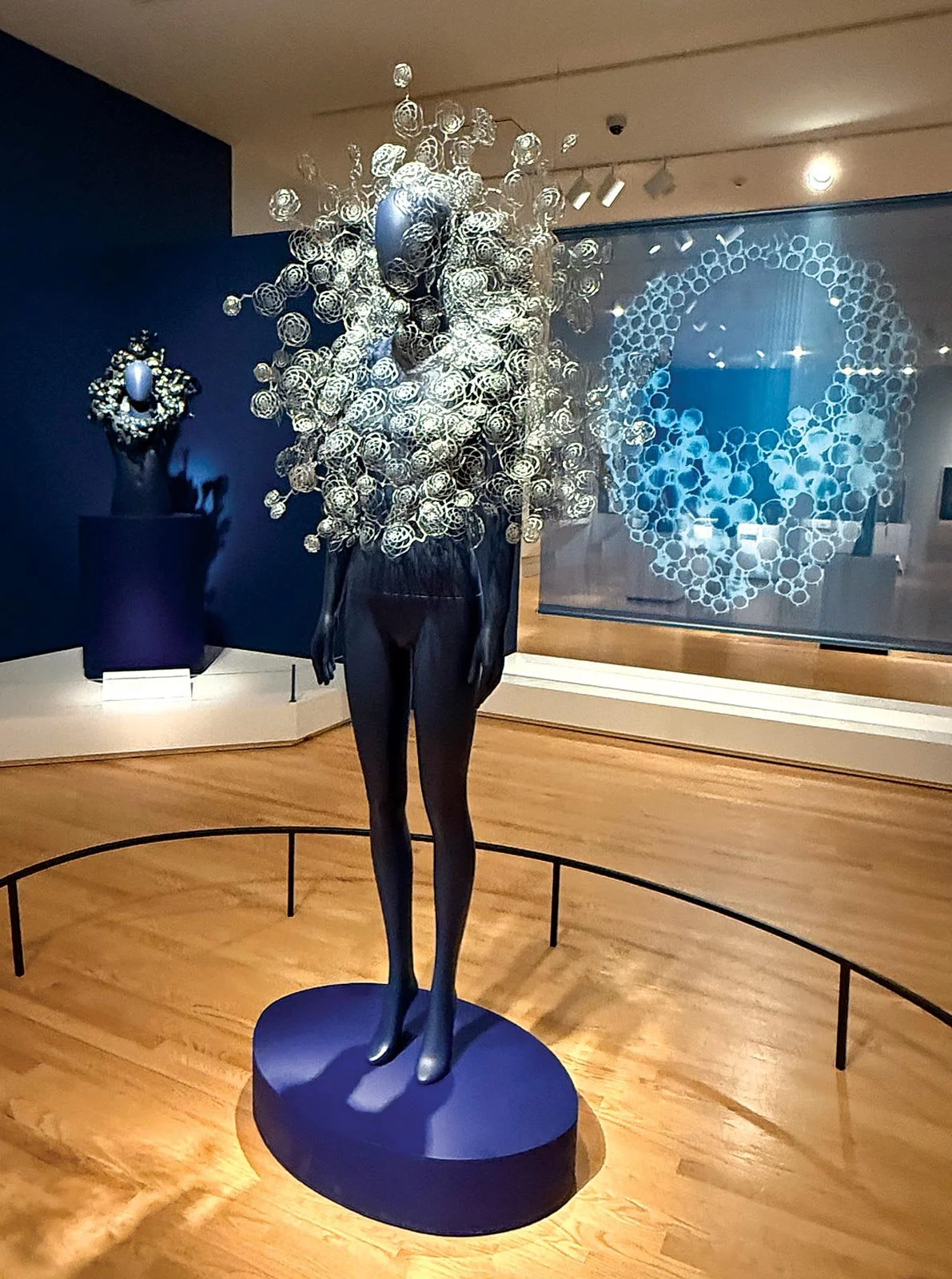
INSTALLATION SHOT of exhibition opening, with Iris Van Herpen’s Aeriform collar of zinc-coated steel from 2018 welcoming visitors to the show. Photograph by Josephine Shea.
Visitors to “Constellations: Contemporary Jewelry from the Dallas Museum of Art” at the Chrysler Museum of Art encounter a sweeping presentation of contemporary art jewelry. Using an extraordinary range of materials, artists reimagine jewelry to create new forms that move beyond tradition. Instead of precious gems, the exhibition dazzles viewers with the creativity artists bring to a form centered on the human wearer.
Organized by curator Sarah Schleuning, the exhibition features work from the museum’s collection as well as promised gifts. She shares, “We are thrilled to present, for the first time, an exhibition that showcases this incredible range of works, crafting a dynamic path of discovery through more than 230 visionary artists representing a broad spectrum of geographies, media, and ideas.”
Schleuning decided to use the concept of constellations, the word associated with a named group of stars, to gather over 350 pieces of art jewelry into four “constellations.” As she shared, “Each object became an individual star, with meanings created through the connections between them.”
At the exhibition entrance, visitors are introduced to the four themes—Zones of the Body, Archetypes, Signals, and Play—with a highlight from each section. The featured work in Zones of the Body displays what could appear to be a necklace, but instead, as seen in the accompanying photograph and by its title, is a head piece with a triangular nose cover.
Throughout the galleries, deep lapis-blue walls evoke the ceiling of Padua’s famed Scrovegni Chapel, while scrims printed with cyanotype images of jewelry create translucent divisions. The installation, designed by Cassie Rangel, Creative Services Manager at the Chrysler, uses a unified palette to convey the calm and wonder of gazing at a star-filled night sky.
Zones of the Body
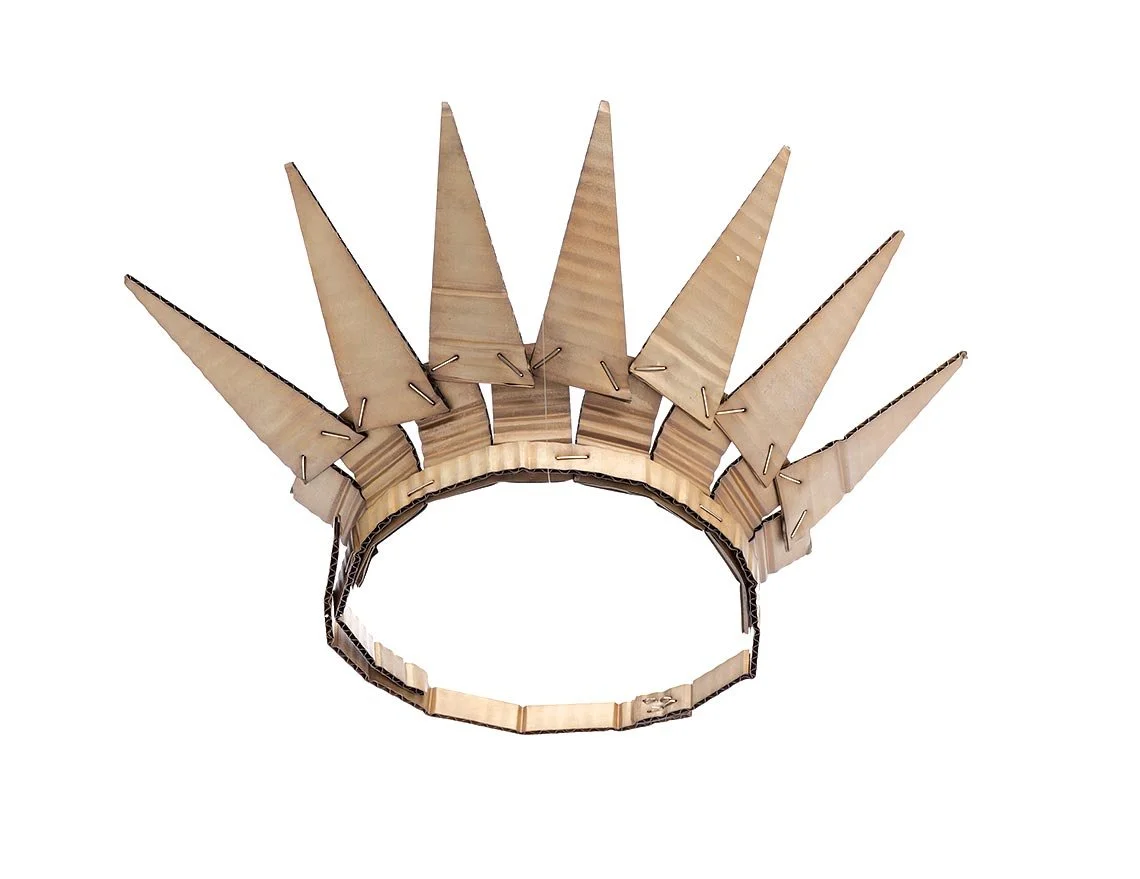
THE BIG APPLE NECKPIECE by David Bielander of patinated silver and white gold, Cardboard Series, 2015. Dallas Museum of Art, promised gift of Deedie Potter Rose. © David Bielander. Photograph by Chad Redmon. Courtesy of Dallas Museum of Art.
A small sketch by Vratislav Karel Novák introduces the first theme, Zones of the Body. A life-size, abstract mannequin, shown left, takes center stage, wearing a necklace made of densely layered, overlapping silver circles that create spheres. It creates a dramatic opening statement, drawing visitors in for a closer look. One might wish for an accompanying video to show how the piece moves with the wearer, but that effect is left to the imagination.
Dividing the body into zones, in Headspace, David Bielander’s The Big Apple Neckpiece from his Cardboard series evokes Lady Liberty’s radiant crown. While the surface design suggests stapled cardboard, the piece uses silver and white gold for the neoclassically-inspired diadem, that can also serve as a necklace.
In the Central Core section, Genevieve Howard’s 2023 Gleo neckpiece is made of layers of shaped Japanese linen paper combined with Fabriano paper, held together with an elastic cord. A photograph shows her wearing it, draping around her shoulders on the rocky Irish seashore, the shapes are based on sound-wave patterns she made at the beach.
The third zone, Limbs, focuses on the hands and arms, where bracelets and rings respond most visibly to the wearer’s movement. Camilla Prasch’s aptly titled MEGA Ring challenges expectations of practicality: measuring roughly 13 inches across, the oversized ring features a bouquet of translucent white silicone discs accented with red-died snaps as centers, connected by red nylon thread. Her stated goal is to create, “Space invading jewelry that takes shape and comes to life when worn on the mobile, living body.”
Archetypes: Curiosity and Experimentation
The second constellation explores the expressive potential of geometric forms, including squares, circles, and triangles. Two standout necklaces highlight the triangle: one by Emma Dahlqvist, known for her textile-based designs, and another by Arline Fisch, celebrated for her woven metalwork. For X no 2, Dahlqvist brings a traditional material, birch bark,into a contemporary context, using laser cutting and origami techniques to create a light, stretchable structure of folded, repeating triangular forms.
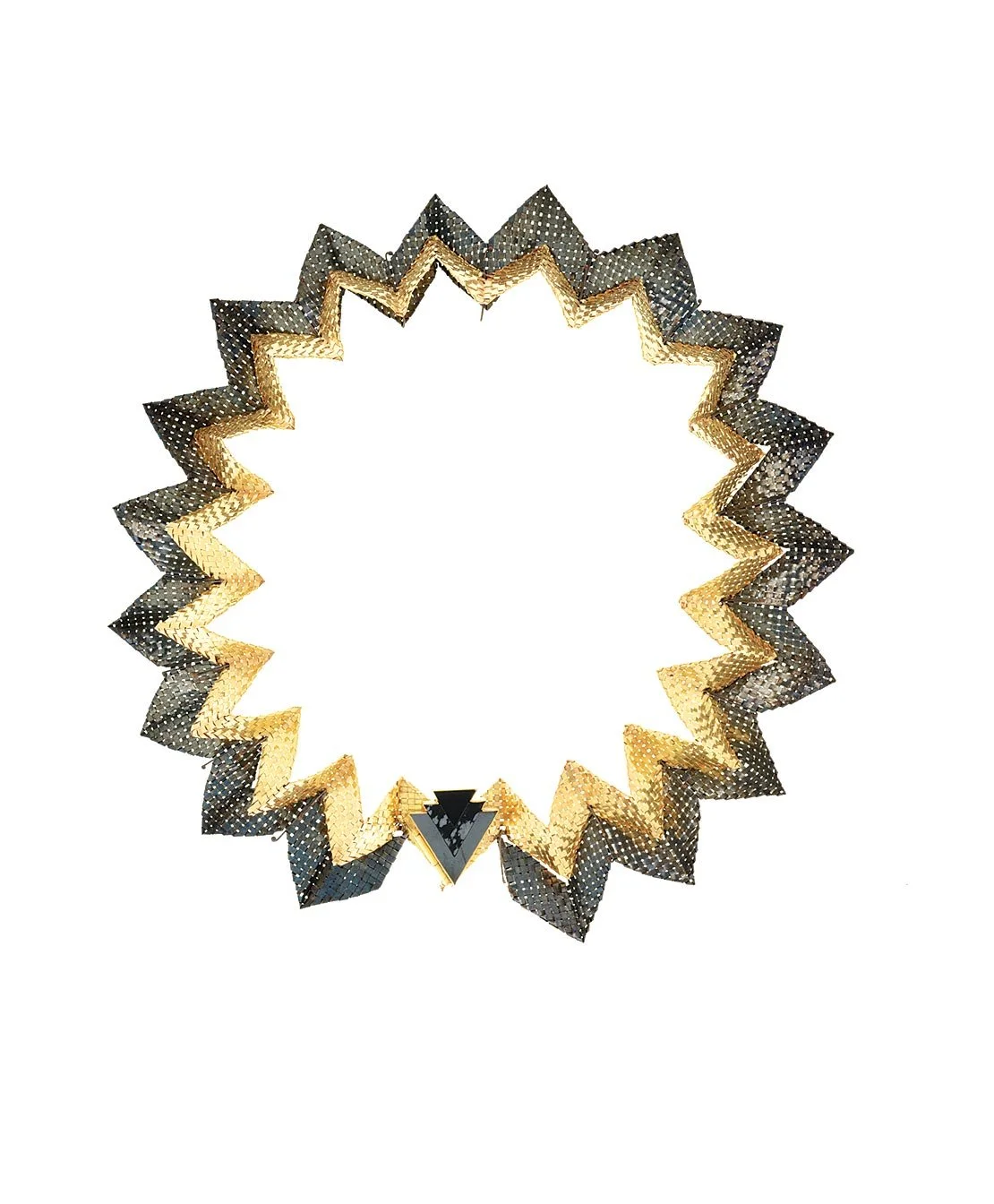
In Double-Zig-Zag necklace, Fisch combines a woven inner layer of 14 karat gold that contrasts with the outer layer of oxidized silver. Describing her practice, she shared, “The use of textile structures such as weaving, plaiting, knitting enable me to produce pliable planes which conform readily to the human form, and which have a softness and warmth not always possible in metal. Most frequently I work in precious metals—silver, gold, and platinum—which clearly reveal the interlaced structures.”
Click for Caption
Chain-link jewelry appears in multiple works on view throughout the exhibit, each using interlocking loops to form a strand. In this section, Mariane Hosking’s Pattern Chain Necklace offers a delicate variation, with thin, flat, pierced silver discs. In contrast, Erinn Michelle Cox’s Let Me Be Me, made of oxidized copper and silver reveal the format’s bolder, chunkier possibilities.
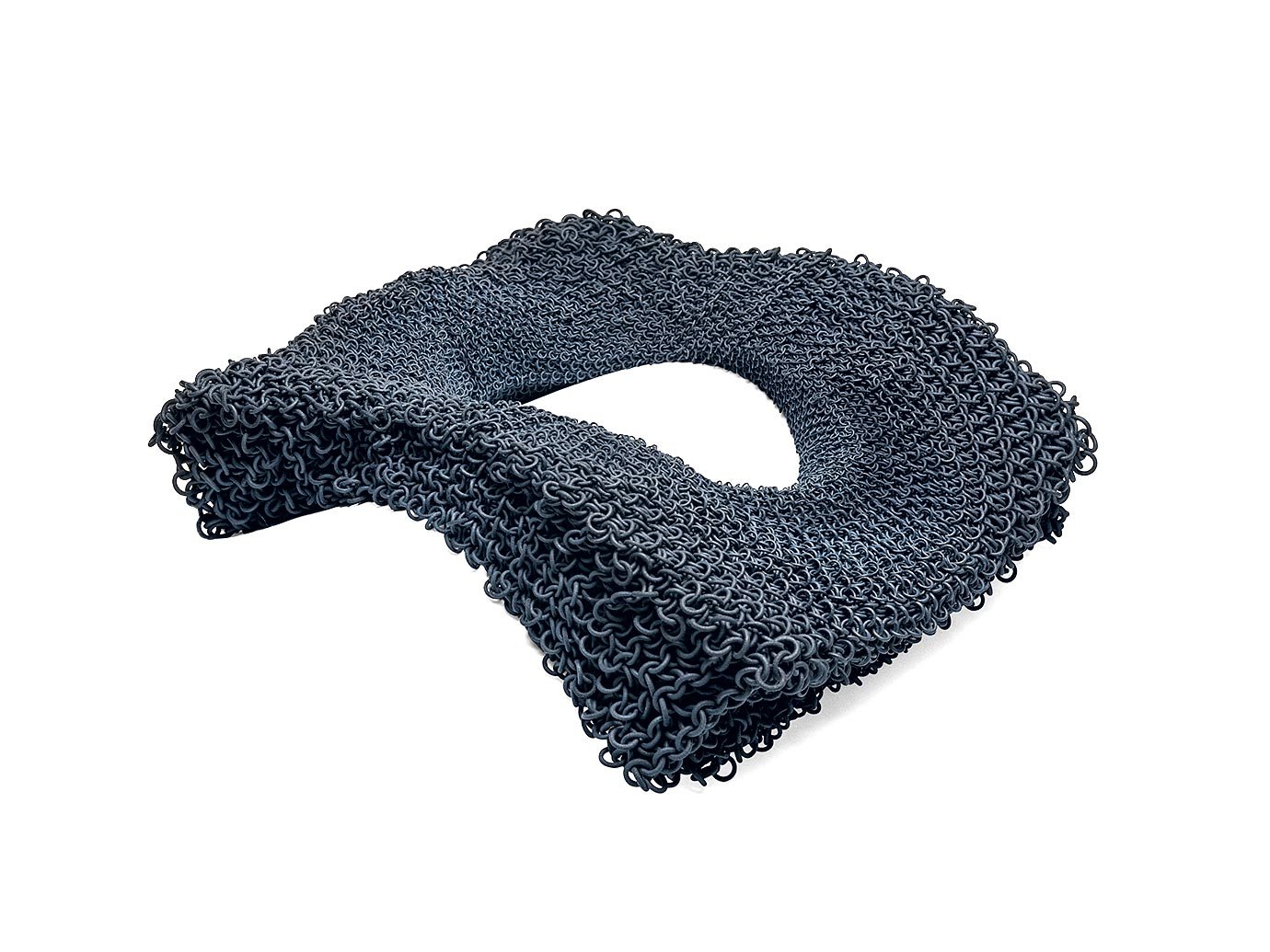
COMFORT ME NECKPIECE by Carrie Dickens of nylon, silver, and magnets, 29.2 × 30.5 × 7.6 centimeters, 1987. Dallas Museum of Art, gift of Deedie Potter Rose.
Signals: Projection of Self
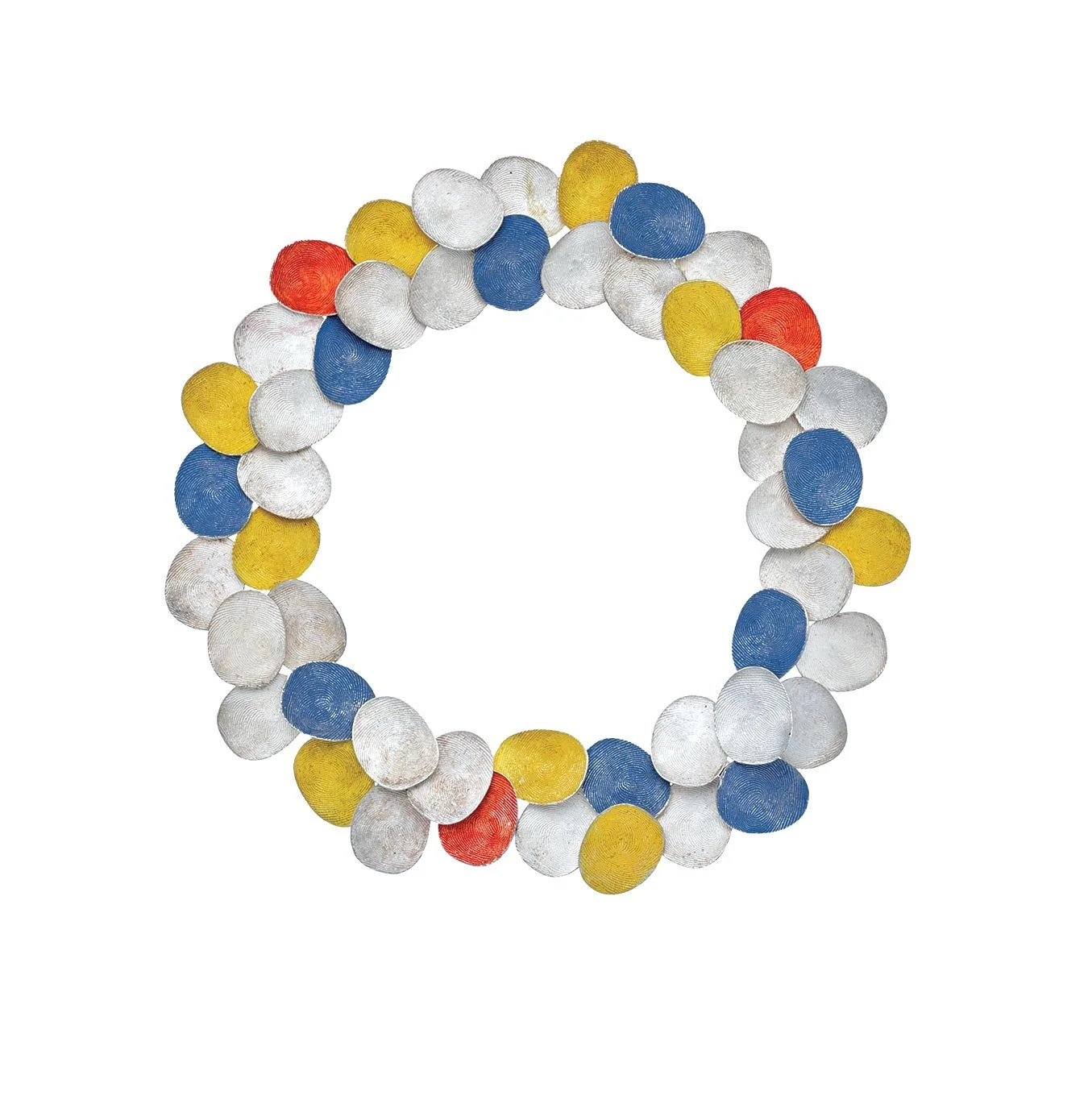
In the Projection of Self section, a drawing accompanies the Gerd Rothmann’s Modeled with the Artist’s Thumb necklace; an artwork made from oval silver discs impressed with thumbprints. Some discs retain their silver surface, while others are tinted with blue, red-orange, and yellow-green pigments. An earlier work, Zehn Finger am Hals (Ten Fingers on the Neck), ten gold squares imprinted with a fingerprint.
Carrie Dickens’s understated yet intriguing neckpiece, Comfort Me, is made of layered 3-D- printed woven black nylon, silver, and magnets. The knitted square rests on the shoulders, with an opening for the neck. The artist’s goal was to create jewelry the “touches back.” Will the piece offer comfort to the wearer?
Wearable Parables
Joyce J. Scott’s dramatic beaded neckpieces dazzle while inviting interpretation. In Dickwhp, red beads cover the form, which is anchored at one end by a phallic shape and at the other by a jumble of letters for viewers to decode. A photograph shows Scott wearing the piece with a slight smile. In Run Down the Highway of Love, Scott shifts from wordplay to narrative tension: a female figure towers over a prone male figure lying face down on a “highway” of black leather.
Asagi Maeda’s A Day of a Train necklace is far quieter. The artist has described the box as a favorite motif, drawn to the limitless possibilities of the world contained inside. In this wearable sculpture made using silver and 18 karat gold, clear miniature train carriages become small boxes holding scenes from Tokyo’s Yamanote line. The cars go from almost empty at the start of the day to crowded with commuters at rush hour. Looking closely, viewers find tiny sticklike figures reading newspapers, pushing strollers, dragging suitcases, and listening to music through headphones.
A DAY OF A TRAIN NECKLACE by Asagi Maeda of sterling silver, eighteen karat gold, and Perspex, 26.7 × 17.8 × 2.2 centimeters, 2019. Promised gift of Deedie Potter Rose.
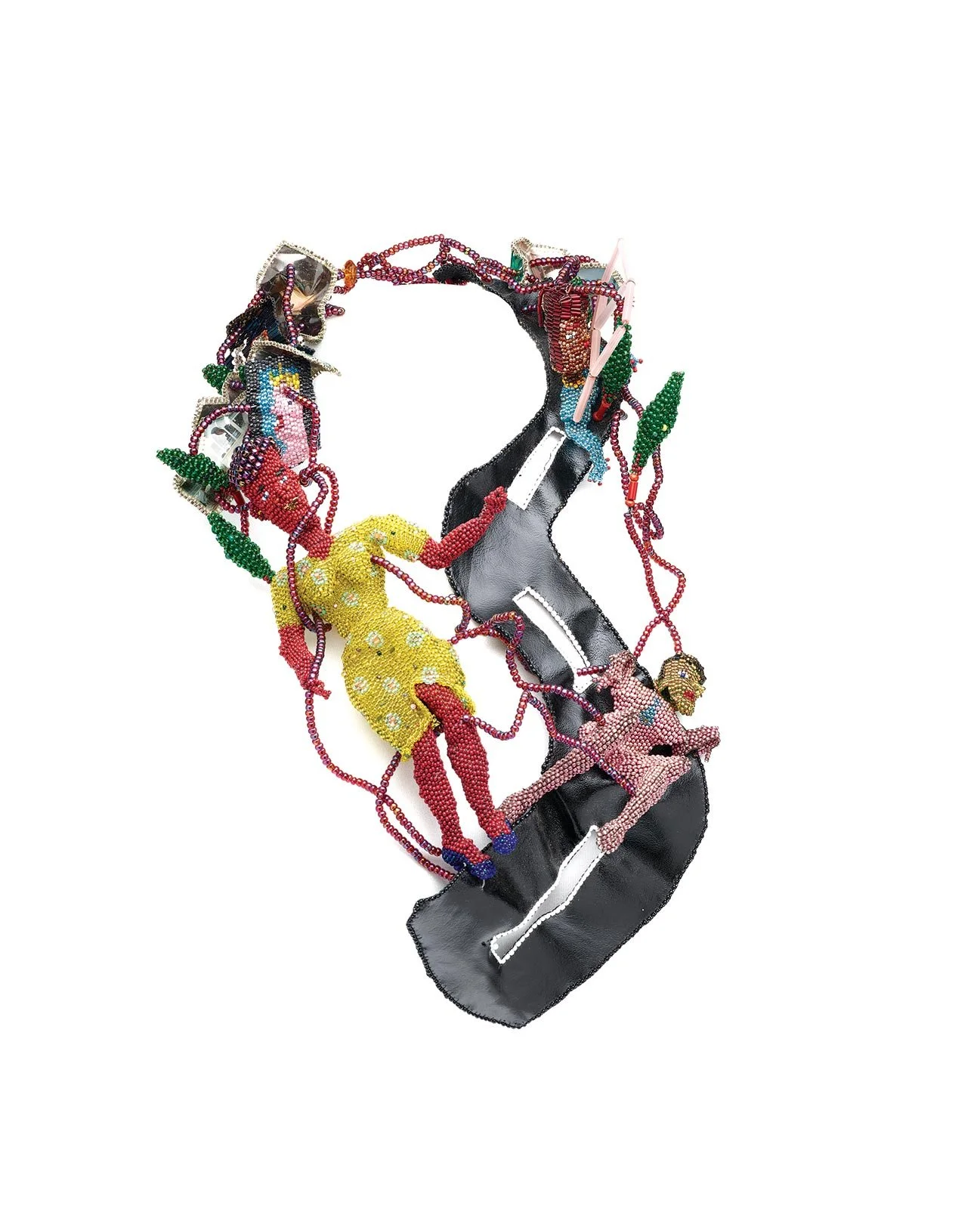
RUN DOWN ON THE HIGHWAY OF LOVE NECKLACE by Joyce J. Scott of glass beads, leather, plastic, wire, and photographs, 1986. Dallas Museum of Art, Discretionary Decorative Arts Fund, 2022.61. © Joyce J. Scott. Courtesy Goya Contemporary and Mobilia Galleries. Photograph by Chad Redmon.
Play
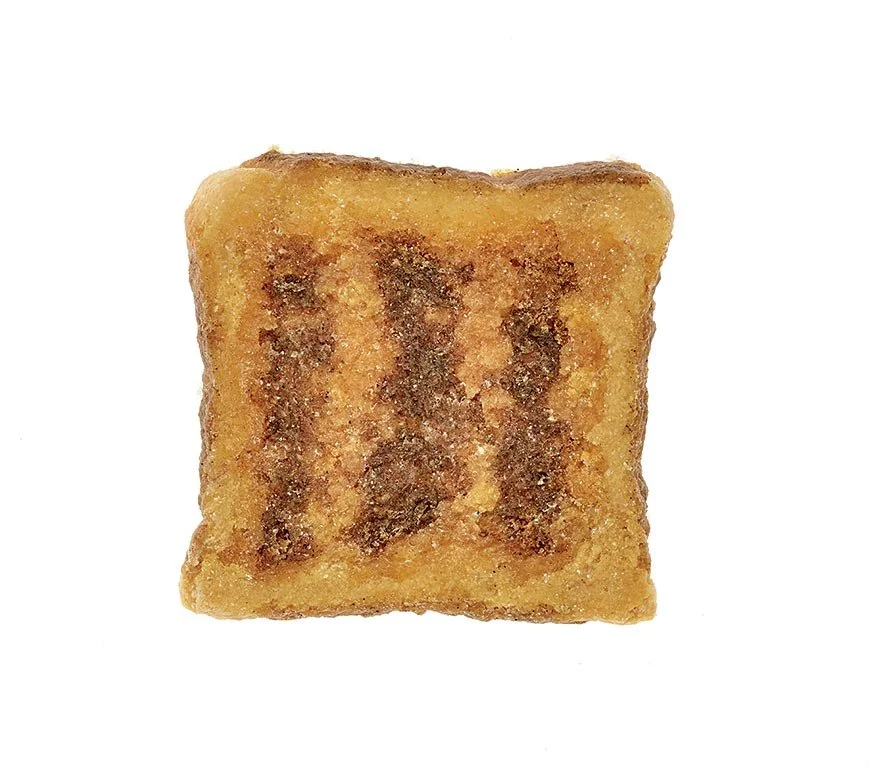
The final constellation, Play, embraces humor and surprise. A work by Bernhard Schobinger’s Furniture Necklace and Ring, transforms a miniature wood dresser into an interactive object: when its drawer is pulled out, it becomes a ring with a small jade “pull”. Another standout is Robert Baines’ Red Car bracelet. Part of a series, its richly granulated gold setting suggests luxury, but instead of holding a precious gem, the mount supports a tiny metal toy car. During a walkthrough, Chrysler Director of Curatorial Affairs Mark A. Castro highlighted four works from Gisbert Stach’s 2019 Golden Toast series. An important figure in conceptual jewelry, Stach creates trompe l’oeil “toast” brooches from crushed Baltic amber and onyx mixed with silicone and layered on stainless steel. These wearable slices, ranging from pale yellow to a blackened brown, have sparked conversations and varied reactions from visitors.
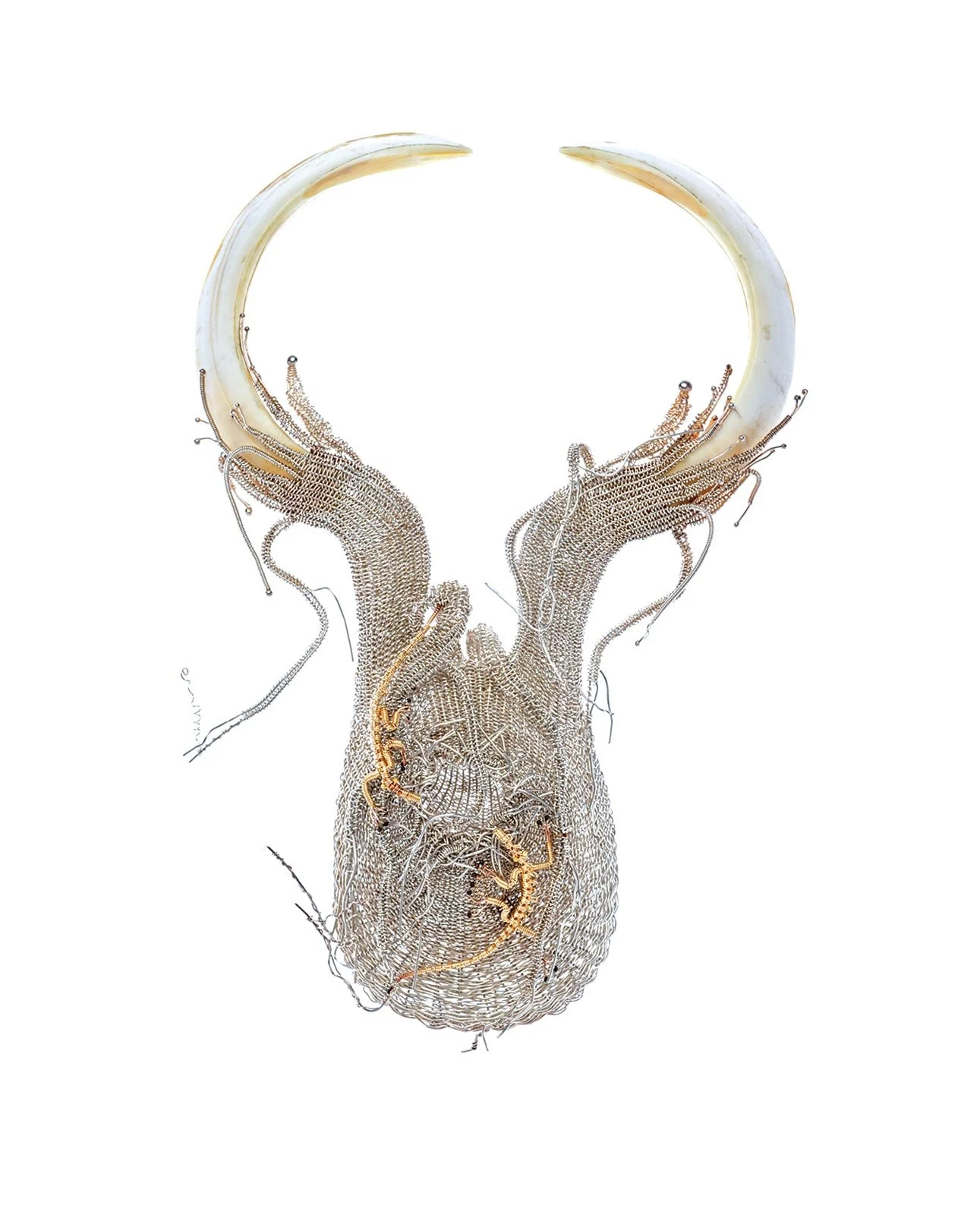
“Constellations” showcases jewelry made from a wide range and often unexpected materials. Known for her exquisite workmanship with silver and gold wire, Mary Lee Hu has been featured in Ornament magazine. As author Carolyn Benesh shared, “A simple line of wire in silver or gold transcends itself in the hands of Mary Lee Hu, as she plaits, twines, knits, and braids its length into woven forms of unassailable beauty.” While Necklace #8 incorporates her signature woven gold and silver wire, two boar’s tusks are used to hold the piece around the wearer’s neck.
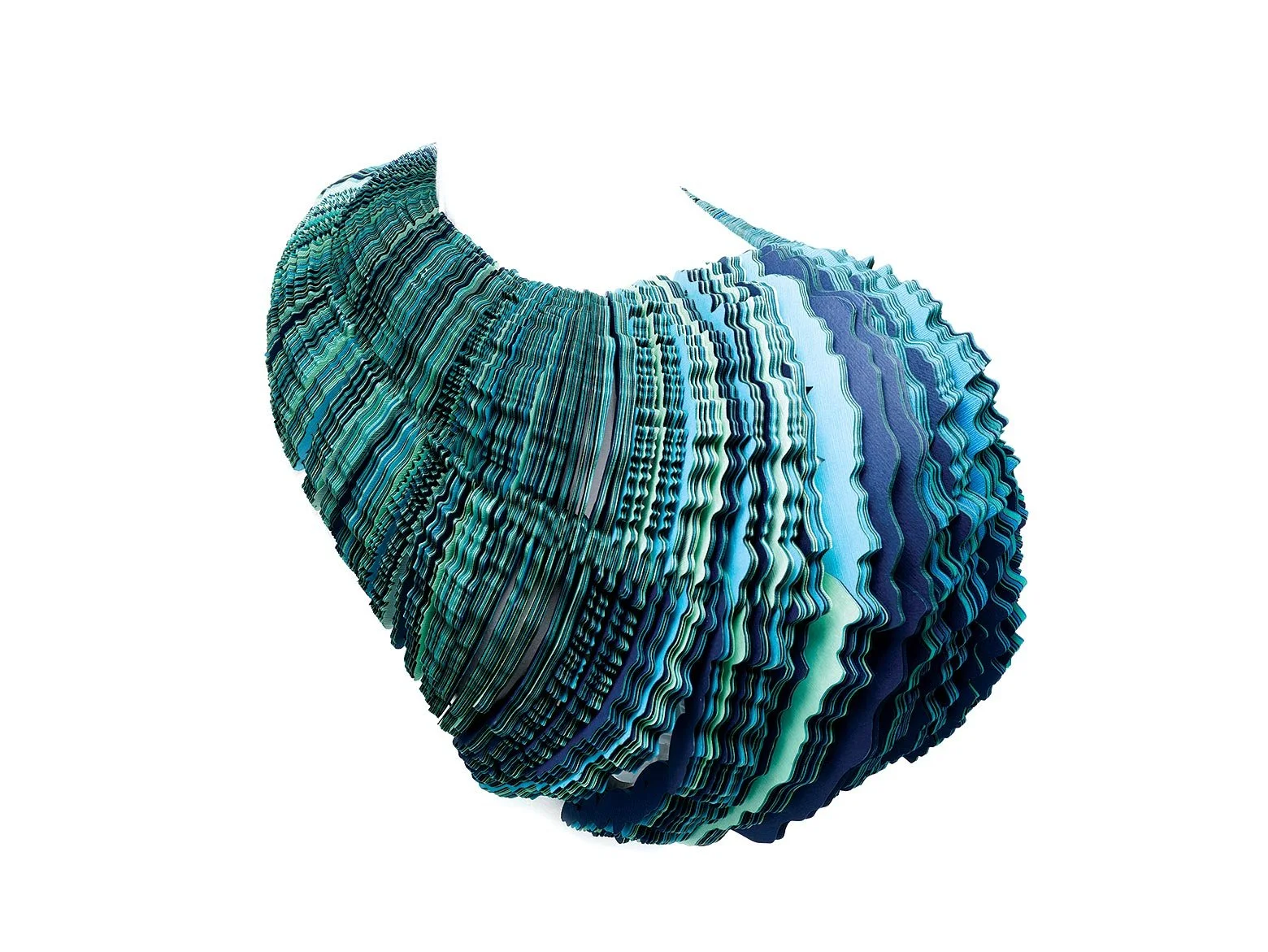
To create his Varied Degree of Protrusion necklace, Yung Hoo Kim custom-dyed Velcro pieces (the “zipperless” zipper). The layered vibrant blue strips are joined to create a design that echoes stylized waves.
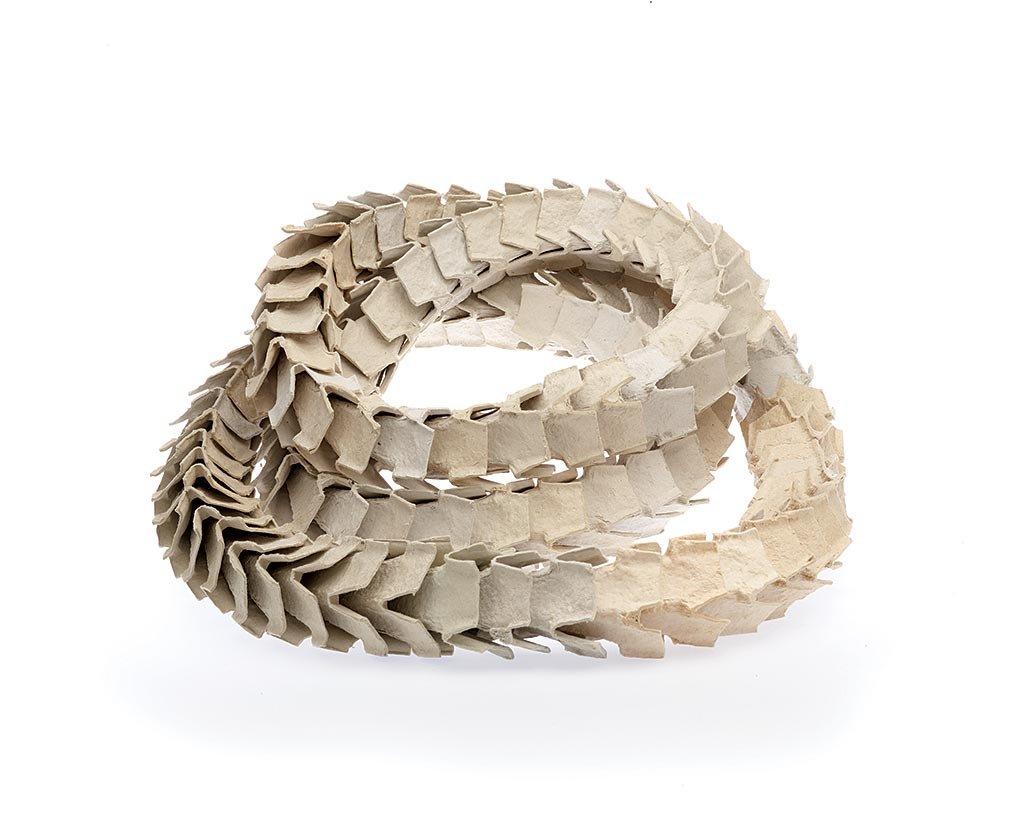
In an egg-themed exhibit case, molded carboard, the paper pulp used to make egg cartons—is transformed into Verena Sieber-Fuchs’ Egg-box Collar from her series Composting Jewelry where she assembles necklaces and head pieces from discarded packaging waste. Nearby necklaces extend the theme, including Poultry Accumulus, a piece Sergey Jivetin made using hollowed eggs, while others incorporate crushed shells.
Perhaps the exhibition’s most unsettling necklace is Bernhard Schobinger’s piece made from four metal scissors: three smaller pairs arranged around a larger central pair; their tips colored with cinnabar. Currently featured at the DMA in “Going Underground: The Jewels of Bernhard Schobinger,” Schobinger is credited with transforming contemporary jewelry by turning discarded materials into provocative works of art.
Click For Captions
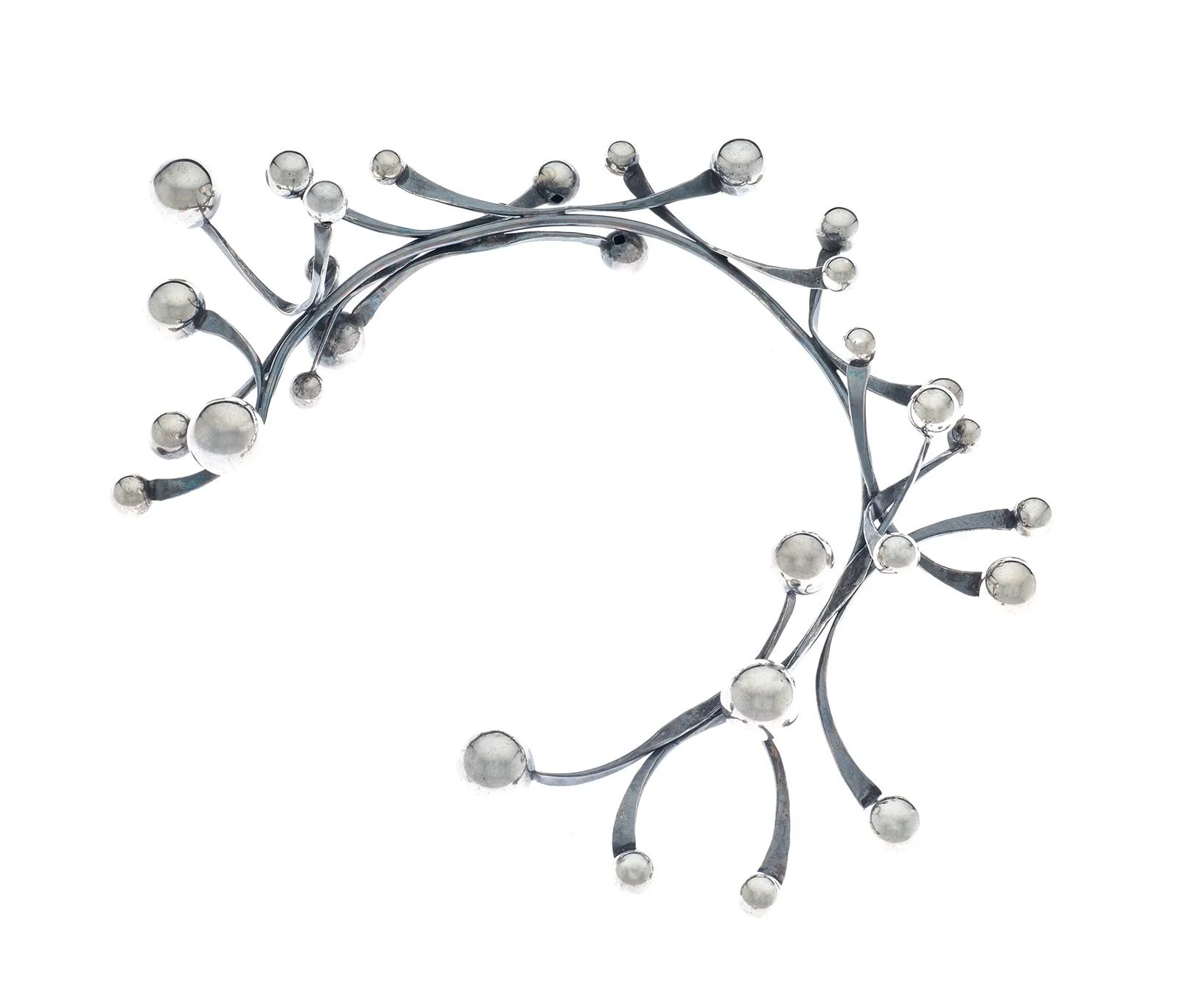
GALAXY NECKPIECE by Art Smith of sterling silver, 25.4 × 22.2 × 7.0 centimeters, c. 1962. Dallas Museum of Art, gift of Kim and Al Eiber.
Building the Collection
Exhibition curator Sarah Schleuning noted, “The DMA has an extraordinary collection that we have been quietly nurturing and building over time.” The final gallery traces that growth, from early acquisitions at craft shows and works by a lesser-known circle of Dallas women artists to the collectors who helped define the collection’s core.
The DMA began collecting contemporary jewelry in 1950 with enamels by San Diego artists Ellamarie and Jackson Woolley. Through the 20th century, the collection grew with works by local and regional makers, including North Texas “Lady Blacksmiths” Velma Davis Dozier and Esther Webb Houseman, as well as Thetis Lemmon.
A major expansion began in 2010 with a gift of contemporary works from collector and longtime DMA supporter Deedie Potter Rose. In 2014, Deedie and Edward “Rusty” Rose gifted Austrian collector and gallerist Inge Asenbaum jewelry holdings, strengthening the DMA’s holdings with more than seven hundred pieces by one hundred fifty artists. These gifts launched a new era for contemporary jewelry at the museum, encouraging further donations, acquisitions, and commissions.
While the collecting path covers some seventy-five years, the exhibit shows nearly a century of jewelry. Mid-century modernism is represented by works by Margaret de Patta, Art Smith, Vernor Patton, and Harry Bertoia. Variously known as studio jewelers, these artists helped elevate jewelry from design objects to wearable sculpture.
Constellations is international in scope. A graphic in the accompanying publication shows the countries represented and the percentage of artists from each. Germany accounts for the largest share, followed closely by the United States, the Netherlands, Austria, Italy, Switzerland, Japan, and Korea. In all, artists from some 41 countries are included.
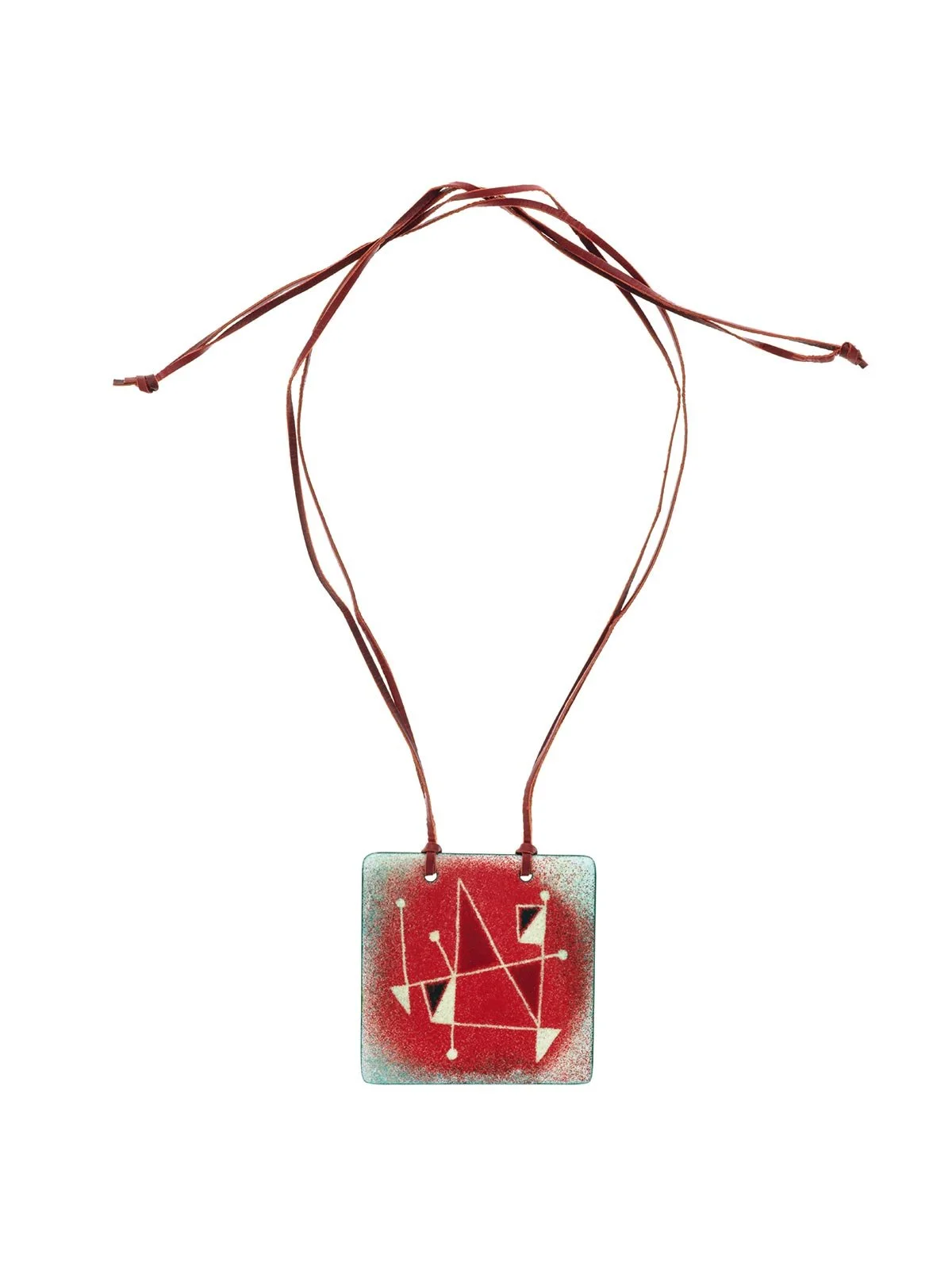
PENDANT by Ellamarie Woolley of enamel on copper, about 1947–1950. Dallas Museum of Art, Dallas Art Association Purchase, 1950.64.2. Photograph by Chad Redmon.
The Netherlands receives special attention. Despite its small size, the country has become a hotbed of ideas in contemporary jewelry, and Gijs Bakker, a leading figure in the field, is well represented in the collection and the exhibition.
Closing Reflections
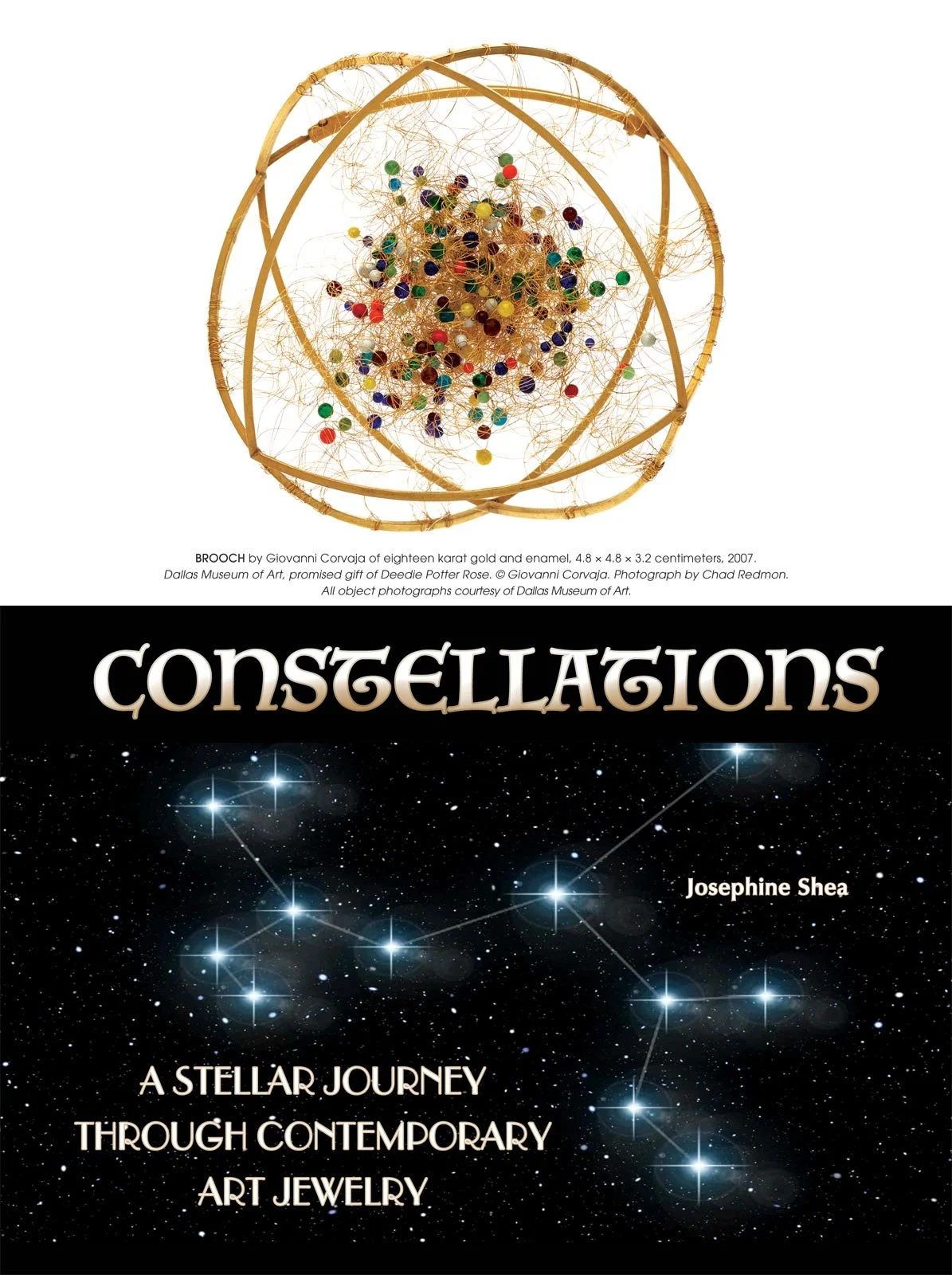
This brief overview can only offer a taste of the jewelry on view in “Constellations”. To experience the full range of work, one should visit—and ideally revisit the exhibition. Large pieces, such as necklaces and headpieces, naturally command attention. Yet smaller objects, like Giovanni Corvaja’s brooch, and many of the rings, reward a closer look.
After opening at the Dallas Museum of Art, “Constellations” is on view at Chrysler through the end of 2026 before traveling to Joslyn Art Museum in Omaha, Nebraska. Whether able or unable to see the exhibit in person, the beautifully photographed 455-page book with Schleuning’s thoughtful essays is a valuable resource and a worthy addition to the bookshelf of anyone interested in the ornamentation of the body.
“Constellations: Contemporary Jewelry from the Dallas Museum of Art” shows through January 3, 2027 at Chrysler Museum of Art, One Memorial Place, Norfolk, Virginia 23510. Visit their website at www.chrysler.org.
SUGGESTED READING
Schleuning, Sarah. Constellations: Contemporary Jewelry at the Dallas Museum of Art. New Haven, CT: Dallas Museum of Art, 202

Josephine Shea explores the intersection of craft, art, and design, across cultures and time as an independent curator, writer, and educator. She recently managed a major grant funded by the Art Bridges Foundation to share the Philadelphia Museum of Art’s collection with eight museums across Pennsylvania with the goal of increasing accesses to American art. After employment at the Detroit Institute of Arts, she served as the curator of the Edsel & Eleanor Ford House in Grosse Pointe Shores, Michigan. There she managed the presentation and conservation of an important and eclectic collection of fine and decorative art in the historic family residence designed by Albert Kahn and set within a Jens Jensen landscape. As curator, she managed art exhibitions that connected with the Fords’ legacy, hosted in both traditional and non-traditional spaces, collaborating with outside curators and artists. Her background includes non-profit art management with programming, membership, marketing, and development experience as the executive director of Detroit’s historic Scarab Club. Projects as an independent curator include “Dubuque by Design” for the Dubuque Museum of Art in 2024, and “Beyond Glass” for the Wayne Art Center in 2022. She has published and participated in panels exploring these topics and shared her knowledge with undergraduate students at the College for Creative Studies in Detroit and graduate students at The George Washington University’s Corcoran College of Art & Design. Shea holds a M.A. in the History of Decorative Arts from the Corcoran College of Art & Design/Smithsonian Associates with a focus on twentieth-century American ceramics and glass, and a B.A. in the History of Art from Michigan State University.