Ojime Universe Volume 47.1

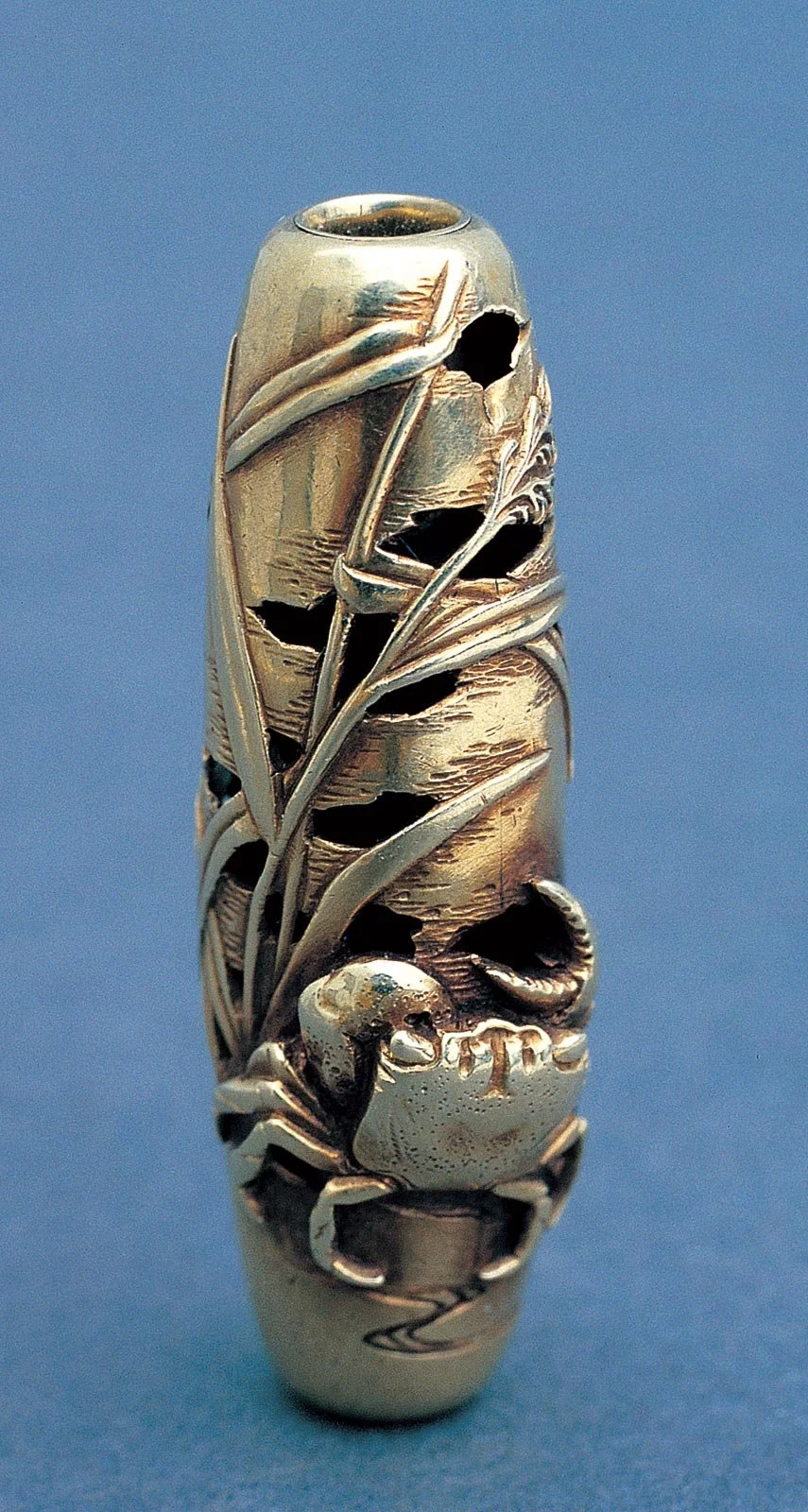
REMARKABLE GOLD OJIME OF CRAB AND VEGETATION, fabricated by piercing, repoussé; note the detailed crab and graceful plants, 2.8 centimeters high. There is an inner sleeve for the himotoshi. Courtesy of Fred Chavez. Photograph from Ornament Photography Archive, Robert K. Liu 1983.
The ojime of Japan are remarkable, intricate, and internationally celebrated artifacts. They are essentially beads, but they also serve a specific function in the wearing of traditional garments, mainly by men. Until Western dress was adopted in the twentieth century, the common robe, the kimono, worn by everyone, was a garment that was belted by the obi (sash) to be held closed in front. Kimonos also do not have pockets for carrying small things—and thus the sagemono and inro ensembles were devised. An inro is most often a compartmented case, the nesting pieces being held together by cords that pass through drilled perforations on each side of these elements. The cords then pass through the ojime—a bead that can be slid up or down. It slides up to open the inro, or is pushed down to pull the boxes together and closed. Up at the end of the cords, these terminate at their connection to a toggle called a netsuke, that has a particular type of perforation (himotoshi); being either on the underside in a “V” conformation, or being two perforations that run top-to-underside, and meet on the underside. The purpose of the netsuke toggle is to act as a counterweight to the rest of the ensemble. The netsuke is placed to the person’s back right side, passed under the obi, where it slightly hangs over the top edge, preventing the ensemble from dropping.
The materials of all parts tend to be precisely made, highly artistic or aesthetic, and might be lacquered wood or metal for the inro; ivory, metal, lacquer, coral, ceramic, mother-of-pearl, a variety of minerals, or even glass and other materials for the ojime; and for the netsuke, similar but fewer materials. In the arena of collecting, many more people collect netsuke than have collected ojime. But ojime have a certain popularity—particularly among people who like beads.
To understand the place of ojime and inro ensembles within Japanese culture, we have to know some history. Japan was essentially governed by a feudal system for close to 1,000 years. The Shogunate in Japan was a hereditary military dictatorship that governed Japan from 1192 to 1867 A.D. Led by the Shogun (a supreme military commander), it functioned as a feudal government where he held the true political power (while the Emperor served mainly as a symbolic figurehead in Kyoto). Members of the shogunate had previously mainly been administrators, though they evolved into a warrior class—the Samurai. As Samurai warriors prospered and came into power, they became the wealthy class in Japan. Their battledress, weapons, and accoutrements became elaborate expensive artifacts.
There is some implication that they vied with each other to reflect their power and wealth through the display of these riches. Most important was the katana and wakizashi—a set of two swords the Samurai carried as his top personal weapon and ceremonial implement. These blades featured extremely fine and complex points of elaboration, and the metalsmiths who made armaments and their decorative elements, or menuki and related decorations were celebrated craftsmen.
Toward the end of the Edo Period (1600 to 1867 A.D.), the use of inro ensembles had become established and formalized. 1868 marks the beginning of the Meiji Period, a time of restoration under the influences of outside governmental systems, and when feudalism was disbanded. Shoguns lost power, and samurai were no longer allowed to ply their militaristic trade. In fact, it became illegal to be seen wearing armaments. The craftsmen who had supplied samurai equipment were forced to turn to other arts, where their skills could be utilized. Carvers and metalsmiths became (among other crafts) makers of ojime—and thus began the modern period when ojime became elaborate but more-subtle expressions of wealth and status.
The Taisho Era (1912 to 1926) postdates the Meiji Period, and became a time when some Japanese carvers turned to making “ojime” commercially—perhaps for both domestic and export purposes. They remain very Japanese in style. However, they were not usually one-off and unique, but rather were carved in multiples as production work. One could say, “an ojime carver makes ojime.” But, without having been traditionally used, as a sliding bead in an inro ensemble, are they truly ojime? Opinions vary.
WHAT IS AN OJIME?
An ojime is a small piece of three-dimensional art with a single centered perforation (himotoshi) that is wide enough to hold the two inro cords snugly. The apertures of the channel may be countersunk; and some ojime feature a metal sleeve through the himotoshi. An ojime averages seventeen millimeters in diameter, but may be slightly smaller or larger. Elaborately carved or decorated ojime must be carefully rotated around their circumference to fully, visually, appreciate the topic or subject(s), the quality and detail of the art itself, and the story the art presents or symbolizes.
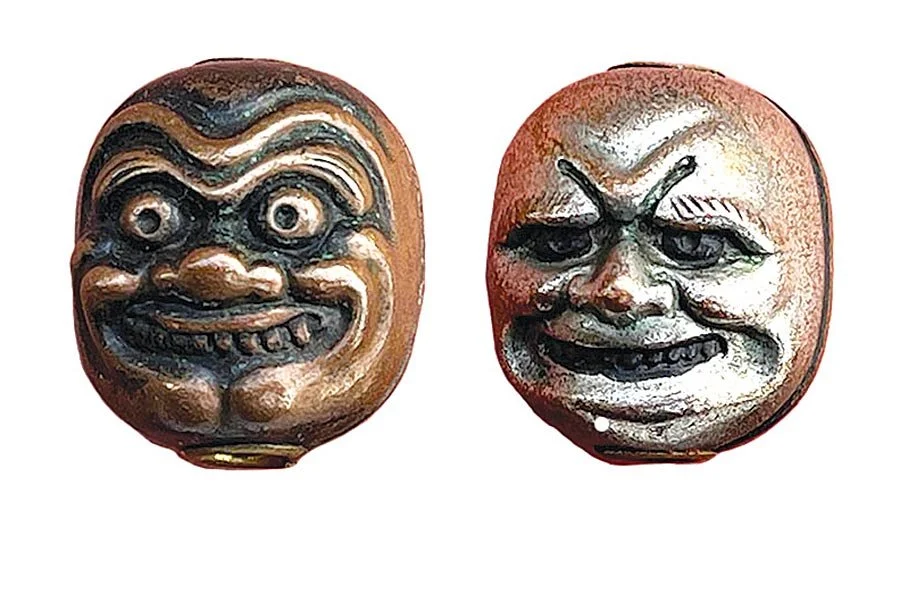
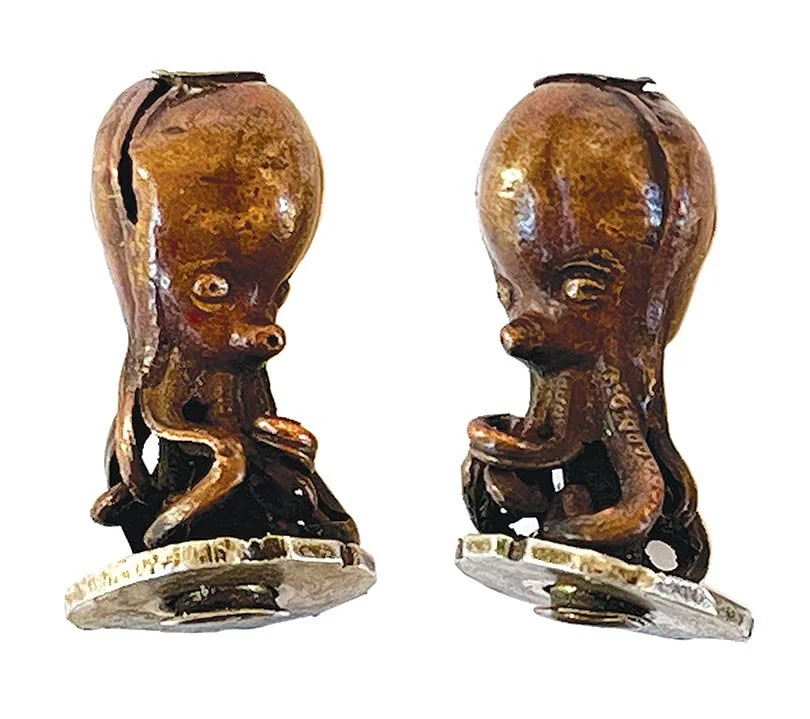
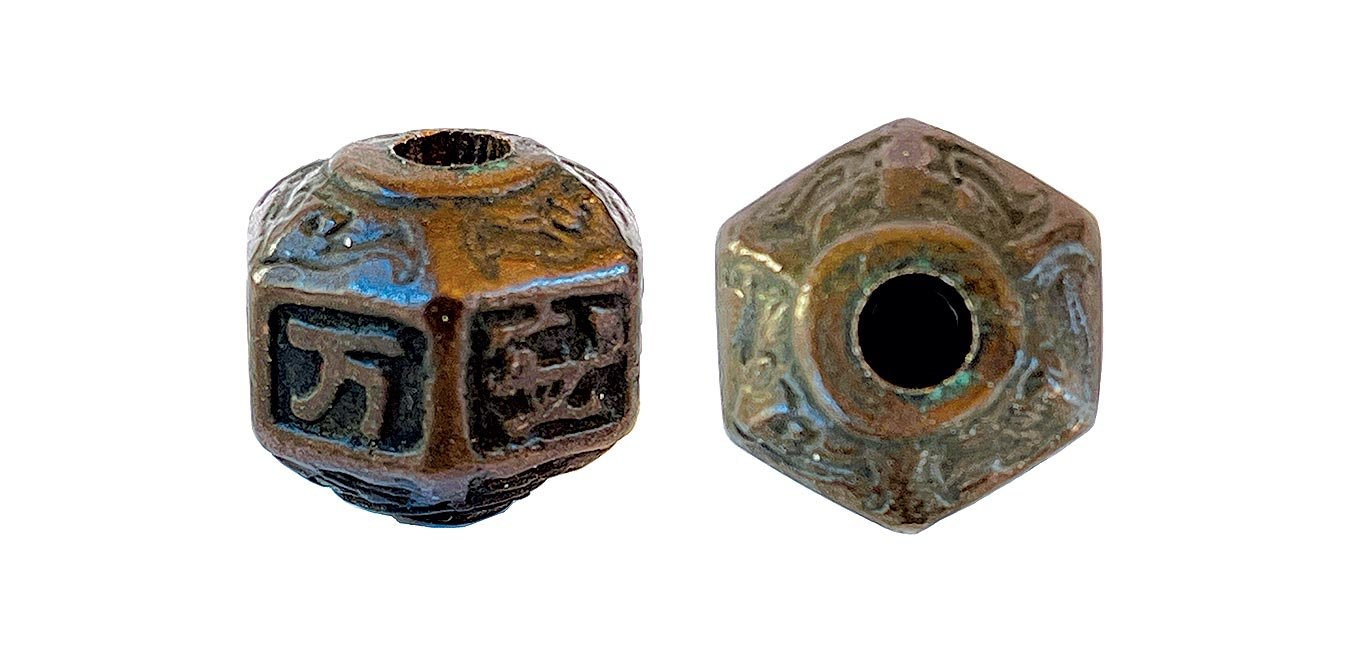
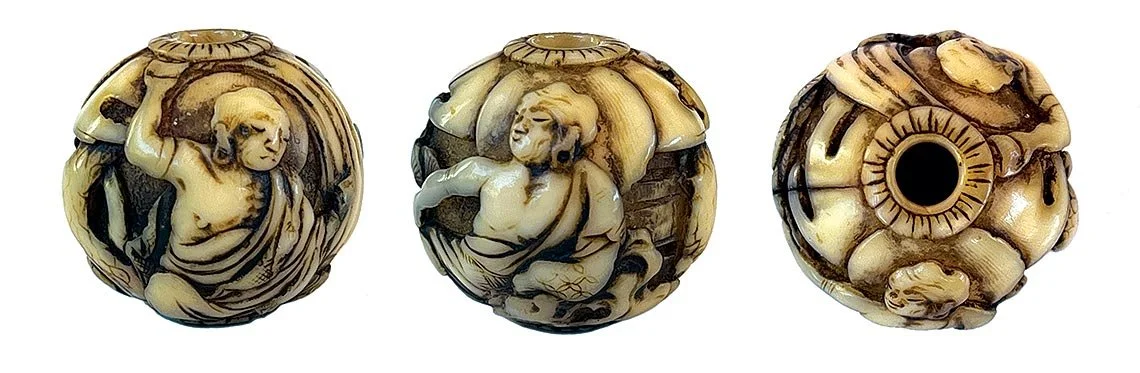
TWO SIDES OF A BRONZE OJIME that depicts Noh characters. BRONZE OR COPPER OJIME depicting two views of an octopus with brown patina. TWO VIEWS OF HEXAGONAL BRONZE OJIME, with a black shakudo patina.
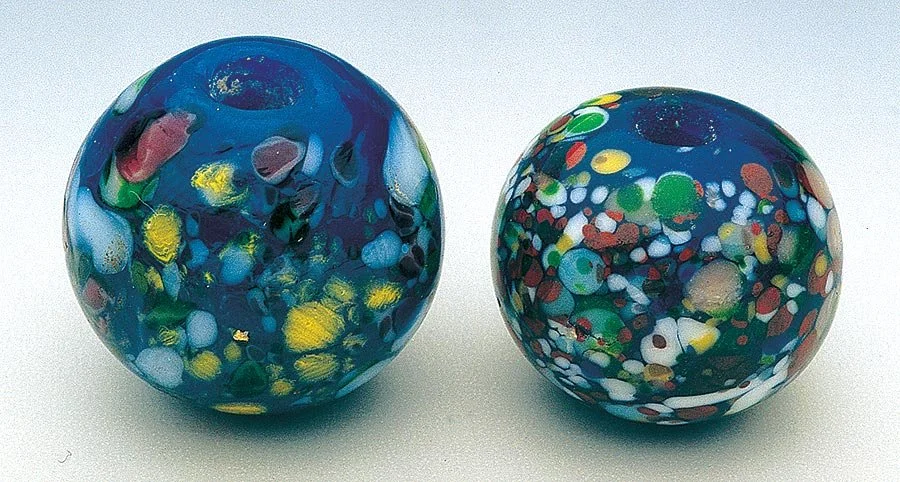
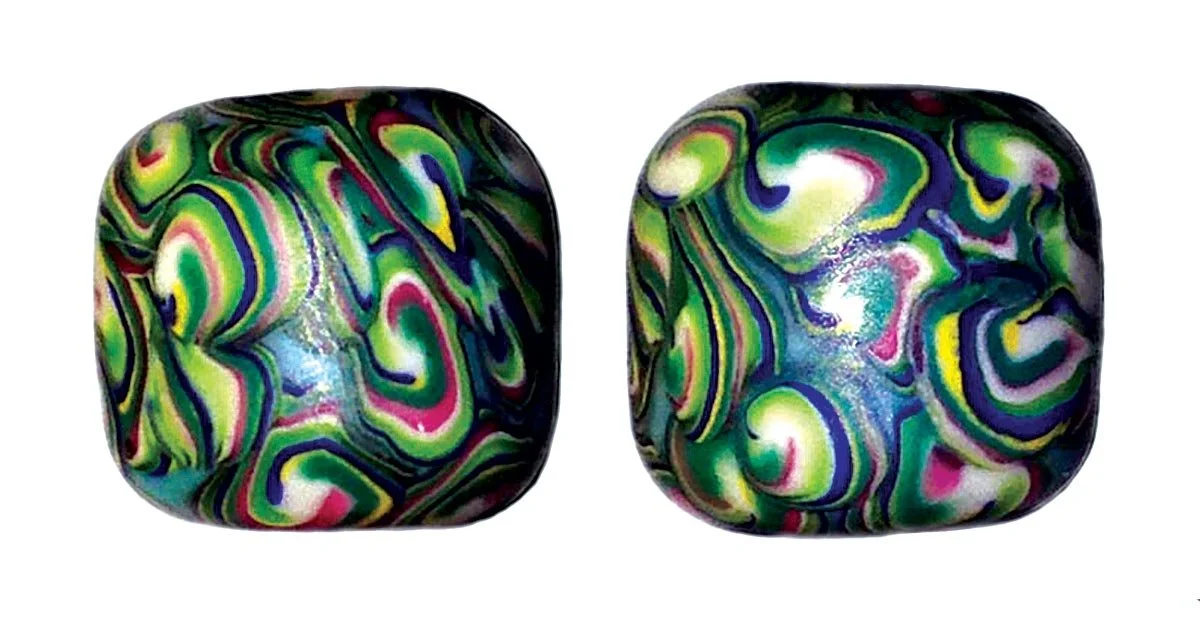
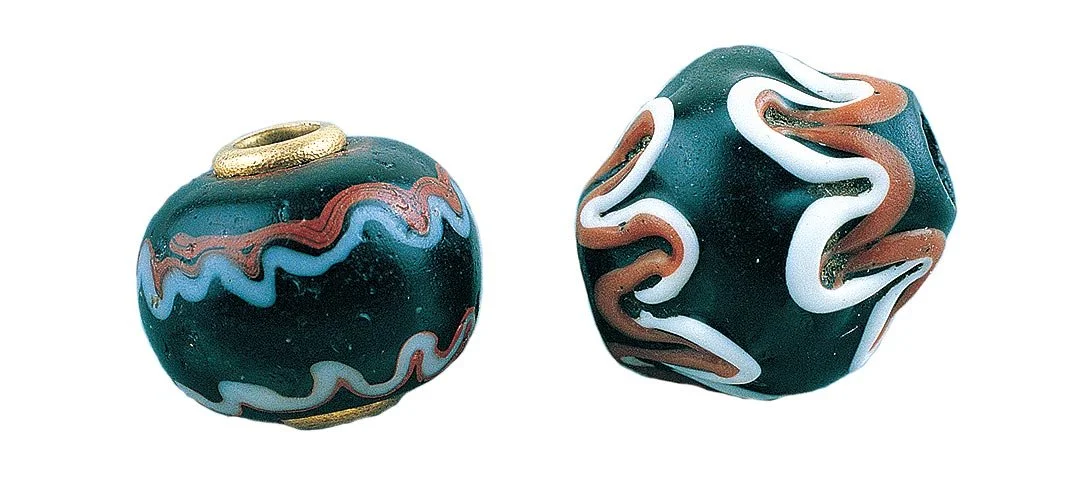
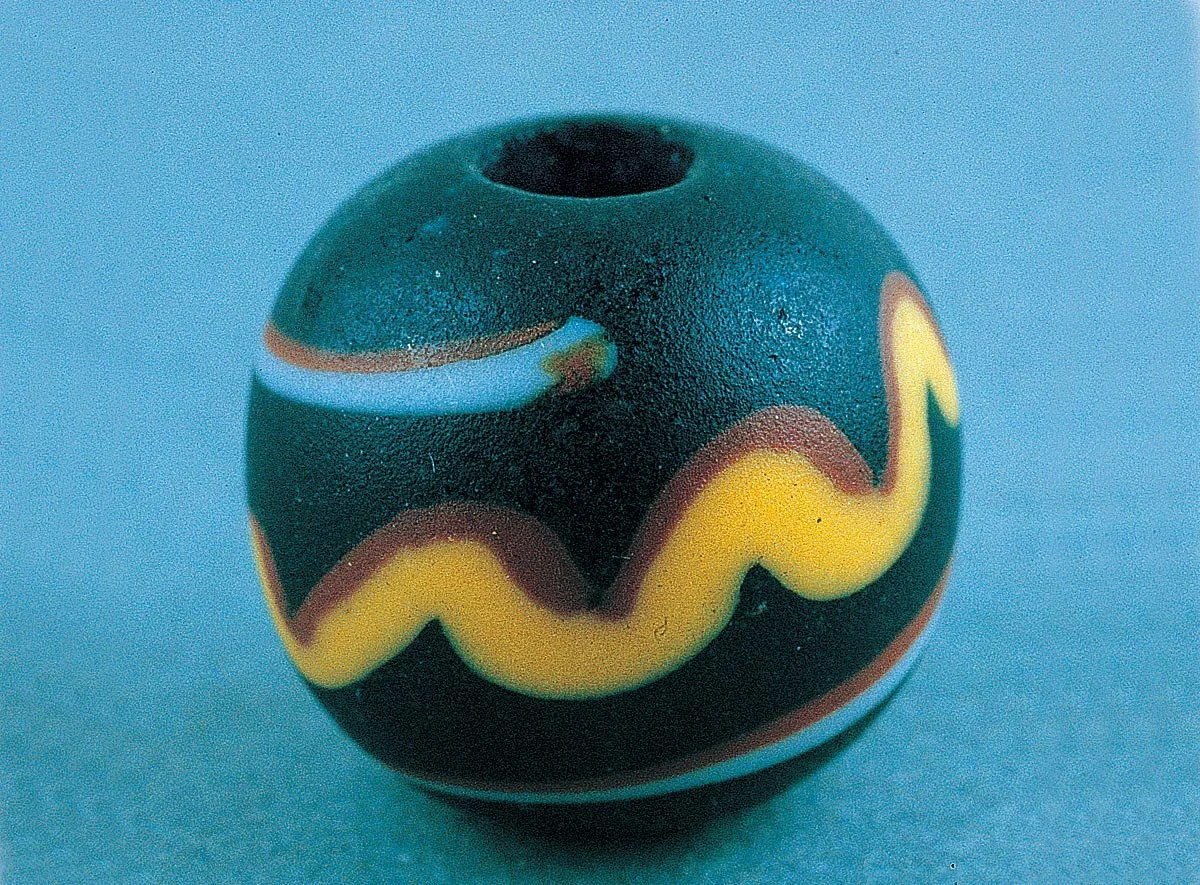
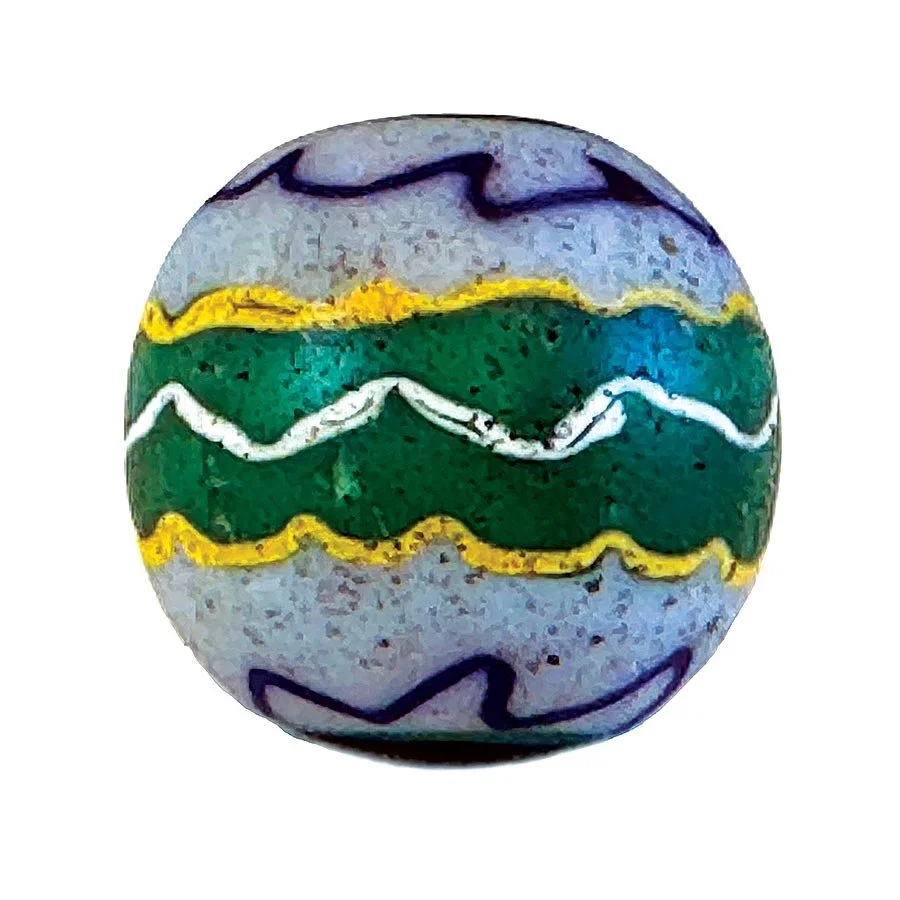
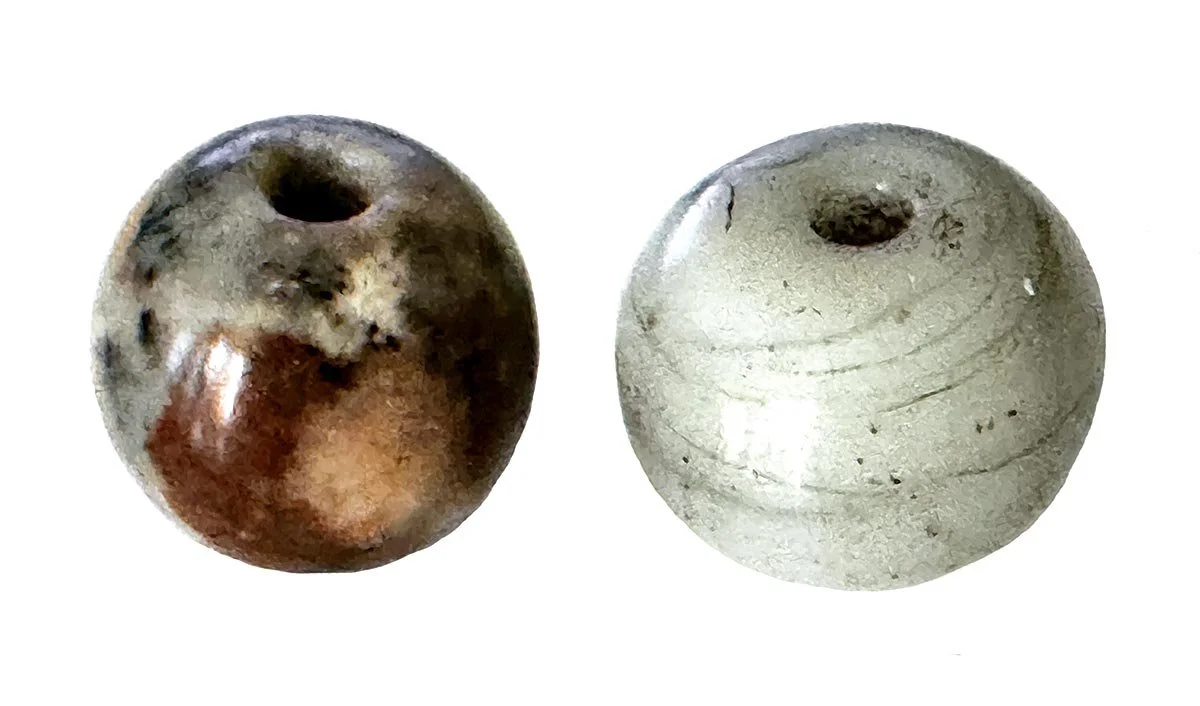
TWO IMPRESSED GLASS CRUMB BEADS USED AS OJIME; poorly-made left-hand Chinese specimen with tell-tale clay in perforation and in center of bead versus a smaller, well-made Japanese specimen on right. TWO VIEWS OF GLASS OJIME WITH TRAILED AND SWIRLED COLORS. TWO CHINESE-MADE IMITATION CHEVRONS, one with gold sleeve used as ojime; other with raised trailing was used by aborigines of Formosa (Liu 1992).
It has been observed that near-sighted people may appreciate ojime more than others. Magnification will provide similar better views.
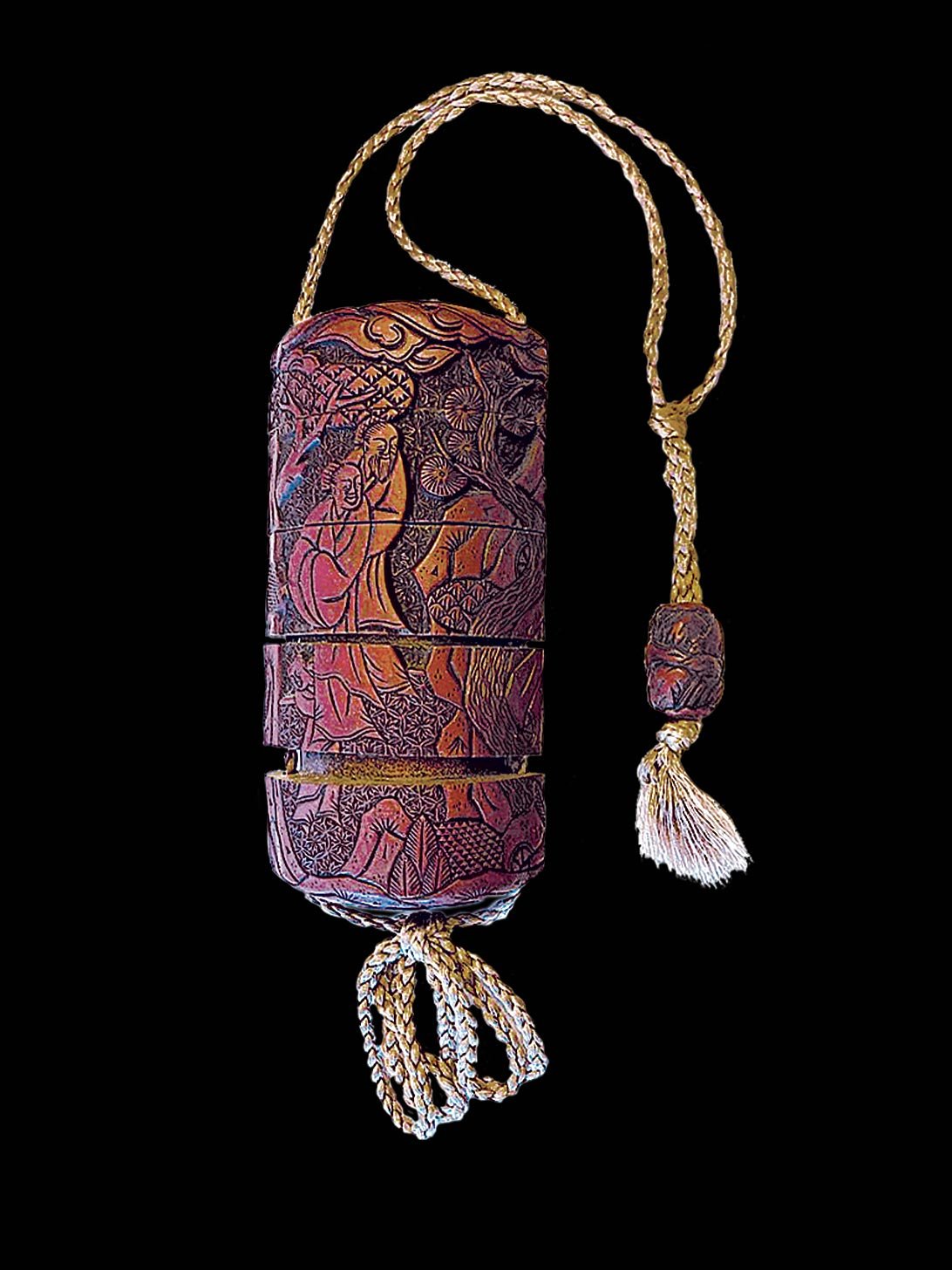
CINNABAR INRO CASE with cinnabar ojime. Collection of Stephanie Schreiber. Photograph by Stephanie Schreiber.
In our present time, the use of ivory, whether from endangered elephants or other mammals, is frowned upon, and many such animals are internationally protected. Being around one hundred or more years old, ivory ojime are discussed as an antique historical phenomenon. In our present world there are other materials that can substitute for live ivory—including fossil ivories and vegetable ivory or tagua nuts. However, elephant ivory was a preferred material in the previous centuries. It was possibly also sourced from other mammals, such as marine ivory (whale, walrus, and narwhal); and similarly bone and antler. Coral and mother-of-pearl were other favored organics. Equally common are ojime made from metals: gold, silver, copper, bronze—and skillfully made Japanese alloys, multi-metal constructions, and gilding onto other metals. These techniques have traditional processes and names—some that are unique to Japan.
Since the 1970s the interest in beads of many sorts has become an international phenomenon. Japanese ojime, being essentially beads, have been avidly collected within this enthusiastic pastime. However, along with this has been the to-be-expected situation where beads that are not ojime are mistakenly believed to be these artifacts. Some of these beads are Japanese, but were never associated with inro. (That is to say, these beads had other Japanese functions, and are not “ojime.”) And some were manufactured mainly for export, rather than domestic use. Many of these mistakenly-identified beads are Chinese. And it is also very likely that, in the early 20th century, Japanese companies collaborated with Chinese manufacturers to create ojime-like ornaments for export.
A question that is sometimes asked is: Is it not possible that a Chinese or other bead might be adapted to become an ojime? And the answer is yes. This is possible. However, specimens where this has happened—where an inro ensemble has a foreign bead substituting for a Japanese ojime—are few. Possibly the ojime seen among other types of sagemono (where they need not be “sliding beads”) have more variety. We should ask ourselves how and when it happened. Did a collector commission or compose the pieces, with this result?
Many ojime are not acquired in-association with an inro ensemble. Particularly from the late period of production, ojime were commissioned that became merely “cabinet specimens” for admiration. So we have to wonder what independent criteria make this a possible proposition? If not used with an inro ensemble, what determines a perforated object to be an ojime?
Also, it has become common in online sales, including from sellers in Japan, that Chinese beads will be offered as “Japanese ojime.” When asked about this, the response I received has been, “Yes, these are Chinese. But since we use them in Japan they are considered Japanese ojime.” This is the casual assessment of a situation where the goal is essentially to make a sale using a recognized name. An astute collector might disagree, even when the Chinese bead is a handsome and appropriate-looking specimen.
In the bead marketplace there are many more pretenders offered for sale than there are authentic ojime up for sale—but that is a topic for another exposition.
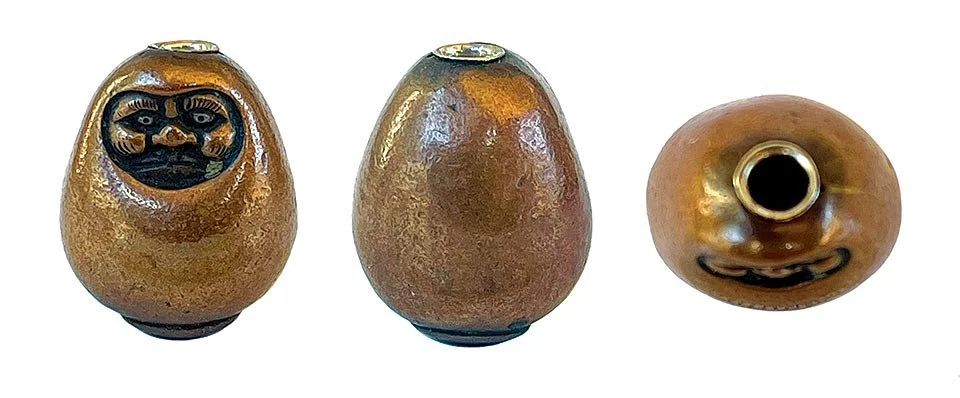
BRONZE OJIME featuring four views of birds and flowers. Photograph by Jamey D. Allen.
IVORY OJIME featuring characters from Noh theater. Photograph by Jamey D. Allen.
Click for Captions
ACKNOWLEDGEMENT
I am very grateful to Fred Chavez, one of the world’s few ojime specialists, who has been an ongoing assist for my exposure to the ojime he has handled for nearly fifty years, and who still engages me in helpful discussions. Our communications remain insightful, challenging, dissenting in only the nicest way possible, and always stimulating.
SUGGESTED READING
Benesh, C. L.E. 1997 Janel Jacobson. Stirring the Dawn. Ornament 20 (3) : 42-47.
Chavez, Frederick Bourguet 1981 “Ojime: An Historical Perspective.” The Netsuke Journal.
—1995 “The Japanese Multimetal Ojime Bead,” [Proceedings of the] International Bead & Beadwork Conference, Kadir Hass University, (not paginated), 2007.
Kakoi, H., M. Kurosawa and H. Tsuneki 2006 “Identification of the horse origin of teeth used to make the Japanese ‘kakuten’ using DNA analysis. The Journal of Gemology 30 (3/4): 193-199.
Kinsey, Robert 1987 The Lacquered Ojime of TOMIZO SARATANI. Ornament 10 (3): 56-60.
—1991 Ojime, Magical Jewels of Japan. Abrams, New York.
Mikoshiba, Misao and Raymond Bushell 1979 “The Soken Kisho and Ojime,” Arts of Asia, Volume IX Number 4, July/August 1979.
Liu, R .K. 1982 Glass Ojime. Ornament 6 (2): 24-28.
—1983 Special Pictorial Ojime. Ornament 7 (1): 25.
—1989 Conference. International Netsuke Kenkyukai Convention, Stouffer Concourse Hotel, Los Angeles, California; January 26-February 1, 1989. Ornament 12 (4): 65.
Wylie, Hugh 1988 Netsuke: Personal Adornment for the Japanese Man. Ornament 12 (1): 68-71, 9.
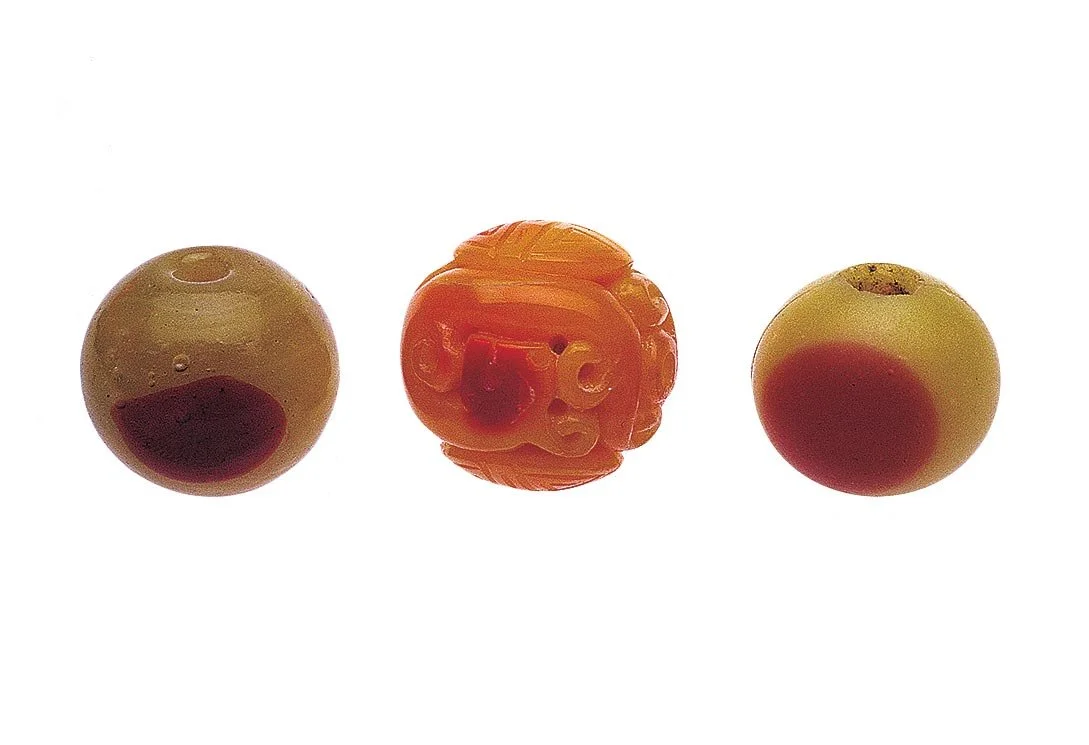
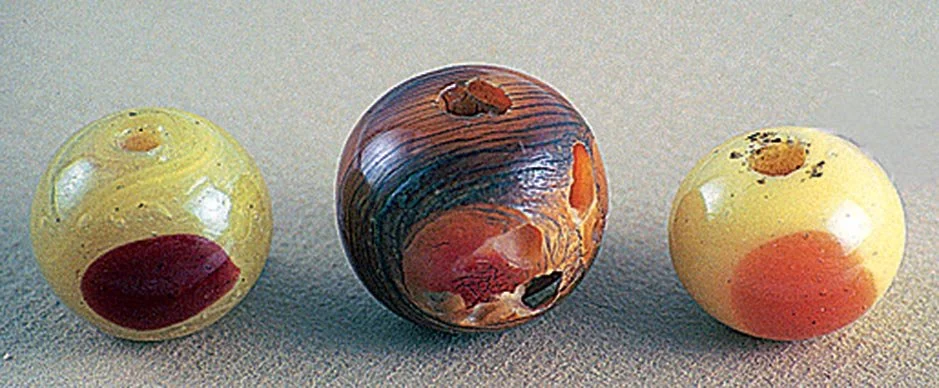
THREE GLASS IMITATIONS OF KAKUTEN, with two of Japanese origin, right-hand specimen possibly Chinese. Far left and right hand ojime have spalling glass. Real kakuten ojime are 1.8-2.0 centimeters in diameter and made from dyed horse tooth, while imitations are around 1.7 centimeter diameters. Specimens courtesy of the late Hugh Weisser and Naomi Lindstrom. Photograph by Robert K. Liu/Ornament.
KAKUTEN BEAD AND TWO GLASS IMITATIONS, the latter most likely of Japanese manufacture and used as ojime. Again, we have an unusual and presumably precious/prestigious material used for ojime, in this case cochineal dyed and possibly glued horse teeth (Kakoi et al., 2006). Middle ojime glass is spalling. Photograph by Robert K. Liu/Ornament.
TWO REAL KAKUTEN OJIME AND TWO GLASS IMITATIONS, the latter used in topmost photograph. Kakuten are cochineal dyed. Specimens on this page are courtesy of Fred Chavez, Norman L. Sandfield and the late Hugh Weiser and Naomi Lindstrom. Photograph by Robert K. Liu/Ornament.
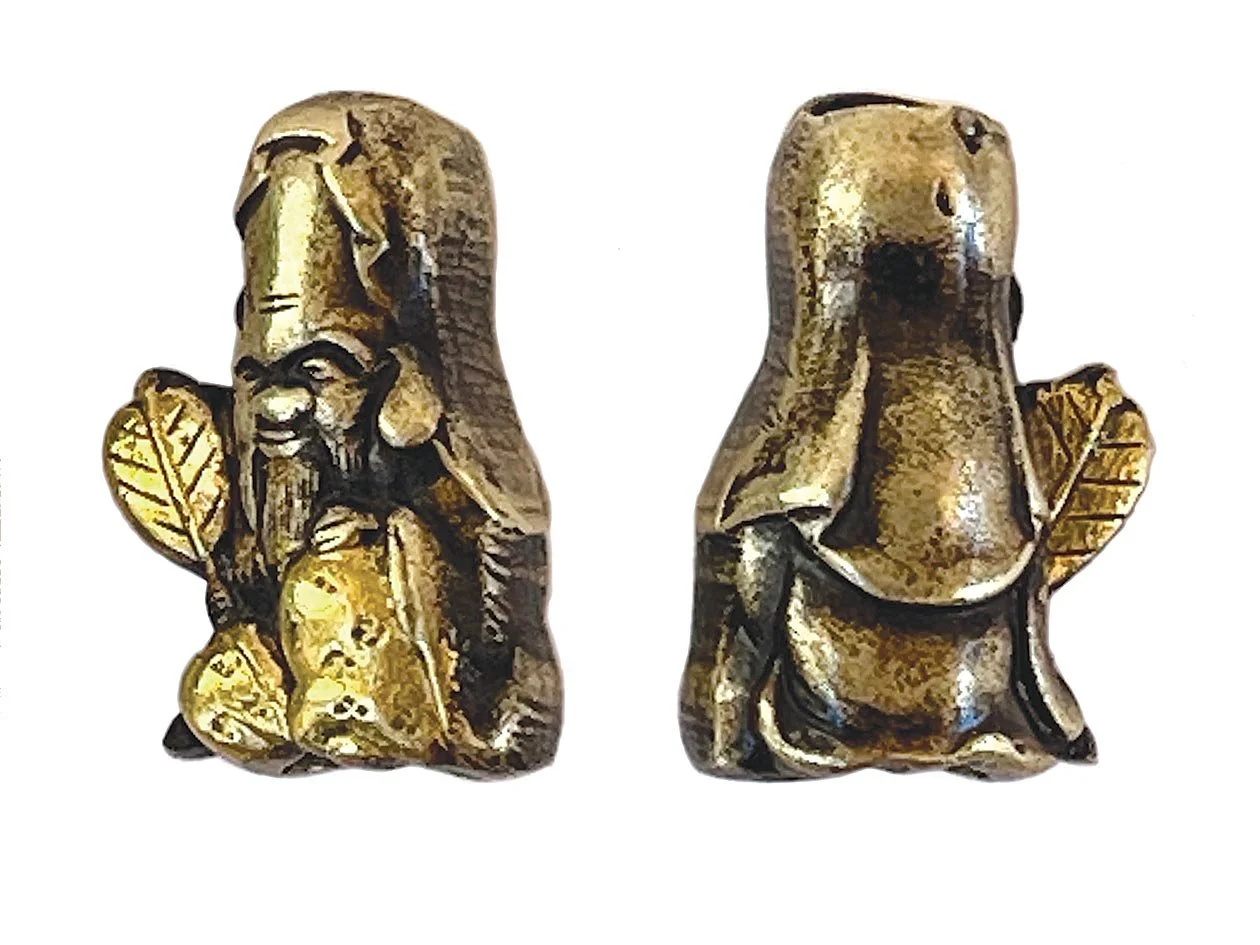
GOLD, SILVER, AND BRONZE OJIME, latter with a black shakudo patina. Photograph by Jamey D. Allen.
Click for Captions

Jamey D. Allen is a lifelong artist specializing in beads and beadwork, as well as bead research at an international level, being the Co-Founder of the Society of Bead Researchers (1981), and was formerly Curator for The Bead Museum in Glendale, Arizona from 1999 to 2011. He resides in Sonoma County, California, has a massive online presence for over twenty years, and continues to collect and study all sorts of beads and personal adornments. He has written for The Bead Journal and Ornament Magazine since 1975. In this issue Allen writes about the exceptional ojime of Japan, once a vital part of men’s attire and widely admired for their fine crafting.