Lynn & K Meta Reintsema Volume 46.3
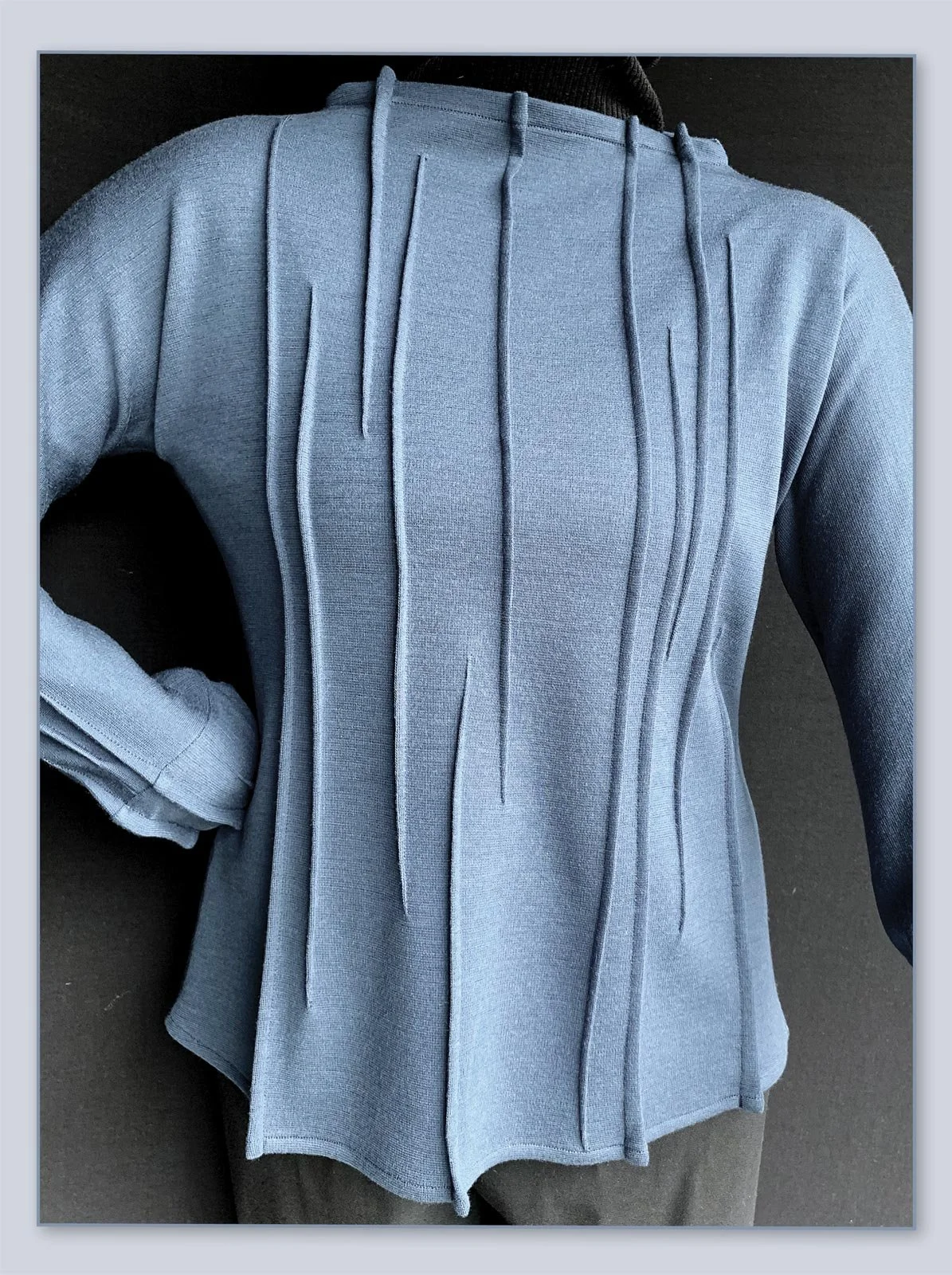
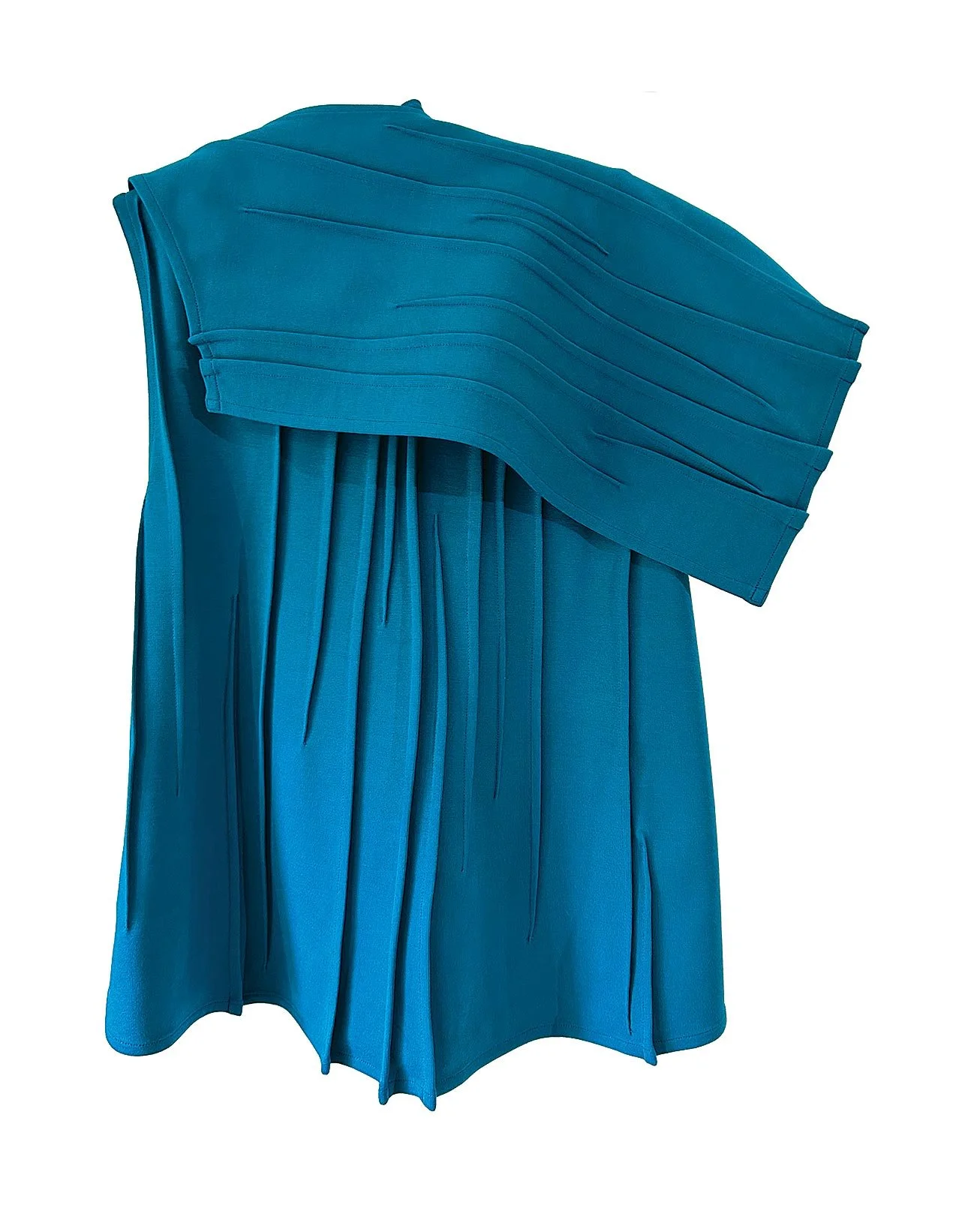
FUNNEL NECK TOP in wool knit. The creases or pleating down the front are all measured by Lynn using her hands and eyes to place them freeform, which she then stitches to add dimensionality and direction. Photographs by Lynn & K Meta Reintsema.
Lynn & K Meta Reintsema
ARCHITECTURE IN MOTION
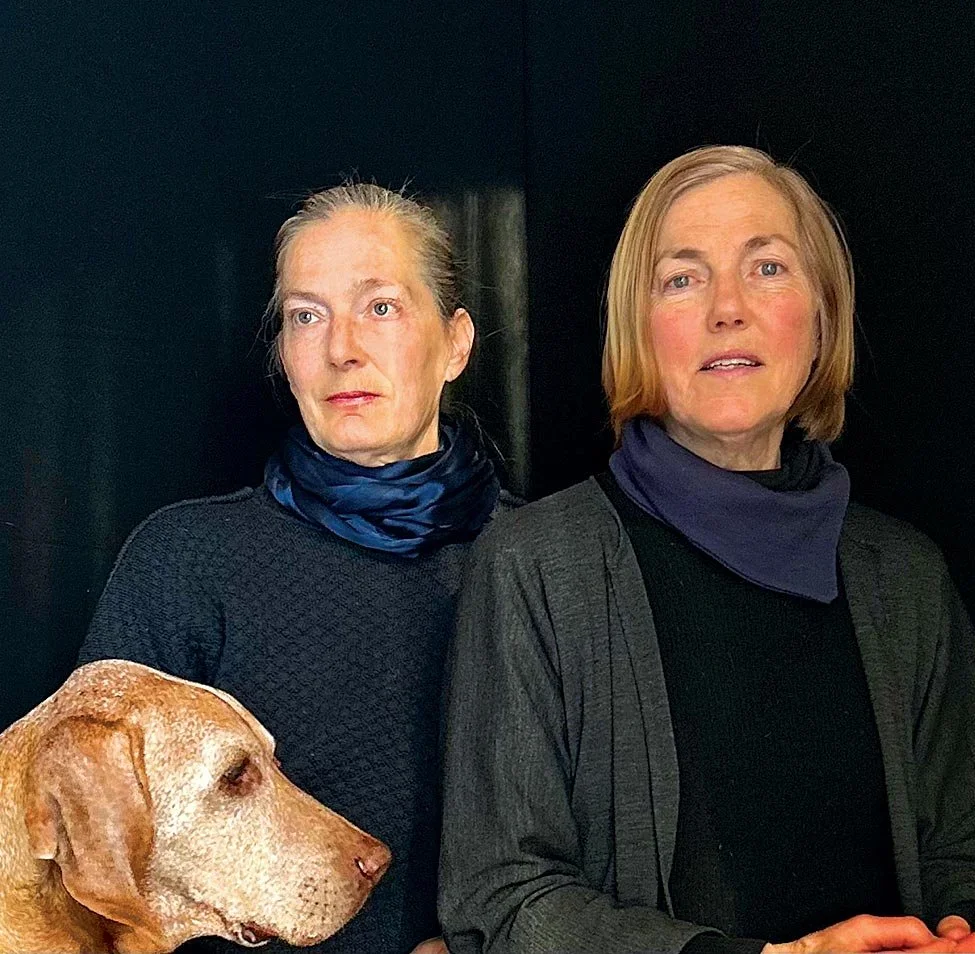
K META & LYNN REINTSEMA, with their dog Tryker, 2026.
A crease, a fold. A tuck, a curve, a line, unfolds. Sisters Lynn & K Meta Reintsema use a palette of organically designed stitching to create endless variations of surface texture and pattern, often against a monochrome fabric. They’ve been experimenting with a blue phase of late, although they feel like something else is calling them.
The Reintsemas don’t talk about it too deeply, but a few comments make it clear that their artistic lineage is generations deep. Their great-grandmother was a seamstress in the Victorian era, whose hand-stitching was most beautiful, they remark. Their grandmother Minerva skipped a generation, as far as sewing was concerned, but was herself a fashion illustrator and a model, the former being a part of her life that she kept well hidden. She won awards for her drawings at the Metropolitan Art School, and they are remarkable. It was only after she passed away, early in her fifties, that her illustrations were found.
Their mother, Joris, has a complicated history, and provides both inspiration and caution. She taught them how to sew from an early age, taking the two sisters to fabric stores frequently. While she introduced them both to the process of creating one’s own garments, she herself put her passion into painting and sculpture. She wanted to get a masters in fine arts in the late 1950s, attending the Albright School of Art, but that quest was derailed by her mother, who insisted she get a teaching degree to make a living. This was a difficult stage of their mother’s life, one which she reckoned with through the 1960s. This didn’t prevent her from being prolific in her painting.
Taking this lineage into account, one gets a deeper understanding and appreciation for where Lynn and Meta’s work emerges from. Despite the cautionary tale of their mother, Lynn went to get a degree in fine arts from a liberal arts college. She didn’t get into making clothes full-time right away, transitioning first through an offer to work with a ceramicist ($2.50 per hour didn’t cut it), to getting a job with a Madison Avenue furniture designer, Ward Bennett.
During this period, she began making clothing to sell, after having made a few pieces for friends who then clamored for more. Still a side passion project for the time being, Lynn found a willing partner when her sister moved to New York, after having received her fine arts degree in dance, and established a living within that sphere. Meta built a dance company with a friend of hers, and became involved with the American Dance Festival, which has been a national fixture, off-and-on, since 1934. Since 1978, it has made its home in Durham, North Carolina.
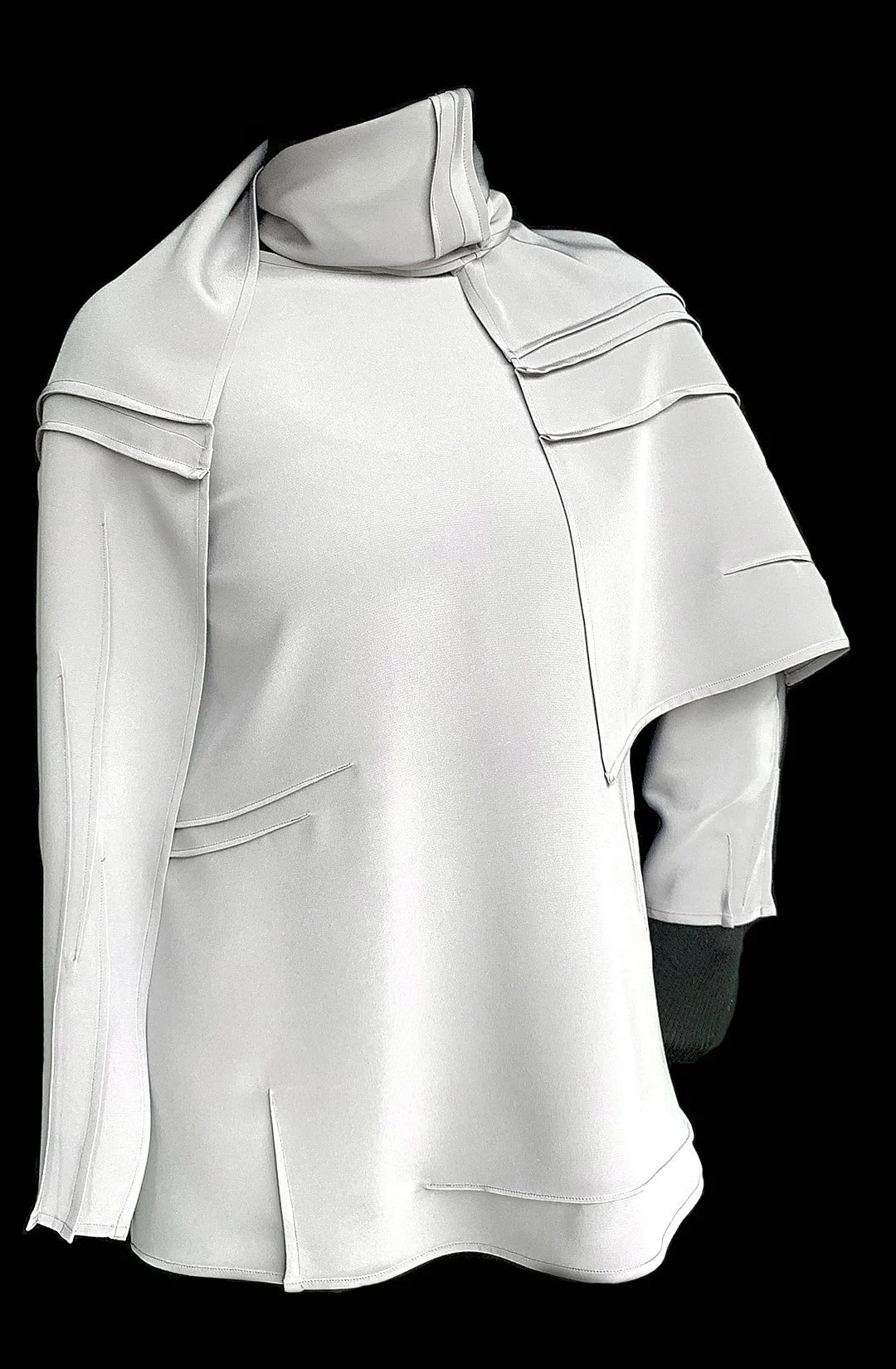
TUNIC AND SCARF in heavy silk crepe. The Reintsema sisters mention how the fabric markets have changed drastically, with heavy silks and wool crepes all but disappeared.
Meta took her sewing background to costume making when she became a costume designer in residence there. During the span of the six-week festival, she would have to make literally hundreds of outfits and learned through the experience how to make comfortable clothes that fit. One thing a dancer can’t have is their ensemble falling off mid-leap, and as a dancer herself who has had to bear the unfortunate circumstances of awkwardly-made costumes, Meta took matters into her own hands. During this experience, she found out how to get results when timelines were tight. Once she remembers spray-painting a set of costumes when she couldn’t get the color right. She also made ballet outfits, which have high technical requirements and are an art form in their own right. One of her friends, a professor from Skidmore College, gave her an original French tutu pattern, which she duplicated from a pamphlet.
Through the Festival, Meta worked with dance companies all over the world, and through this, was introduced to up-and-comers from New York. As she performed with different choreographers (including greats like Paul Taylor, Pilobolus, and Santo Loquasto, who worked with Woody Allen), she eventually found her way to the Big Apple, where Lynn was making her life.
While we were having our conversation, the sisters’ fifteen-year-old dog, a viszla by the name of Tryker, pushed his face into view. It’s easy while talking of costume-making and craft shows to forget the hum and rhythm of life, the banalities like taking care of one’s pets or making time for family. Part of the early struggle for Lynn and Meta was making sure someone stayed home to watch after their two dogs while the other was at a craft show.
Craft shows didn’t even figure into their minds in the beginning. In a funny way, their early exposure to the Rhinebeck shows as kids set a certain tone that needed education to correct. At the Rhinebeck Festival in those days, artists sold out of the backs of their cars on grassy fields. While homey and charming, that was not theimage the sisters were aiming to present. It took one of their friends, the owner of Whole Wheat Gallery up in the Berkshires, to set them straight, by directing them to a few shows they should apply to. They checked them out, among them West Springfield, and it clicked. Professionally done booths with finely made work, whatever the medium, was part of the spectrum of “craft”, and that’s where Lynn and Meta found their groove.
It became a cycle, of lining up shows throughout the year, getting work done, coming home and fulfilling orders and taking commissions, and then it’s the beginning of the year again. The two have been exhibiting at the ACC Baltimore Show for decades, and there is both fond reminiscence and wry commentary about the joys and challenges of that location. The shows these days are thankfully shorter, they say, laughing about spending days in the basement, like moles. The ACC show, with its wholesale counterpart, was a big moneymaker for many craftspeople in those days, and continues to be a vital pillar to the yearly schedule.
It was at these shows that first Lynn, and later Meta would meet other artists, as well as their future clients and collectors. These people, whether fellow professionals or individuals who found something resonant and attractive in the clothing the two sisters created, became friends.
There’s a certain community at craft shows that may be invisible to the casual observer. It manifests in waves, beckonings, and warm embraces, shouts of recognition and the thrill of laughter. Huddles of artists, deep in conversation appear before the show opens, and regretfully, when lulls in the crowd occur. There’s always a bit of tension, as the expense of exhibiting is steep, and one has to match one’s expenses and, hopefully, far exceed them in sales. Sometimes a day can go by with no sales at all; then, suddenly, on the last day, a few collectors come by and make the whole thing worthwhile.
Through these shared bonds of camaraderie, a lifetime friendship can form. During the first several times you’re doing a show, there’s plenty of time for anxiety and loneliness, and a kind word can make one’s day. Lynn and Meta are old friends with Mina Norton, another clothing artist who was already a regular when Lynn first started out. Norton talked with them about their images in applying for shows, and had praise for their work, and that early note of confidence laid down a trail that has blossomed into a deep relationship. They often cross paths at the Smithsonian Craft Show in Washington, D.C., a reunion which enriches the lives of all involved.
Click For Captions
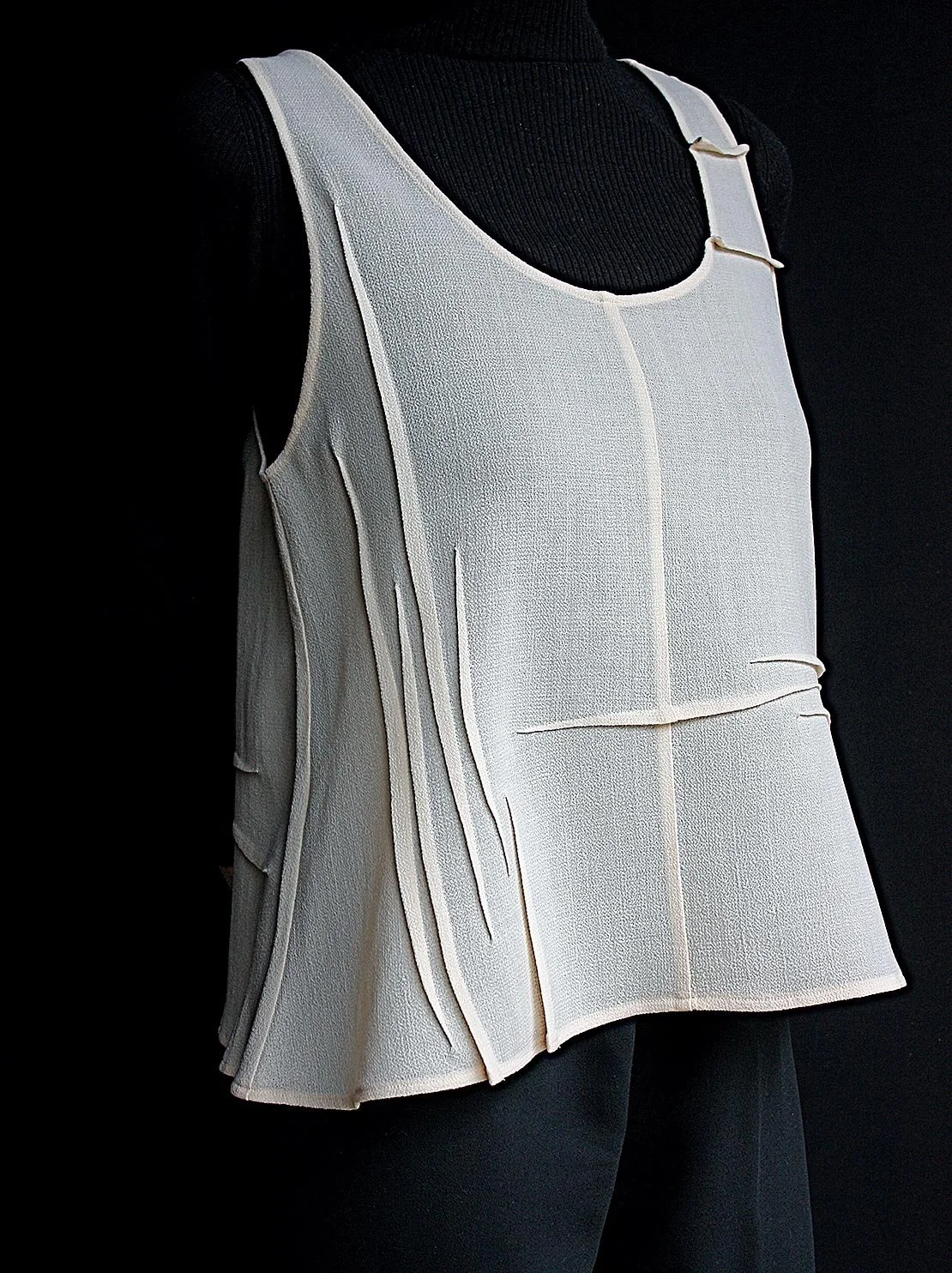
“The Reintsemas don’t talk about it too deeply, but a few comments make it clear that their artistic lineage is generations deep. Their great-grandmother was a seamstress in the Victorian era, whose hand-stitching was most beautiful, they remark.”
Lynn and Meta ran into some headwinds as well, as fiber is perhaps one of the most competitive media in craft. Everyone is comparing everyone to someone else, and how much of the process one does with one’s own hands is carefully noted and tallied. It’s understandable, and someone who has put in the time of making the fabric by hand, all the way to producing the pattern and clothing themselves has invested both time and years of education into a single piece. Yet in all things, there is a balance. The Reintsema sisters purchase the fabric from various sources and suppliers, and then cut it apart and sew it together according to their own pattern. Apart from making the fabric, they are involved in every step of the process, including creating their own patterns. That’s why a careful eye will appreciate the intriguing shapes, the forms that drape and fold and fall over the wearer.
“The first step is in the process, of course, is the fabric,” Lynn says, after we had meandered through the topic earlier in our talks. “We do search far and wide for our fabrics, as we were saying earlier. We’ll start with the selection of the fabric.” Meta chimes in, explaining, “We both have to agree on that color, texture, etc., in that first step.” Lynn weaves back in, continuing, “We do not cut layers. We cut individual garments, one at a time. You don’t want to make a mistake, on many levels. If you make a mistake on one garment, it’s a lot less costly than making a mistake on a few. We cut by hand, and we cut one at a time.”
Meta is the main pattern-maker, and her designs are influenced by her prior lessons in costume-making. While there is plenty of stitching, particularly for creating surface textures that ripple and dance across the fabric, her patterns incorporate very minimal seaming, which is where the most waste comes from. Careful and conscious use of material is of prime importance to the Reintsemas, especially with fabric being more expensive and in less supply these days. For one of their bestsellers, a simple cashmere vest, the only fabric cut away is the arm hole. The pants they make only has the inseam, with no outseam, making for a very clean, minimalistic garment.
While we’re talking about pattern-making, one of the sisters remarks how their technique is very similar to Japanese methods of clothing construction. Yet, neither of them ever studied Japanese clothing-making. The similarity is uncanny, and we all share a laugh about parallel evolution. In some ways though, it’s not a surprise. We arrive at certain destinations depending on the intent we carry, and the goals we seek. When one is looking to achieve both comfort and minimalism, there are only so many ways to get there. Good design, whether in Japan, or in Saratoga, New York, is universal.
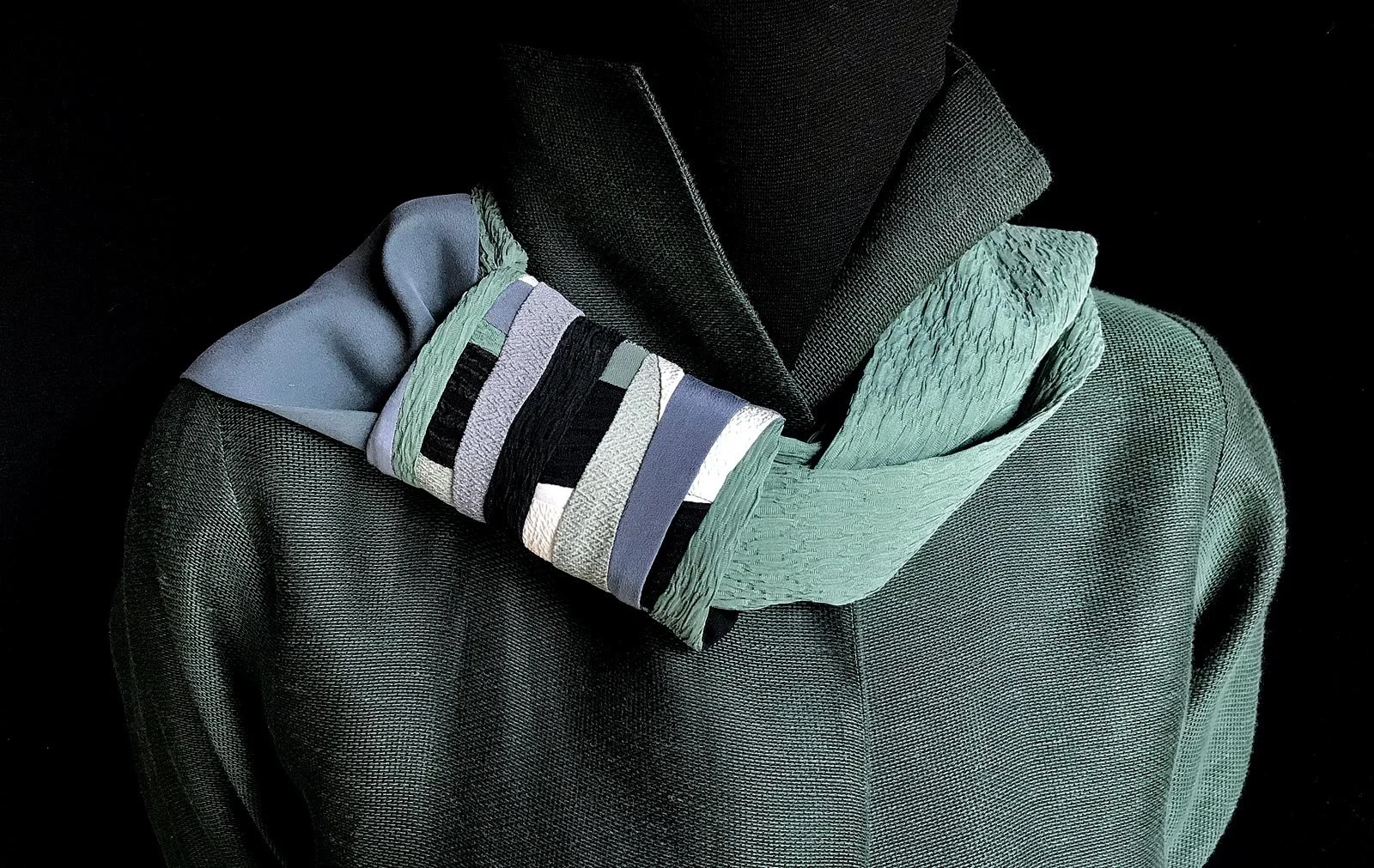
SILK COLLAGE SCARF over silk jacket. Their collage scarves reflect their early work, which involved a lot of piecing of dyed linen.
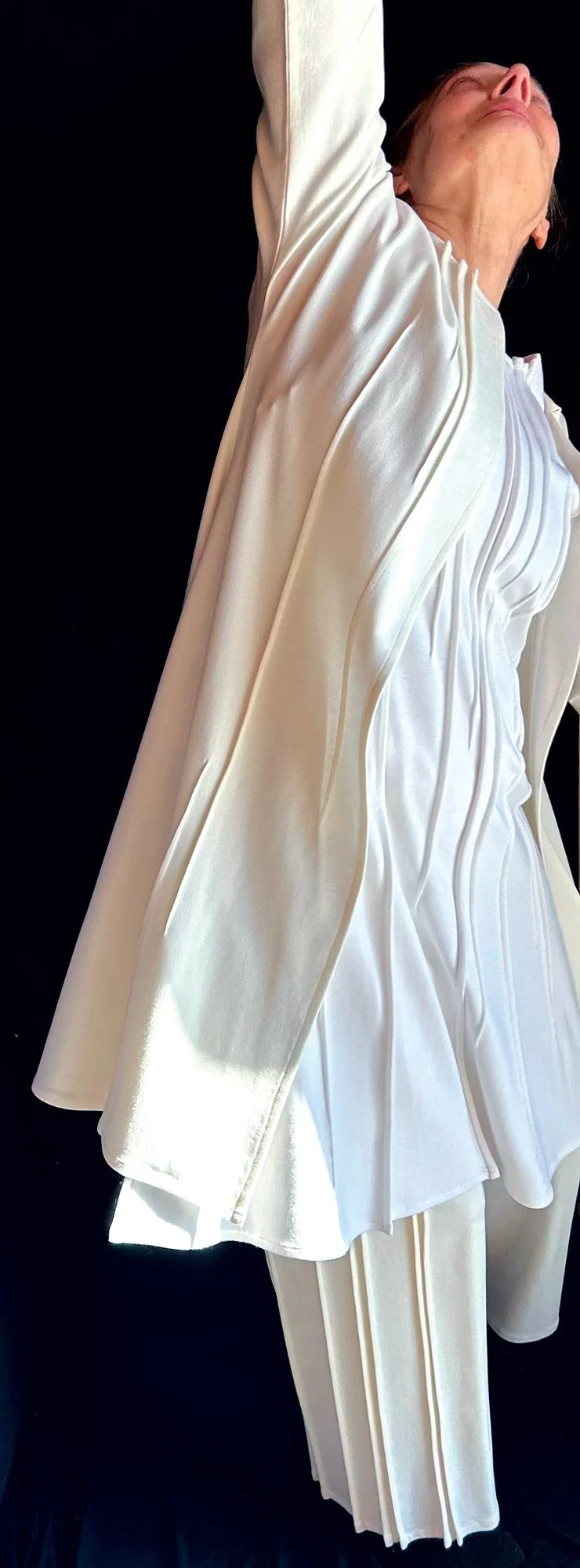
TUNIC/DRESS, JACKET AND PANTS in rayon ponte. Model: K Meta Reintsema.
The Reintsemas started out on two home sewing machines, but have collected a few choice industrial options over the years, including a serger, which Meta uses to make the seams. They have two machines, the five-thread serger, and an industrial straight stitch sewing machine, which Lynn works on (they use Juki’s). It’s simply much faster, and comes from Meta’s background with costume-making, where she had the opportunity to work with the industrial versions in costume shops.
The careful planning and thought behind Meta’s pattern design is contrasted with the almost freeform method of applying the stitching, which creates the pleats and lines that are so architectural in their arrangement and orientation. This is Lynn’s domain, as she finishes the garment with this intricate, almost intimate dialogue with the fabric. Often, clothing makers use chalk to mark lines for stitching, but Lynn prefers a more hands-on approach. She doesn’t even use pins at times, instead using her hands to pinch the cloth. Her eye carefully takes everything in, where her memory and keen mind keeps everything in place. The lines begin to emerge, rippling like waves on the water, or a few judicious folds, with one or two small tucks carrying on the energy as echoes.
Lynn often takes a modest position on her own contributions, but both sisters are manifestly proud of her freeform approach, and its results. They’ve taken to doing an open booth with Mina and their mutual friend, jewelry artist Reiko Ishiyama, and that’s led to a rather complimentary observation. Lynn begins, “Reiko has had more time to sort of take in the work, and in Philly, she was saying to me, each time she has more time to look at the work, she realizes that there’s nothing that’s multiple about it. She’s like, ‘Each one, you start looking, and you realize there’s no two that are exactly alike.’ Meta explains, “So that’s been our joke, that even if we try to do another, it’s really difficult.”
To the uneducated eye, one fold or line may look much like another. But that’s not always the case. There is an energy retained and imbued by the hand, and sometimes, sensitive people can easily recognize it. How that recognition blossoms can differ; one can simply feel, with no concrete thoughts or logic beyond being drawn to a piece. Maybe the person so affected is visualizing it, picturing themselves wearing it, and nodding with inner approval at how the vest drapes itself. Perhaps something in the color, or the shape of the garment reminds that person of something their mother wore, or their grandmother. Maybe it reminds them of the ocean and how it makes them feel.
However it happens, we respond to what the human spirit invests into. In the case of the Reintsema sisters, they’ve been fortunate to experience that joy and recognition from many people, some of whom have become not just repeat customers, but also dear friends, who always visit the booth to stay and chat.
The general public, particularly in America, tends not to know how things are made, and that lack of knowledge is a hindrance to proper recognition. For many of us, types of fabric, like cotton, wool, and linen all carry impressions of their qualities, along with the preconceptions we’ve built around each. But we don’t know. We don’t know the different levels in quality within the same type of fabric, unless we’ve had personal experience in that. Early on, Lynn and Meta noticed many of their New York buyers were Europeans who could recognize and gauge the quality of their fabrics. They were mostly doing Manhattan shows, such as the Park Armory show, three times a year, and that’s how they survived. There, they found people from all over the world who fell in love with their work. “Our New York customers, we still have New York customers from our very beginning days. I mean, they are the most loyal, amazing, most of them have become friends. They have been incredible people.”
After almost forty years of making clothing, there has been growth and change. Looking back, Lynn mentions that in the beginning, they worked almost exclusively with linens. Lynn had a friend who was with Angelheart Designs, another small clothing studio, and when she stopped doing shows, she first gave, then sold the scraps and discards to the sisters. There was a lot of intensive dyeing of the fabrics themselves. It was over ten to fifteen years that they remained in their linen phase, as they ran out of the discards, and the fine Hamilton Adams mill closed, which produced high quality linen. Initially they did vests and jackets, all pieced together, which were very labor intensive and one-of-a-kind. The collage scarves they still make (Lynn jokes that Meta hasn’t given them up yet) are a callback to those days.
“Craft is our life,” Lynn says in a tone both matter-of-fact, and with deep undertones of emotion, as Meta nods approvingly. “People who we’ve done shows with are like family. We have friends all across the country from doing shows. We know more people across the country than we do than we do in our little community here. That is our world.”
LYNN & K META REINTSEMA can be reached at reintsemadesigns@gmail.com, or by phone at 518.587.1879.

Patrick R. Benesh-Liu is Coeditor of Ornament and a lifelong participant in his parents’ creative journey. From growing up in the Ornament office on La Cienega Boulevard in Los Angeles to his first administrative work in the Vista, California building during high school, Benesh-Liu has been fortunateto be immersed in craft, culture, and wearable art. As time goes on, he feels ever more fervently that craft and wearable art are a vital pillar for a deeper, more humane society. As 2026 begins, he writes on the minimalistic, elegant, and graceful garments crafted by sisters Lynn and K Meta Reintsema for over thirty-five years. Careful stitching and draping of the fabric embraces the wearer, with bold blues and solid whites providing a simple canvas where contrast and depth is achieved with each careful line. He also explores the history of Indian chintz, brought to light in the exhibition “Global Threads: India’s Textile Revolution” at the Bowers Museum in Santa Ana, California. Enlightening, it reveals how a luxury fabric became unfairly maligned, and began an industrial revolution. In a textile extravaganza, he wraps up with a recent exhibition by Korean immigrant Chunghie Lee, who has committed herself to elevating the folk art form of bojagi, a type of Korean quiltwork.