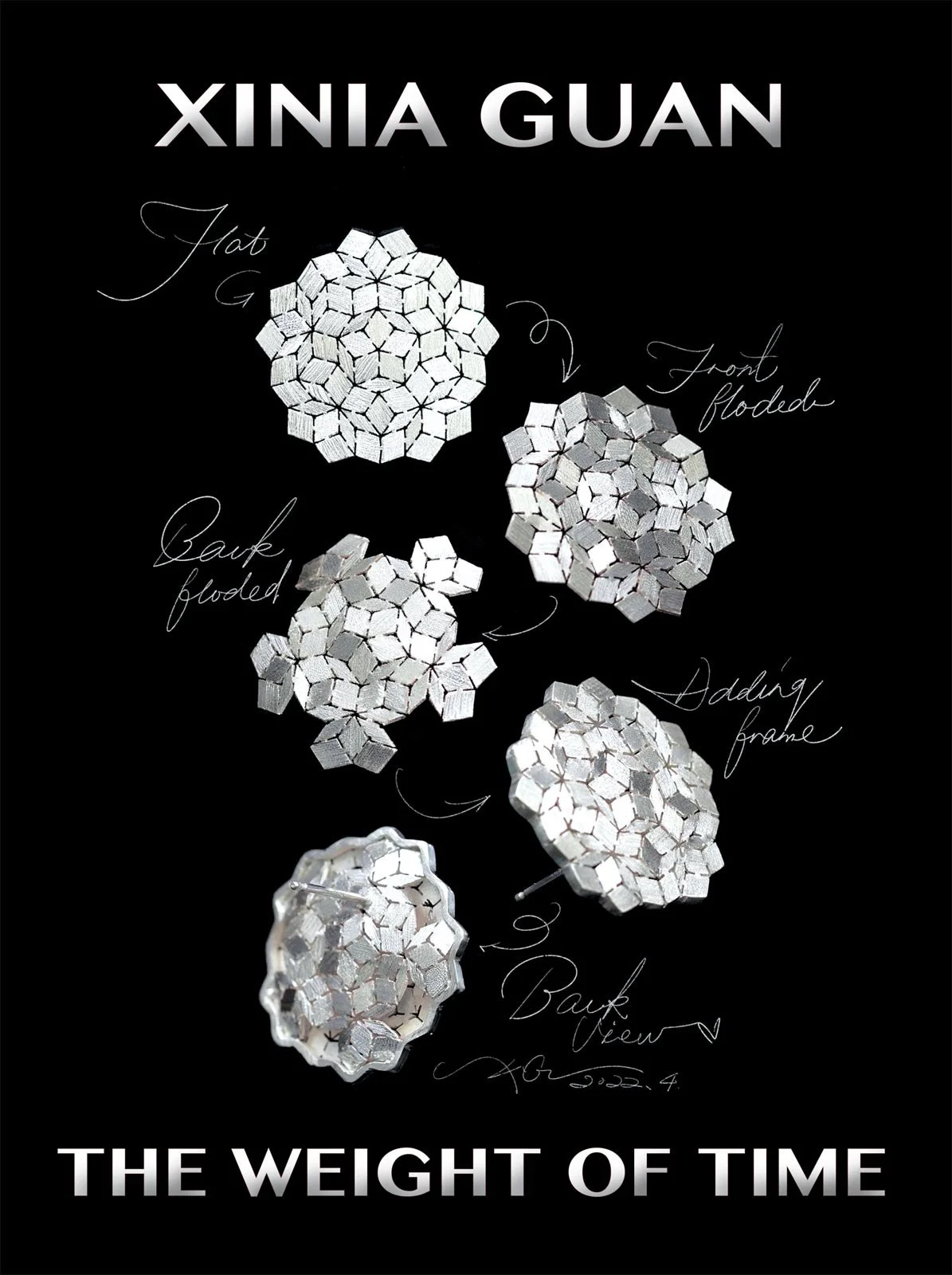
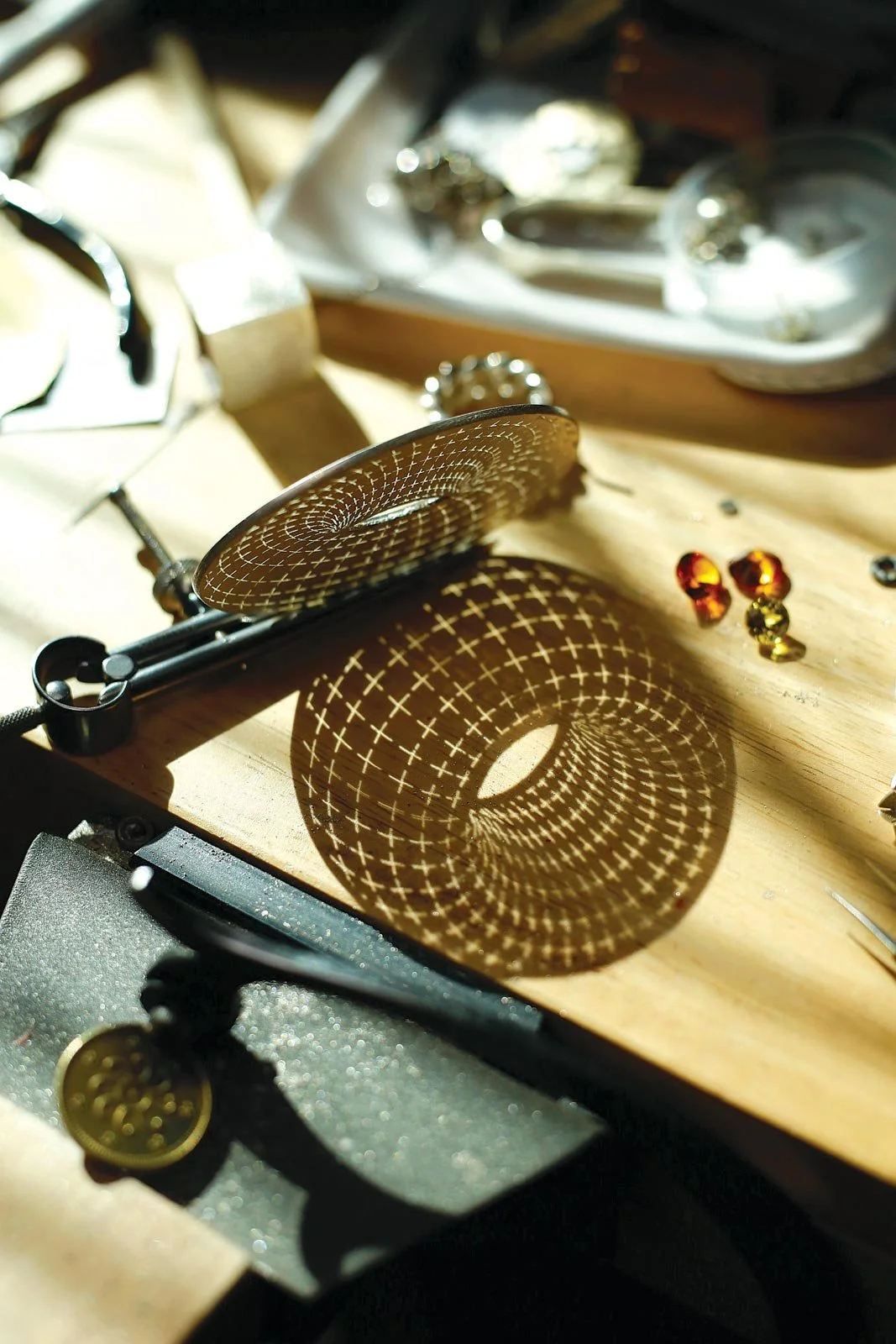
WORKING PROCESS of sterling silver, hand sawing, hand-fabricated, 2.7 x 2.7 x 2.0 centimeters, 2022. Photographs by Xinia Guan.
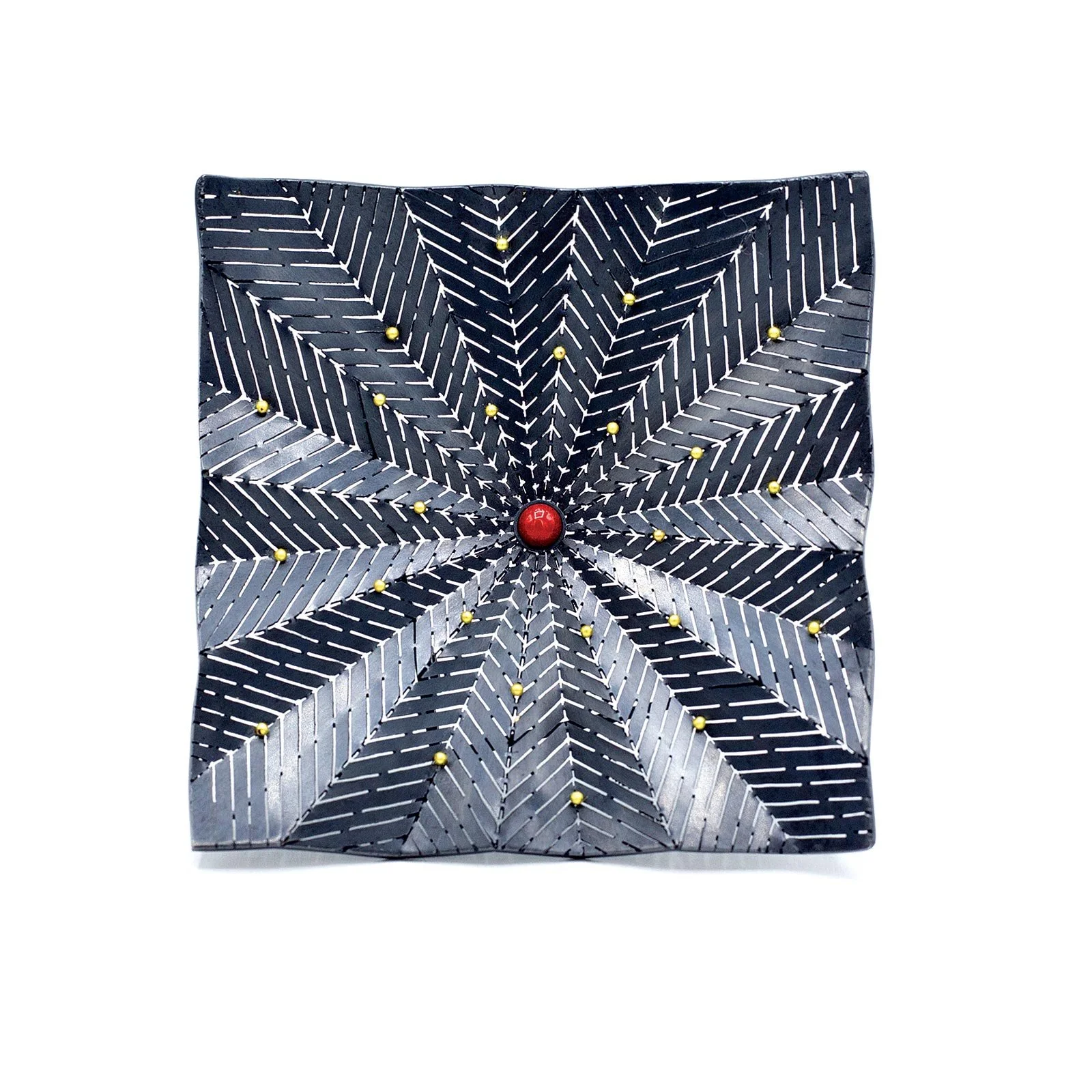
CAPTURE T of sterling silver, FW black pearl, stainless steel (pin), hand sawing, hand-fabricated, 6.2 x 6.2 x 1.1 centimeters, 2021.
ONE YEAR of silver saw dust collected for one year, brass, hourglass, 32.0 x 12.0 x 12.0 centimeters, 2020.
The carefully crafted object One Year, consisting of a double-lobed glass chamber set on a black metal stand and contained within a pivotable wire cage, is unmistakably an hourglass, and as such it provides a productive entrée to the art and thought of metalsmith Xinia Guan. Although not in itself an example of wearable art, One Year is intimately connected to Guan’s work as a jeweler and equally to her jewelry as works, both labor and its products being inseparable from time (albeit time as construed from different points of reckoning). In One Year, two constructions of time—linear time conceived as duration and non-linear time reified as material quantity—are presented simultaneously, making the hourglass a dual-purpose chronometer. The grains may flow from one chamber to the other over a fixed number of minutes, but One Year, just as accurately and just as concretely, represents what its title suggests: the contents of the hourglass being a physical form of synecdoche effected through the accumulated silver dust from every piece on which Guan worked by hand over a period of twelve months. “It’s what remains with me,” she explains. “It reminds me of every single moment I was standing or sitting at the bench creating. It’s solid evidence. You can see the weight of time.”
A key thesis piece, One Year was produced during Guan’s final term as a graduate student at the Savannah College of Art and Design (SCAD), where she earned her MFA in jewelry in 2020, but its conceptual roots stretch back to her reflections on both philosophical and psychological formulations of time as an undergraduate double-majoring in Chinese language and literature at Inner Mongolian University. Perhaps most important for the time-conscious work that Guan produced as a graduate student, however, was her past experience as a photographer, which included several years of freelancing in China.
Specific commissions—documentation of a rock band, for example, or representations of classic cocktails for a bar—were personally revelatory. “The camera,” she asserts, “is a door. Through it you can enter a completely new field.” More important, it is a means to “remember things, beautiful things in life: to memorize a specific moment in time.”
CONTEMPLATION SERIES EARRINGS of sterling silver, twenty-four karat gold, plated sterling silver, hand sawing, hand-fabricated, 2.7 x 2.7 x 2.0 centimeters, 2022.
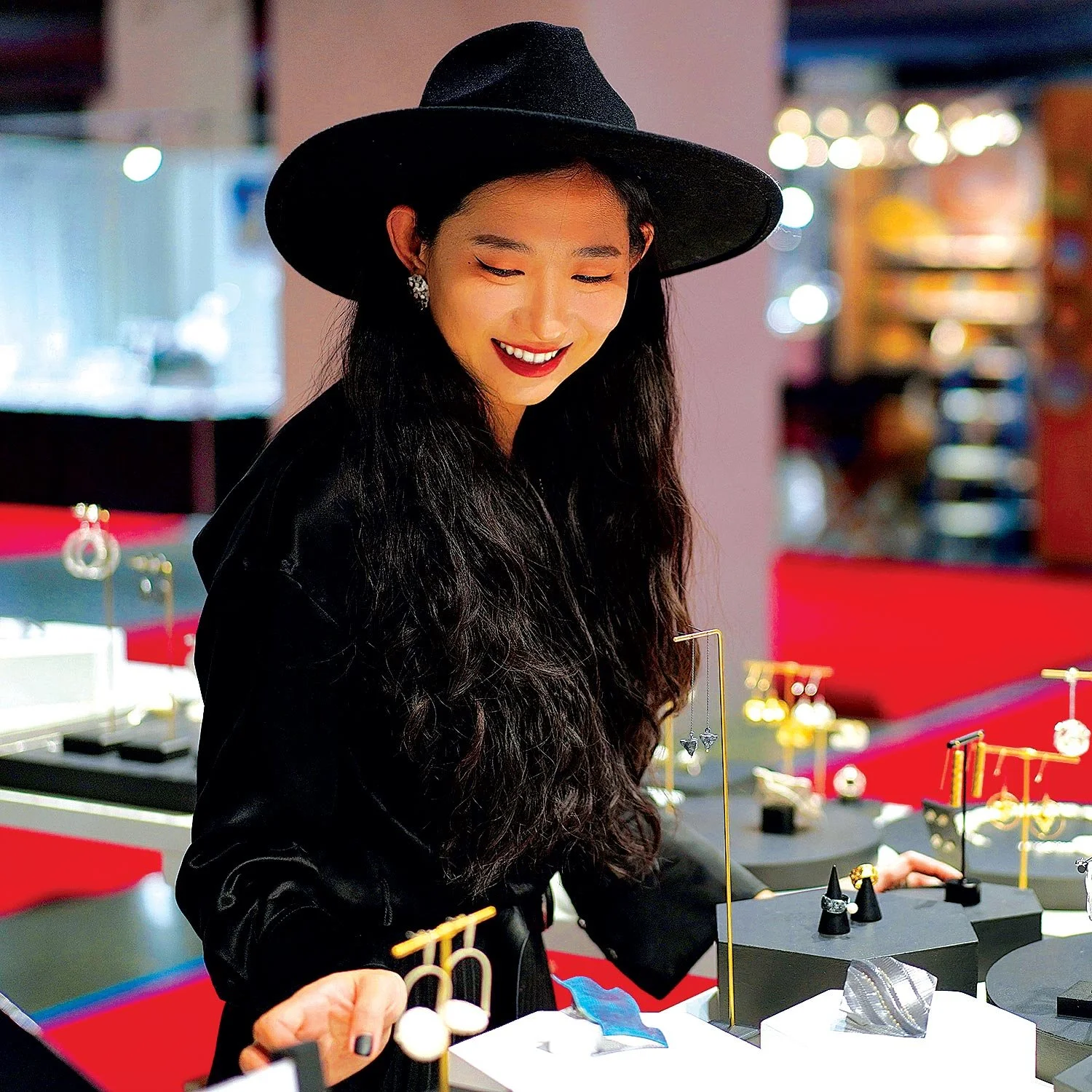
XINIA GUAN at the Philadelphia Museum of Art Contemporary Craft Show in 2022.
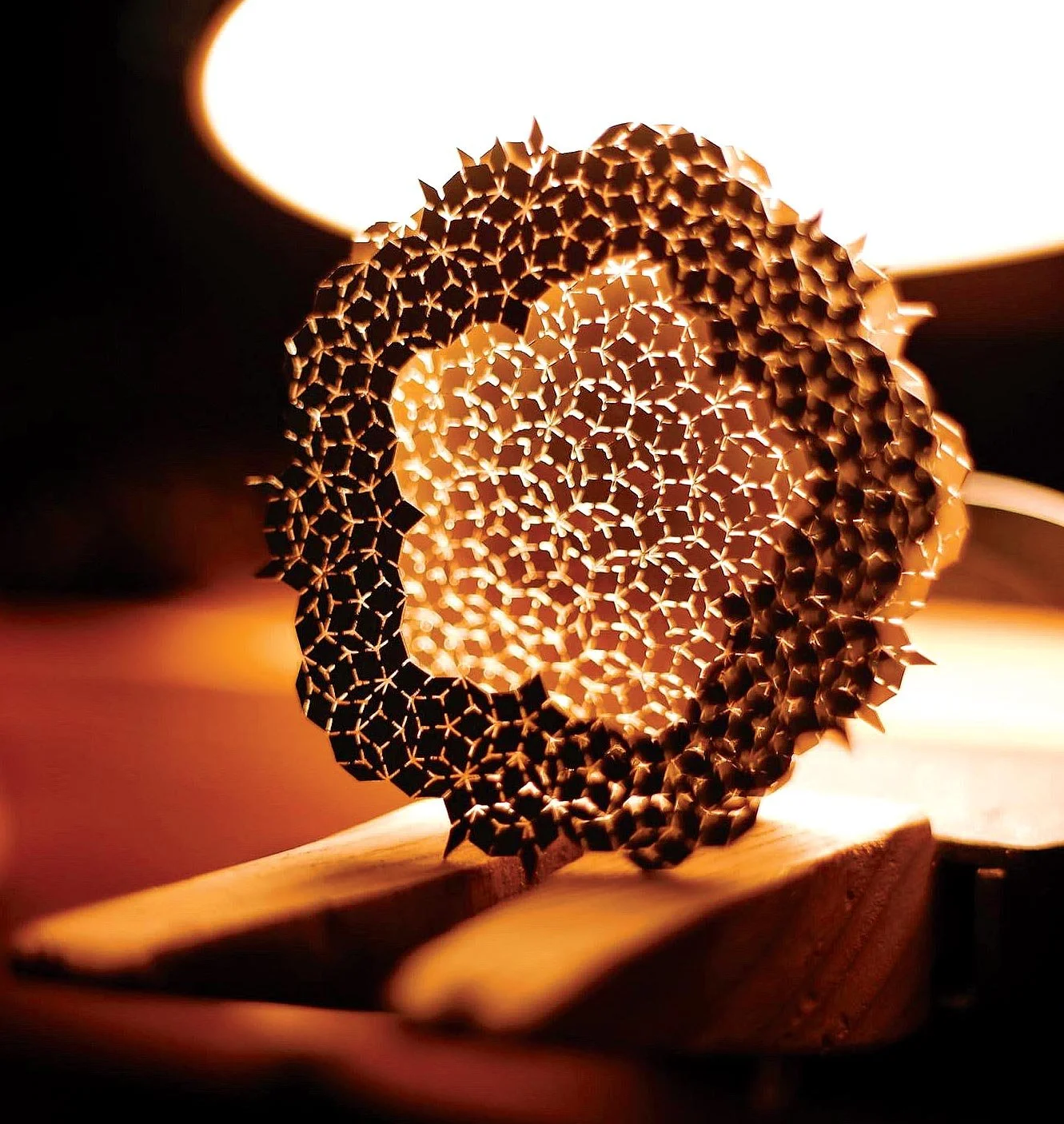
The series Capture, a collection of brooches begun in 2019, is about this ability of the camera to encapsulate moments, a function that links it to impressions of ephemerality and absence—what Roland Barthes famously described as the photograph’s “having-been-there” quality—and so to feelings of nostalgia, even melancholy. Photographs, Guan notes, are evidence of what has been lost in the passage of time, and “as for the sound of the shutter, it happens so fast and exists so temporarily it is reminiscent of our existence.” The initial brooch in the series, composed of eight convex triangles arranged with their points forming an octagonal opening, might at first glance seem a straightforward representation of the aperture of a camera lens, but recognition of a hint of pathos and the evidence of time make it a wistful, contemplative piece. Seven of the triangles are bright sterling silver, but the eighth is oxidized, not only imparting to it a more somber shade but also reflecting a change from a previous state that is irrecoverable.
Contextualizing this change and its hint of mortality in the medium of time are the myriad linear piercings, all done meticulously by hand over a span of countless hours, that together form a regular pattern of diamonds. Each of these diamonds has been individually and painstakingly bent along its major axis in a process that Guan compares to folding origami—with one significant difference. “The sheets I’m using are 24 gauge silver,” she explains. “It’s really thin metal. If you bend it back and forth multiple times you’ll break it. So, in order to bend all those small sections I needed to anneal it constantly. I can’t remember how many times, probably hundreds.”
FLATLAND III of sterling silver, eighteen karat gold, stainless steel (pin), hand sawing, hand-fabricated, 6.2 x 6.2 x 1.6 centimeters, 2021.
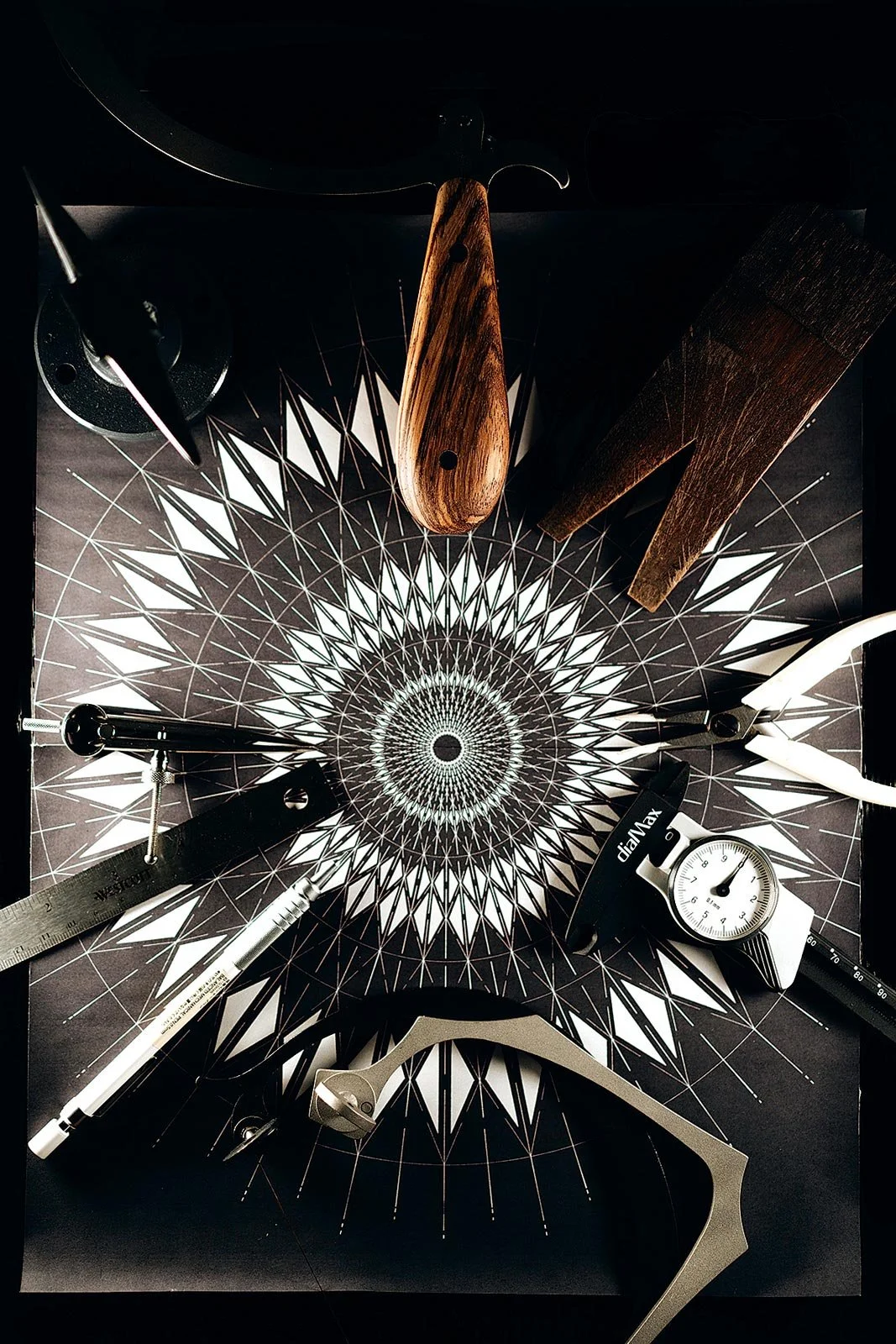
While later brooches in the Capture series have largely retained the diamond pattern of piercing, in a series titled G (for Guan), begun concurrently with the Capture brooches, the piercings are based on the ancient pattern of overlapping circles known as the Flower of Life. While its first documented appearance is on the threshold of the palace of an Assyrian ruler in the 7th to 6th century B.C., the pattern also occurred historically in ancient Roman mosaics and Islamic and Gothic architecture. Today it is associated with the New Age movement. For Guan, it is not only a pattern with a long chronological history; it is also both spiritual and a symbol of cyclical time, specifically the cycle of life. “The Flower of Life,” she asserts, “extends to four different states. I was thinking about a seed becoming a tree that flowers, and then the fruit comes, containing seeds. Psychologically, I’m creating the work within this circle.” In the brooch G.V, for example, the Flower of Life gives rise to a tremendously complex folded form distinctly floral in appearance, while G.IX, enclosing the pattern in a circular frame, suggests a fruit from which spills a cascade of gold-plated sterling silver seeds, each formed by folding a single unit of the larger pattern. The intent, however, is not so much to represent the seed, tree, flower, or fruit in itself as to emphasize the transformation between them. “The pattern,” Guan notes, “is a flat form, but if you bring it into the three-dimensional world, you can imagine it in real, and specific, reactive forms.”
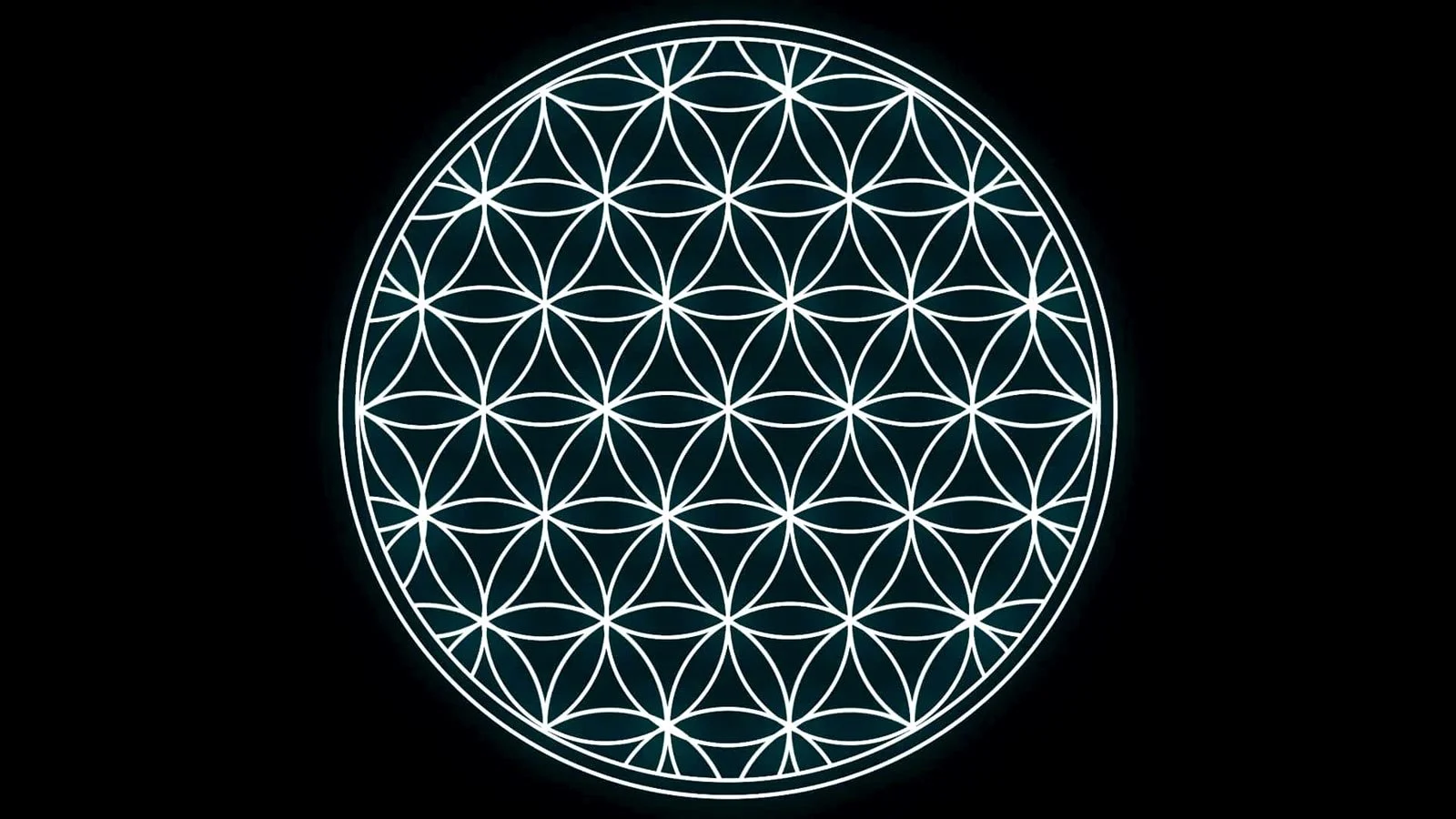
FLOWER OF LIFE PATTERN.
CAPTURE IV of sterling silver, eighteen karat gold, stainless steel (pin), hand sawing, hand-fabricated, 6.7 x 6.7 x 1.4 centimeters, 2020.
Click for Captions
FLATLAND RED of sterling silver, ceramic coating, stainless steel (pin), hand sawing, hand-fabricated, 7.0 x 5.2 x 1.2 centimeters, 2024.
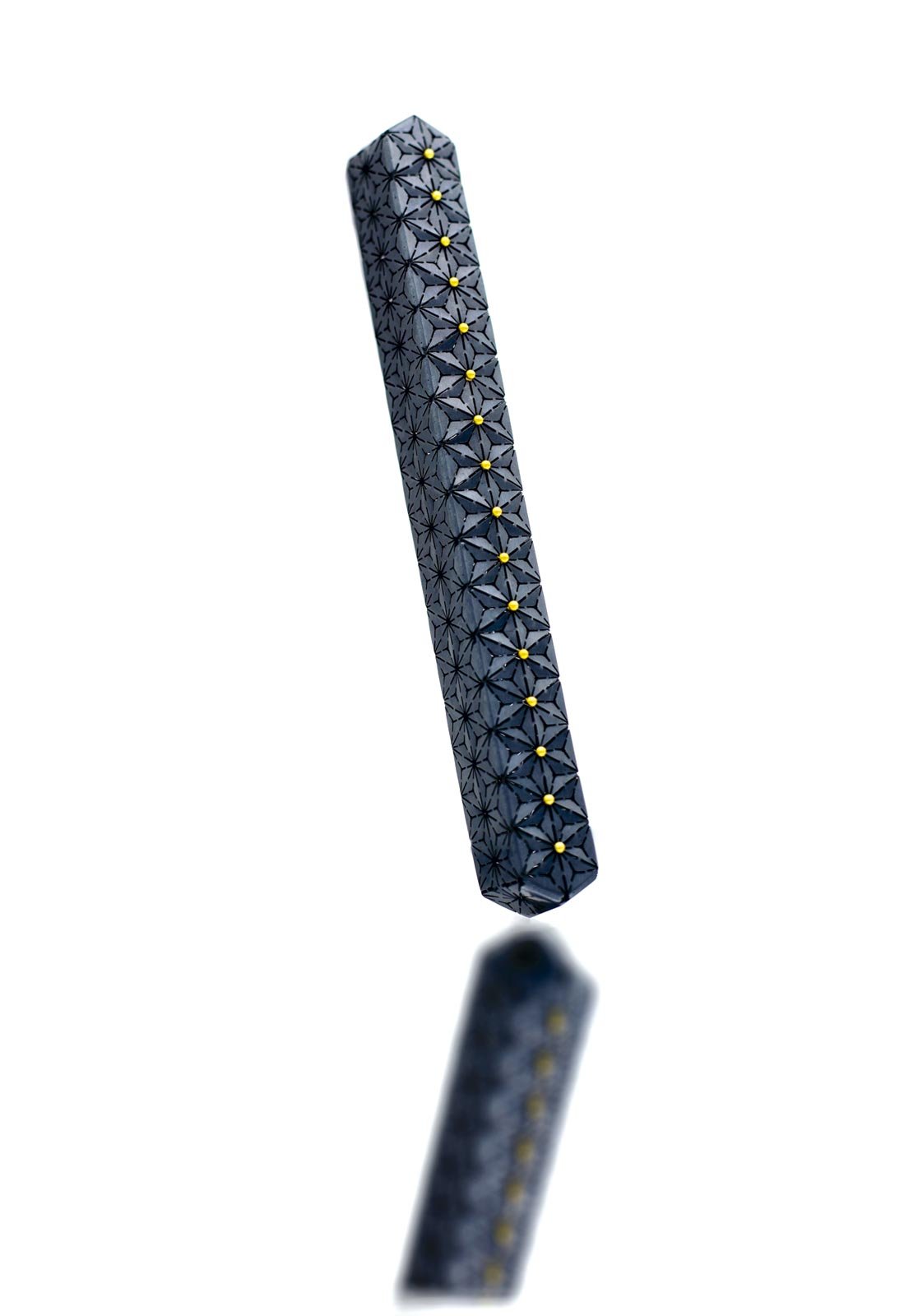
The process of transformation from flat pattern to three-dimensional form, one that Guan describes as a “Jewelry 101 issue” (in reference to the content of classes she currently teaches at her graduate alma mater), is central to a series of brooches that she began in 2020. Conceptually, her Linear series employs the transition from two to three dimensions principally to comment on a particular sense of time, one more expansive than the metaphor of an arrow: “a yesterday, today, and tomorrow, where you can’t go back and forth.” While that may hold true materially, Guan questions whether time is actually experienced that way, given that through memory and anticipation, the mind constantly collapses the past and the future into the present. Moreover, in the terms of geometry, a line is an infinite series of points, any two of which define the line. As geometric points have no dimensions, a line, line segment, or ray has length but no width or depth. “That’s not how I feel time is,” Guan says. “I feel like I’m a scavenger in the flow of time. I capture everything that I can and feel everything is flowing through me. So, when I think about a piece of work I’m usually not just thinking about the hundreds of hours. It’s about the sounds, the music I’m listening to while I’m sitting at the bench, the memories of the books I read, the people I talk with, the food I eat. It’s really, a combination: a package of things during that time.” That package, she asserts, has width and depth and weight, because it is not merely a line, nor is it an empty box. Linear II, a bar-shaped brooch, is exemplary of how this conception of time permeates the series. Begun as a flat sheet pierced with a pattern composed of line segments, it is itself a line segment (implicitly a temporal unit, a period in time) but one that possesses width and depth as well as length and, through its multiple facets and its tiny gold appliqué beads, presents a complexity suggestive of that period of time experienced as a multi-dimensional plethora of sensory information.
For all its conceptual exploration, the Linear series remains tied to what Guan considers a conventional train of thought and a correspondingly conventional step-by-step process typical of jewelry making. She notes that she teaches students in the same way that she was taught: “We show them how to move from 2D to 3D, from hand renderings and thinking about ideas to applying the technique and creating a 3D object.” In a series titled Flatland, however, she has perfected a technique that, in effect, reverses that process, making the illusion of three-dimensionality conform to physical two-dimensionality. In part, the inspiration for the Flatland series came from a novella by the same name, Flatland: A Romance of Many Dimensions, authored by Edwin Abbott Abbott under the pseudonym “A Square” and published in 1884. A satirical commentary on social hierarchy in late Victorian England, the story is an allegory related through geometry. “I’m a bookworm,” Guan confesses. “I read a lot, and that’s an important part of my resources, my inspiration. After reading that book, I realized how much training in school teaches you to draw if you have an idea. With a paper and pen, you’re drawing and thinking about a way to involve technique and bring everything into 3D. I thought, why not push backwards?”
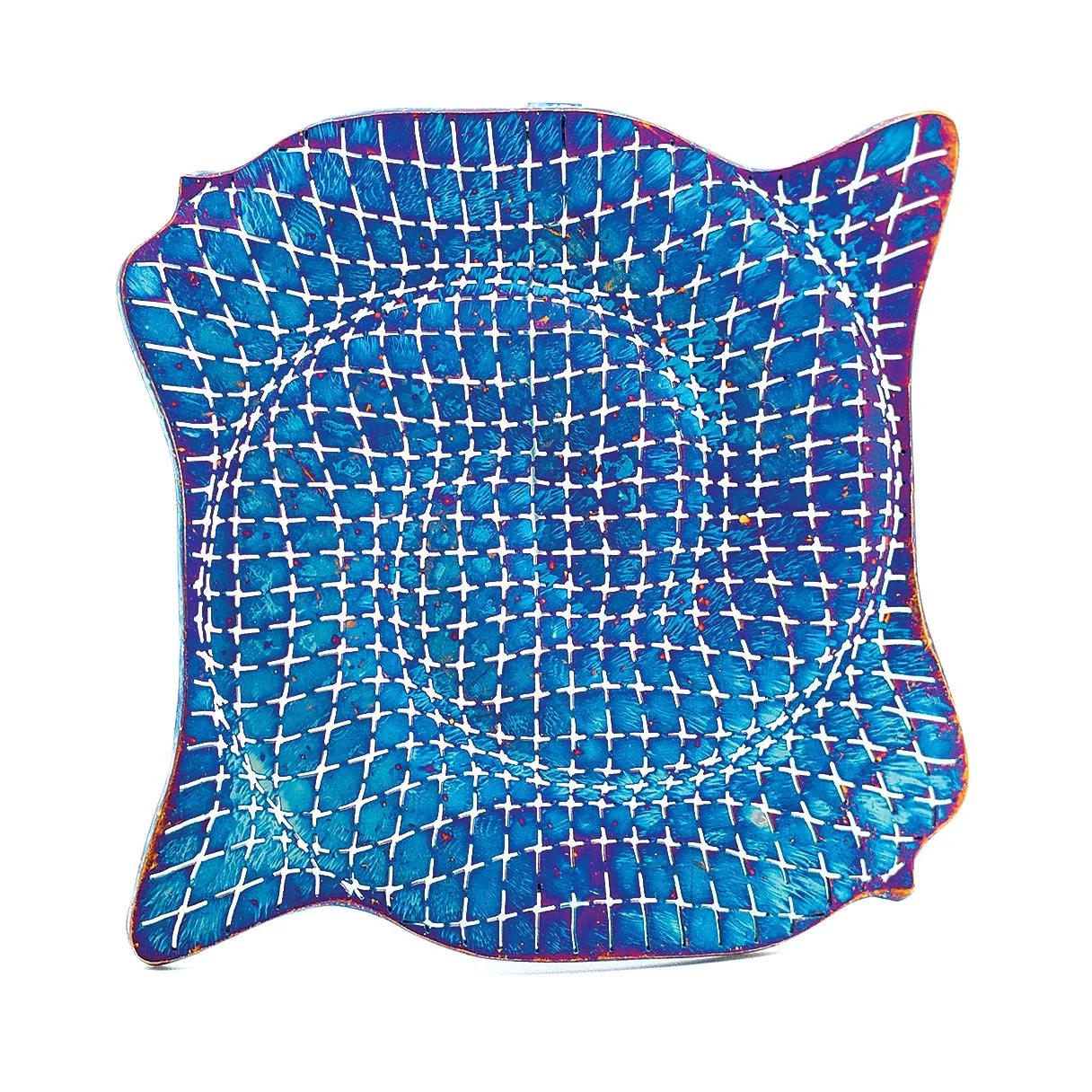
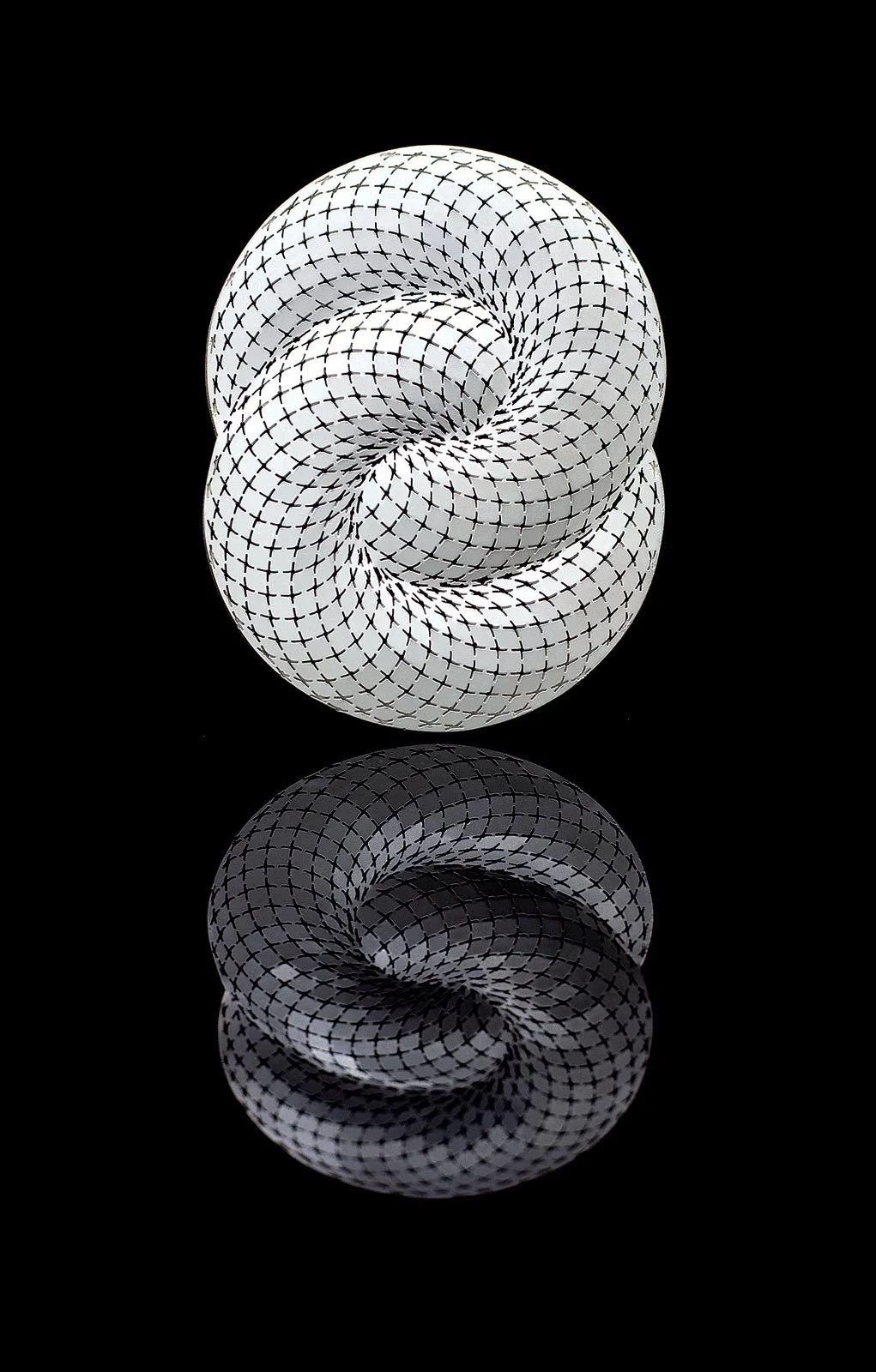
While such a reversal might have been achieved by various means, Guan’s technique is every bit as precise and demanding as her hand-piercing has always been, and the results of her meticulous craftsmanship are so extraordinary that anyone who first encounters a brooch from the Flatland series through a photograph is bound to be snared by its carefully set trompe l’oeil effect. The brooches appear robustly rounded but in fact are flat planes. Flatland II, for example, represents a torus, or doughnut shape, viewed obliquely. Flatland IV is even more audacious in its illusion, appearing to cut open the torus to provide a glimpse into its hollow interior.
Such an effect in an oil painting—where perspective is a matter of draftsmanship and chiaroscuro can be introduced with a few flicks of a brush—would be perfunctory, but achieving a comparable effect on a flat sheet of silver is no simple task. The hand-piercings must be precisely configured so as to produce the effect of foreshortening (in these works an effect aided by Rhino design software) and the appearance of shadow on a curving surface is created by means of oxidation, in the case of these brooches a process that imparts to the surface both tone and color. “The extremes of oxidation are black and white,” Guan explains, “but in between, the reactions—due to different times, different temperatures of sulfur solutions, different thicknesses of solutions—can produce a rainbow of colors. That’s where the purplish color comes from. I can control it sometimes, but it’s not really a one-time result. If the colors don’t look uniform, I need to burn down everything and start over.”
Enthusiasm for developing such techniques remains central to Guan’s approach to jewelry. For example, the challenges presented by a recently initiated series of necklaces composed of hollow pierced-patterned links bent from flat sheets of sterling silver were met with the creation of a template so technically complex that Guan could only design it with a software program called Processing, the use of which proved so complicated as to require a ChatGPT-aided crash-course in coding. The actual execution of the linked pieces, however, is still faithfully carried out by hand in the meticulous and laborious manner that situates Guan’s work so conspicuously within the medium of time. She is, after all, only half way toward a goal conceived back in 2020, a commitment always to acknowledge the weight of time. “Everyone has to think about how they spend their life,” she observes, “and I’m happy to be a lucky one finding the sweet spot, being able to involve myself constantly in my practice. The dust is the core. My goal to have a ten-year solo show, and when you walk into the gallery, you’ll see ten different forms of hourglass. Inside them will be the evidence of how I spent my first ten years as a professional artist.”
SUGGESTED READING
Shershow, Leslie. “FLOW: Searching for Infinity.” Metalsmith: 42, No. 1, 2022.
Click For Captions

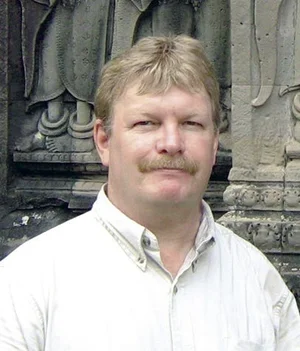
Glen R. Brown is a professor of Art History at Kansas State University, and writes in this issue about the labor-intensive jewelry of Xinia Guan, who, despite her reliance on computer-aided design for planning some of the structurally challenging aspects of her recent work, remains firmly dedicated to a meticulous technique of piercing and bending by hand. “So much of contemporary innovation in productivity is geared toward reducing the human component, regardless of what’s lost as a consequence,” Brown says, “that Guan’s willingness to commit long periods of time to her work, and to make that commitment an enriching aspect of her experience, is impressive.” He found the exhibition “Second Skin: Exploring Adornment as an Extension of Self” at Belger Arts, in Kansas City, Missouri, to be something of a reunion, as he remembered one of the works on display: a 2011 piece made by Shae Bishop, a student with whom he held a studio critique at the Kansas City Art Institute in 2012. “One of the best rewards for a long career,” Brown says, “is when you get to see your predictions about young artists’ futures proved right!”