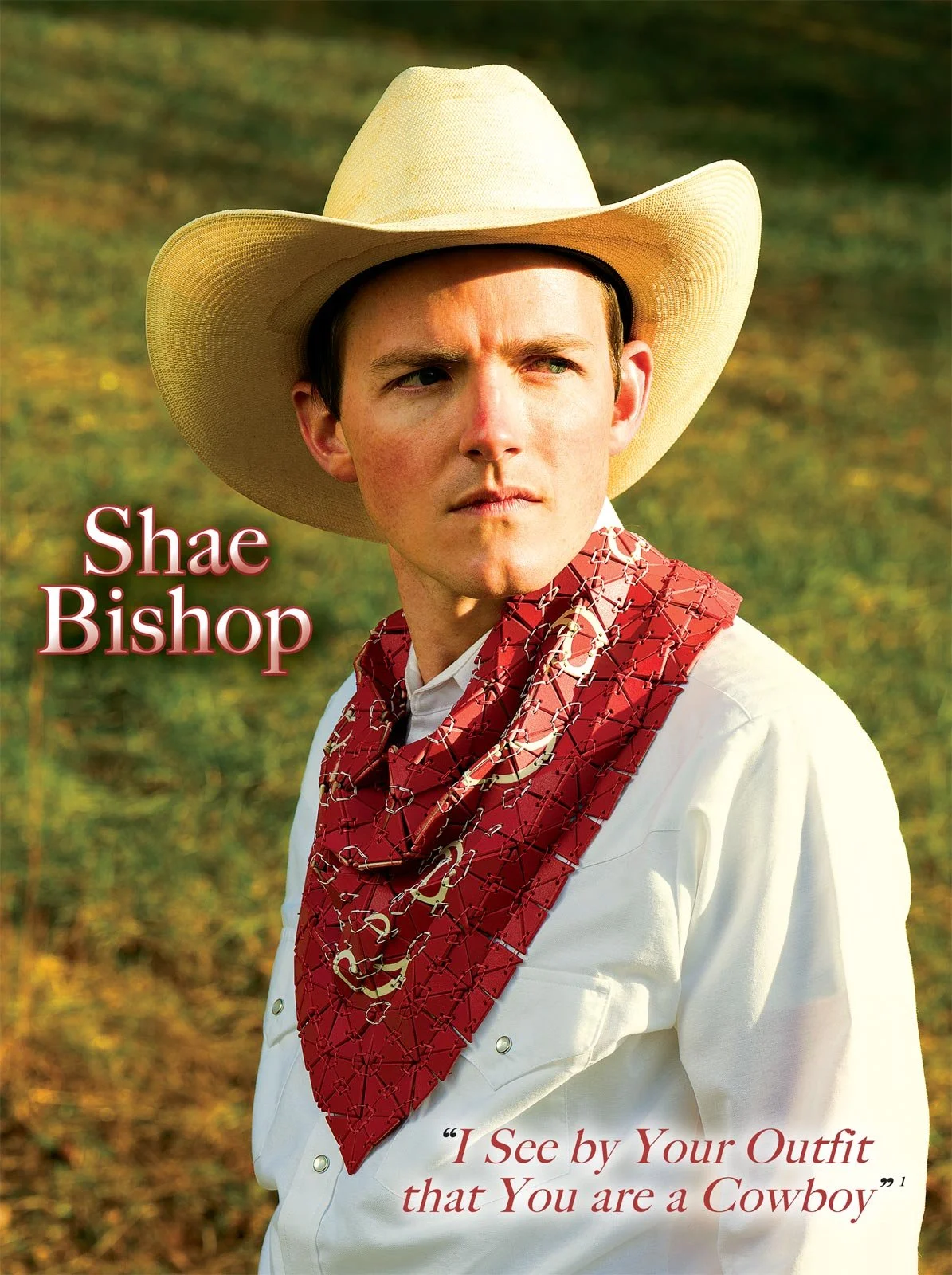
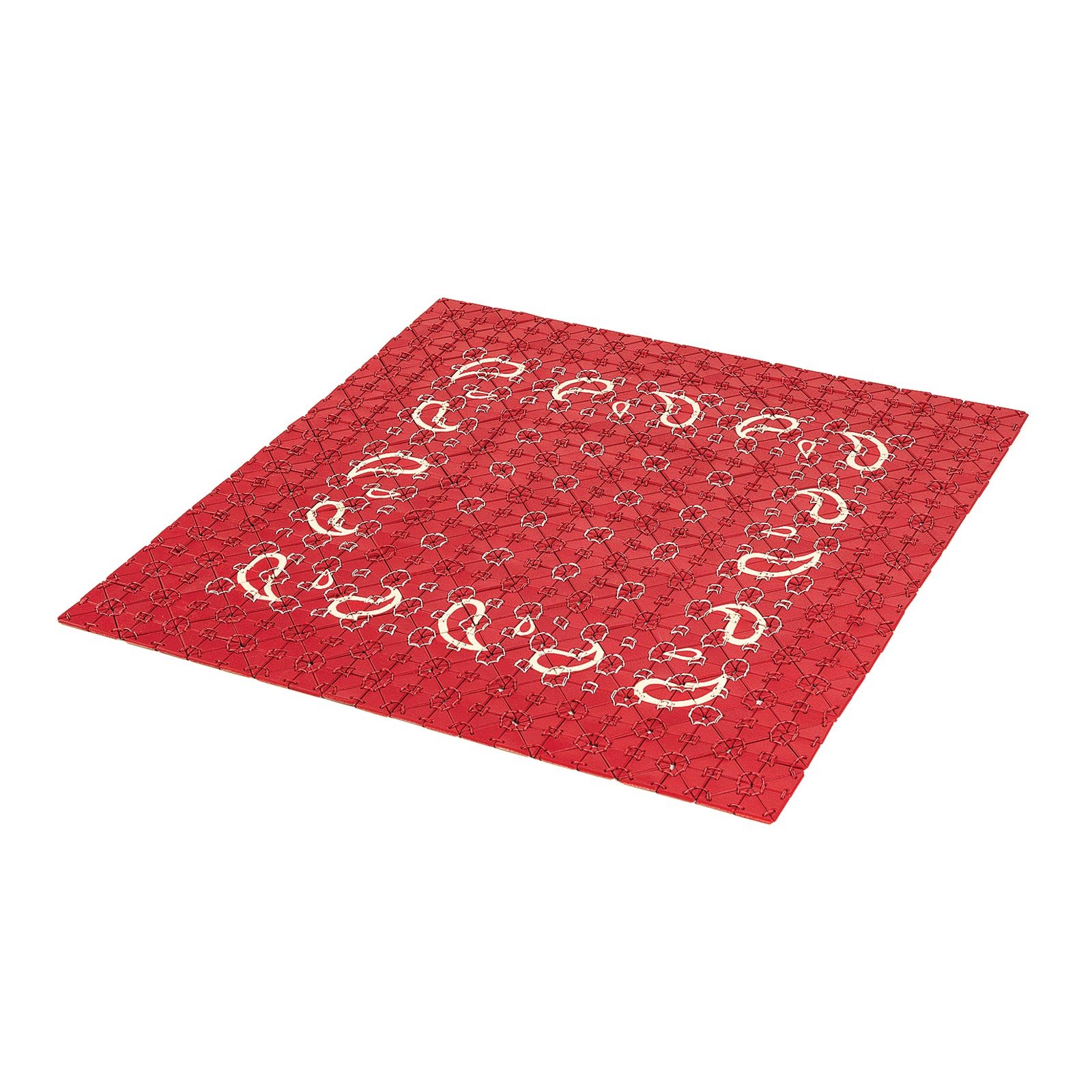
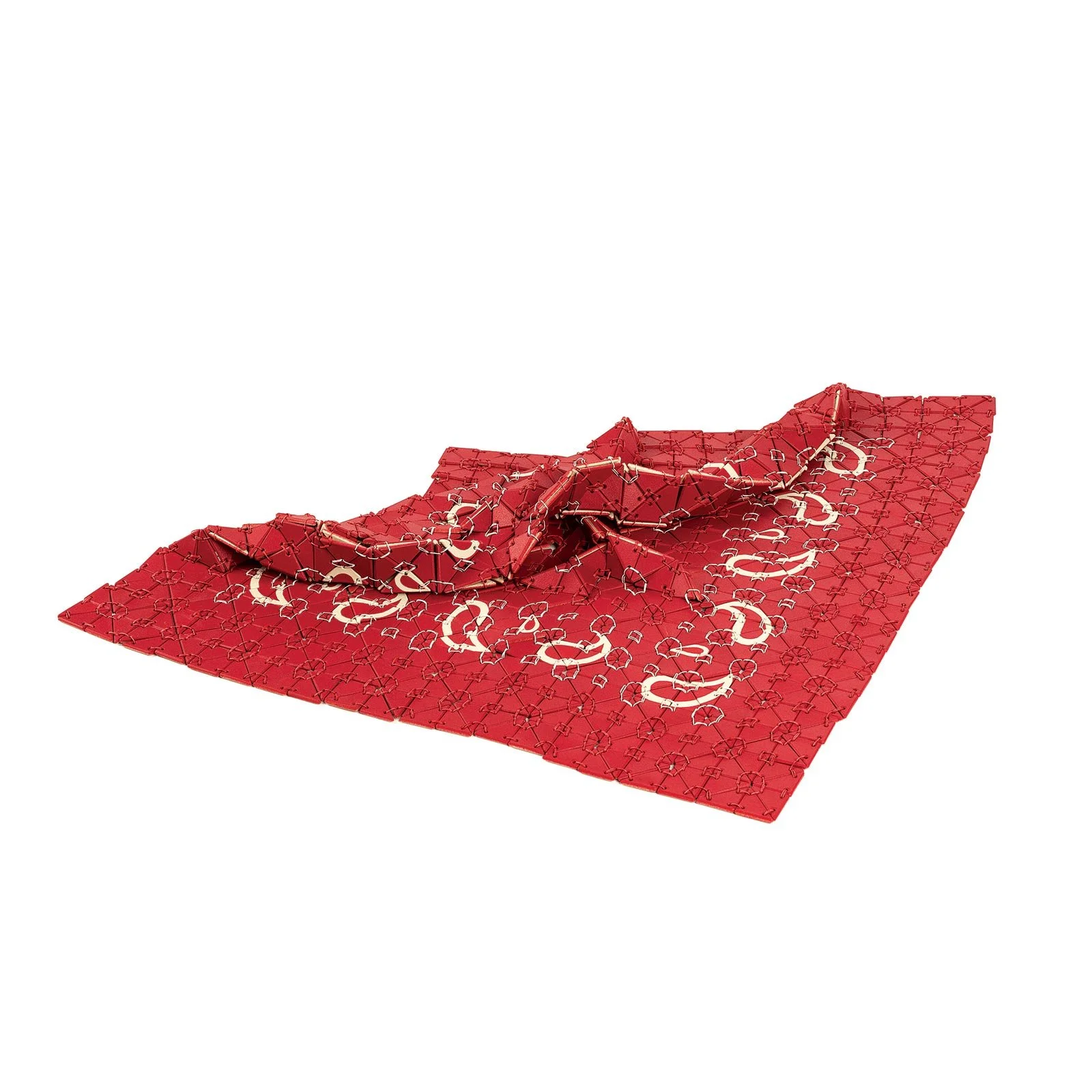
BANDANA of ceramic, underglaze, PE fiber, 50.8 x 50.8 centimeters, 2022. The Bandana is made up of 1600 handmade triangular tiles, stitched together through tiny drilled holes. Photograph by Loam.
The iconic image of the American cowboy is, indeed, pervasive. Not only does his outward appearance spring immediately to mind, but he represents masculinity, heroism, individualism, chivalry, and common sense. Revisionist history has brought reality to the image by way of documenting what life was, and is, really like on the range and by debunking the heterosexual, racist, and misogynist tropes that surround the cowboy. Nevertheless, the myth refuses to die as seen in current cinema and television (e.g. Yellowstone), advertising (Louis Vuitton Menswear Fall/Winter 2024-2025), and long-standing journals like True West Magazine.
The icon can be mesmerizing, as it was for Shae Bishop when he attended his first rodeo. Despite being born in Tennessee and raised in Kentucky, it was not until Bishop was an artist-in-residence at the Archie Bray Foundation in Helena, Montana, in 2017, that he observed bull riding and bronco busting. He says, “I saw all these guys walking around with tight-ass jeans and big decorative belts, shiny buckles and colorful shirts. It made me think about some of the contradictions that are inherent in historical and contemporary cowboy masculinity.” 3
Over the next few years Bishop considered how to express these thoughts and address the love/hate relationship he has with some of those stereotypes. He smiles as he gives an example: “I love my big old pick-up truck but I am also cognizant of global warming and the climate crisis caused by America’s lust for petroleum products.” Thus, fully aware of his own inconsistencies, it would be fair to say that the cowboy commentary that resulted from his reflections in his ‘Fragile Masculinity’ series should be read as statements rather than criticisms. And those statements are made in a highly unusual medium: ceramic wearable art.
You’re a bronc fighter by the looks of your clothes
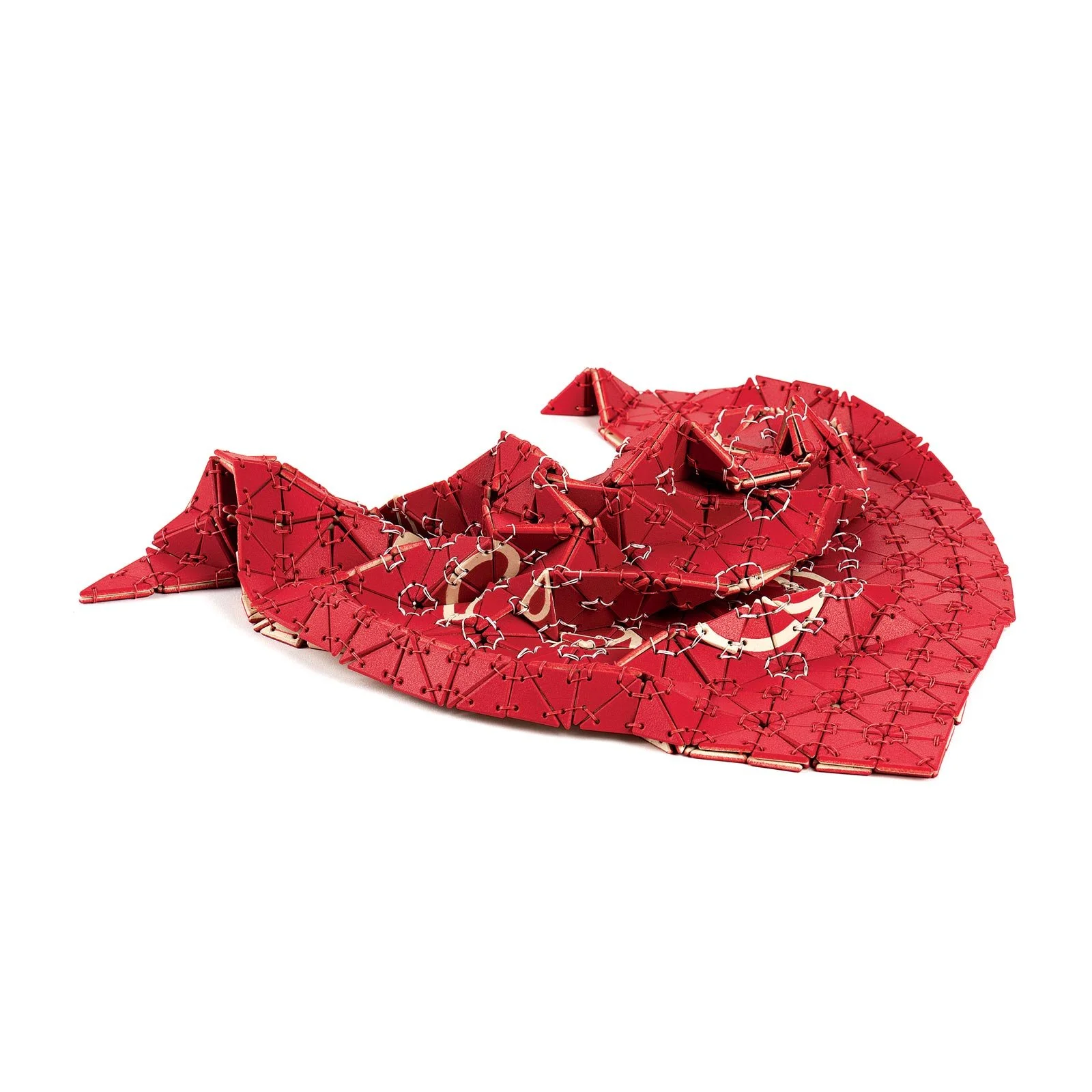
GARDEN VARIETY COWBOY of ceramic, underglaze, sterling silver findings, 38.1 x 30.5 x 12.7 centimeters, 2021. This hat references the history of flamboyant florals in fancy western suits. Photograph by Loam.
The mental picture of the cowboy as stated above—hat, boots, bandana, chaps—contains orthodox materials. The hat, if pricey, is made of beaver pelt; boots and chaps are of leather; the neckerchief is cotton with a paisley pattern. For Bishop, however, since his medium is ceramics, the regalia (except for boots) are made of porcelain. He started with the hat. “In my studio my first challenge was to figure out how to make a very thin and lightweight ceramic hat that I could wear. So I decided to use slip and created a hybrid casting and hand-building technique.” The first one, Garden Variety Cowboy, is a reminder that florals have never been excluded from the Western sartorial repertoire. The painted flowers, butterfly, and reptiles on the brim and crown of Garden Variety, as well as fringe—albeit of ceramic pendants—are motifs that a self-respecting cowboy would wear. It is comfortable, too, weighing around two pounds.
YOU LOOKIN AT ME PARDNER? of ceramic, 71.1 x 30.5 x 12.7 centimeters, 2021. This hat for two cowboys is made by a combination of slip-casting and hand-shaping. Photograph by Loam.
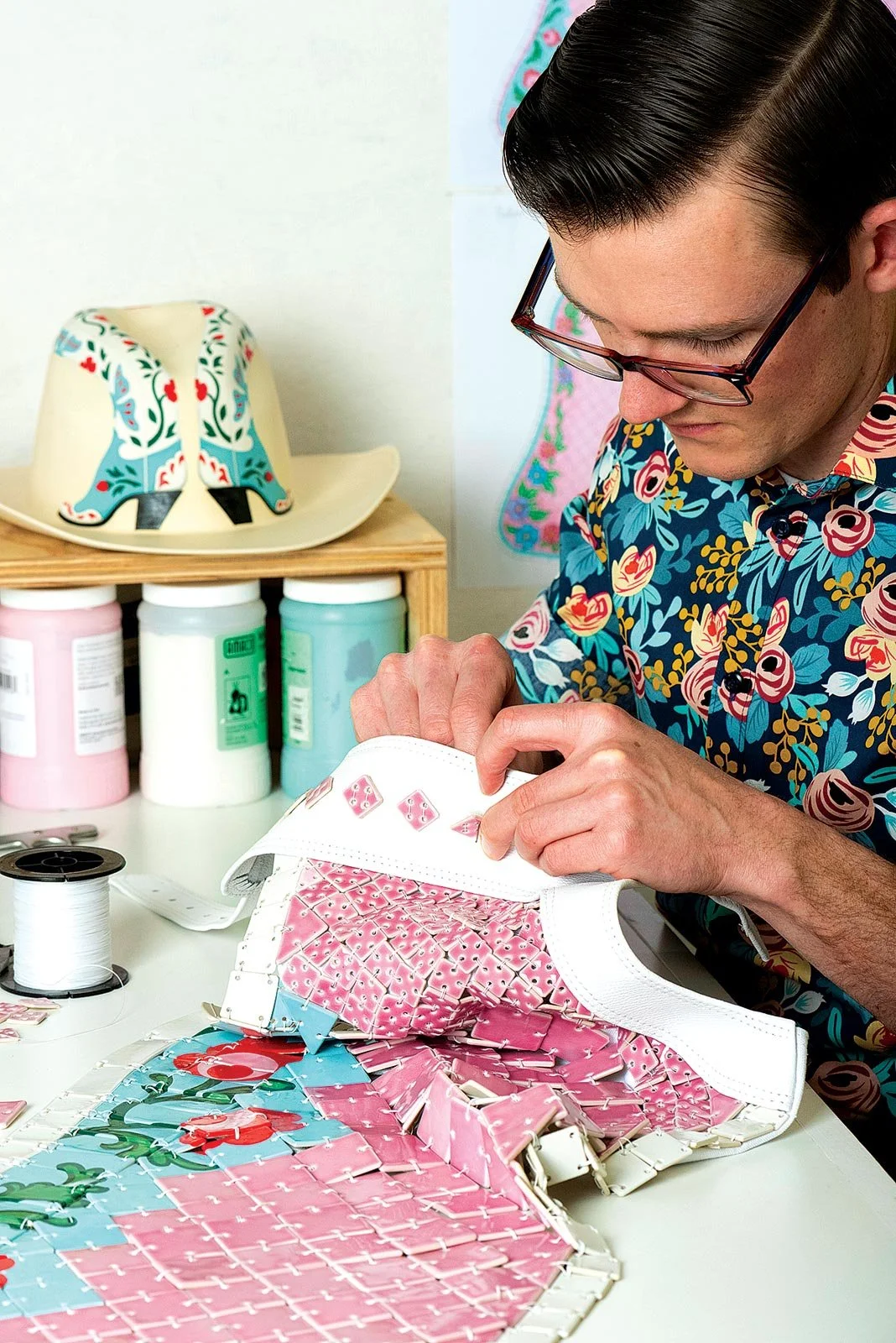
BISHOP AT WORK sewing the chaps for Eternal Cowboy. Photograph by Loam.
Bishop recalls that the hats barely fit into his kiln, with one piece being especially difficult: You Lookin’ at Me, Pardner? This hat duet parodies a gunfight between two tough hombres. As Bishop says, “Eye contact is key. One look from someone can tell if you’re being respected or disrespected. And this is especially important when protecting your fragile masculinity.” The image is humorous at the same time as being social commentary: proximity can either provide resolution or aggravate the situation further. In any case, the viewer is made aware of the wit of the maker and his lampooning of bluff and swagger.
Chaps were Bishop’s next item to explore. The finished pair, part of Eternal Cowboy, which took a year-and-a-half to make, consists of diamond-shaped tiles in pink tones and turquoise tiles with graphic floral motifs forming the flaps. Smaller tiles accommodate movement in the hips and square white tiles on the inner legs segue to leather attachment straps. Bishop sewed the white leather yoke that straddles the cowboy’s waist to which the smaller pink tiles are affixed. The floral motif on the sides of the chaps is repeated in a ceramic belt buckle attached to a white leather belt.
The ease with which Bishop wears his chaps can be seen in a short video shown during his JRA presentation. He draws attention to the soft clink of tile-on-tile as he moves, yet the rigidity of ceramics did not interfere during their ultimate test. Bishop recalls, “My vision from the beginning was to be photographed on a horse, which is the essential place for a cowboy. I wanted the outfit to function with my body but also specifically to function while mounting and riding.” The placidity of Darcy is testament to the fulfilment of the maker’s intent.
Rounding out the cowboy outfit, although not part of Eternal Cowboy, is Bandana. The bandana, as an item of apparel, came to the United States via India and Europe; America imported large quantities of bandanas and some were worn by cowboys to keep the sun and trail dust off their necks and faces. This bandana, made of 1,600 triangular tiles, folds and drapes as if it was a piece of fabric. The design and execution of a rigid material to replicate a pliable one is indicative of patience and persistence.
Like a rhinestone cowboy
Shae Bishop majored in ceramics and art history at the Kansas City Art Institute, graduating in 2012. It was there that he first explored ceramic clothing by making a coat 6 to fit himself. When asked if this choice was related to fashion, he replied,
“Although I was always interested in fashion, I was more interested in historical fashion than contemporary. I loved Alexander McQueen and other amazing big-name designers but I wasn’t deeply into the contemporary fashion world. I think I had a sense that that wasn’t a career path that would be fulfilling to me because I like to work so slowly. The way I make garments is very personal and working with industry and having to make things that are presented in the way of the contemporary fashion world didn’t appeal to me.”
Even though Bishop did not pursue fashion and apparel as a career, several years after completing his tertiary education he decided to set ceramics aside and concentrate on textile practices like weaving, fabric printing, pattern drafting, and designing and sewing his own clothing. The year-long break increased his understanding of fiber materials and honed his garment construction techniques, as seen in the shirt and pants of Eternal Cowboy. In addition, when he was invited to create an exhibit at the John Michael Kohler Arts Center in Sheboygan, Wisconsin, he created a mixed media suit that has several threads of meaning.
First, Rhinestone Rattlesnake Boy is a tribute to Loy Bowlin who, upon hearing Glen Campbell’s song, ‘Rhinestone Cowboy’, in 1975, embarked on the transformation of his persona, clothes, car, and house by means of rhinestones, glitter, and paint. The Kohler Center owns Bowlin’s reconstructed home, as well as other Bowlin artefacts, and Bishop created a fabric and ceramic suit as a homage to Bowlin’s joyful eccentricity. He described the result: “The finished outfit incorporated many different materials. I designed the fabric and had it custom printed and then sewed the garment. Then I cut and dyed leather to create the appliqué which I stitched on [floral patches on sleeves and pant legs]. The hat, tiles and belt buckle are ceramic with over 1,000 rhinestones applied throughout the suit.”
Secondly, the project references the history of cowboy entertainers and promoters from Buffalo Bill, Tom Mix, Gene Autry, and Roy Rogers, to rodeos, country music concerts, and oaters (western films). These references are combined with the phenomenon of reptile attractions—roadside serpentarium, circus sideshow, and rattlesnake roundup—which titillated audiences, converted reptiles into freaks of nature, and fostered fear and the compulsion to eradicate.
As an avid amateur herpetologist, Bishop deplores the negative reputation of snakes. So, what better way to celebrate rattlesnakes than with rhinestones! “I wanted to shift the role of the snake from a nemesis, shocking novelty or pest needing extermination, into the role of hero, an icon and ecological ambassador.” The rattlesnake, complete with segmented tail, appears on ceramic tiles symmetrically on the front of Rattlesnake Boy’s collarless jacket and intertwining on the back. In addition, Bishop draws attention to the hat: “The hat has five different kinds of rattlesnakes. When I am glazing my ceramic hats I use tiny brushes and I build up layer upon layer to create the detailed imagery. I spent over 100 hours glazing this hat.”
Bishop appeared at the Kohler wearing the ensemble; to emphasize his penchant for snakes, he handled a harmless bullsnake which, unfortunately, in its mimicry of rattlers, is frequently misidentified and killed.
His backdrop was ‘The Original Rhinestone Rattlesnakeboy’ tent, with a hand-painted and lettered wooden facade, that contained educational materials about snakes and their habitat. Until September 2026, Rhinestone Rattlesnake Boy, sans bullsnake, is on display on a mannequin replicating Bishop’s body at the Smithsonian’s Renwick Gallery in the exhibition, “State Fairs: Growing American Craft”. Please note that Shae Bishop’s glasses have rhinestones just as Loy Bowlin’s did.
THE ORIGINAL RHINESTONE RATTLESNAKEBOY of ceramic, underglaze, glaze, PE fiber, printed denim fabric, leather, metal findings, wood, paint, canvas, electric lights, over 1,000 rhinestones, 2024. Here, the Rattlesnakeboy engages gallery visitors with his snake sidekick, Rodeo. In addition to the suit and hat, the installation includes a portable tent. Photograph by Jack Mauch.
You can have my girl but don’t touch my hat
Research into cowboy hats unearths their history, art, culture and function. The eponymous Stetson, originally labelled with a graphic of a horse drinking from one, was created in the mid-nineteenth century and quickly gained favor with wearers for its protection in all weathers: John B. Stetson’s first hat was named “Boss of the Plains”. Today hats can be custom-made according to fabric and head size and embellished with laced and beaded brims, decorative bands and linings. Unless you are an afficionado of cowboy hats you would not know that “the nature of the crease in the crown and the shape of the brim creates a unique accent for the person wearing a particular hat.” 8
Shae Bishop’s hats all have a central ridge-top crease, facilitated by using a single mold. Until recently decoration has been applied with paint and ceramic bobbles suspended on silver rings. The Higher the Heels celebrates the return of high heels to men’s wardrobes, as they convey literal stature, confidence, and swagger. Pickup Lines tips its brim to Reba McEntire in her song, ‘I Want a Cowboy’:
I want a down-home, up with the sun rise man,
A pick-up truck driving, bull riding, strong steadied hand,
I want the Wranglers, Stetson, and all that stuff,
I want the real McCoy, I want a cowboy.
Pickup Lines is particularly humorous on its underside. Petromasculinity is a darker take on the truck, as its carbon sootprint wafts over the brim, sullies its edge and leaves residue beneath. The toxic scent of diesel smoke lingers as the red vehicle with its bull testicles suspended from the rear bumper disappears down the sage-brush trail.
DUCK, BUCK AND BASS HATS of ceramic, underglaze, 2026. Photograph by David Hunter Hale.
Beginning in 2026, the hats incorporate sculptural motifs that broaden the activities of the Western lifestyle. Duck, Bass, and Buck relate to self-evident pastimes, although these hats stray into the realm of political craft in that they raise issues about sustainability, depletion of environment, and judicious use of resources. Most obviously, making hats in porcelain means that no animals were harmed. The mallard and largemouth bass species are authentically painted with habitat displayed on the hat’s crown; Buck is more confrontational with the antlers forming a trophy and alluding to machismo and gun culture. Up to now Bishop’s art has been benign in its commentary on social ‘norms’ whereas now, with his establishment in the craft and museum community, he can afford to be overt in expressing values and opinions that are important to his ethos.
Home on the Range
Shae Bishop was raised in a home and schools where making things by hand was valued. He invested that background into his choice of ceramics at the college level and, subsequently, at various work placements and residencies. He teaches workshops and adjunct classes and accepts invitations as a visiting artist, all of which contribute to his becoming more proficient. The gigs, alongside his partnership with Annie Evelyn, a furnituremaker/artist, provide financial resources to ensure that creative ideas and skills continue to develop.
In addition, as part of Generation Y he is concerned about the environment, Western society and the current trajectory of geopolitics. As for where the cowboy theme fits in this mix, Bishop says, “The cowboy work is a facet of some element of me but not who I am by any means. There’s a lot of different things going through my mind simultaneously. We live in a world that has so much darkness, so many problematic things happening. But I also want to be a person who can have empathy and somehow tread the path between devolving into self-hatred and despair for my complicity in the problems of the world and, on the other hand, still have empathy for people that have different beliefs and outlooks from myself. I try to maintain a sense of humor.”
There is still much to explore in cowboy culture but Bishop confesses a burgeoning interest in hand-made shoes and boots. Regardless of which direction the artist chooses, he will undoubtedly continue to trailblaze.
FOOTNOTES
1 ‘Streets of Laredo’ lyrics.
2 Jim Hoy, “Whither Cowboy Poetry?”, Great Plains Quarterly, Vol. 19, No. 4 (Fall 1999), 291-297, 291.
3 Quotations by Shae Bishop come from a JRA Distinguished Artist Series presentation on October 21, 2025 (https://www.youtube.com/watch?v=hEm6-tDJcJg), and an interview with the author on November 26, 2025.
4 Curley Fletcher, ‘The Strawberry Roan,’ 1915. Poem that became a popular song, sung by Gene Autry and Marty Robbins.
5 Glen Campbell, ‘Rhinestone Cowboy’, 1975, song lyrics.
6 For images of Shae Bishop’s Coat and other ceramic garments see Ceramics Monthly, April 2026.
7 Lyle Lovett, ‘Don’t Touch My Hat’, 1996, song lyrics.
8 William Reynolds and Ritch Rand, The Cowboy Hat Book, Layton, UT: Gibbs Smith, Publisher, 1995, p. 17.
9 John A. Lomax, ‘Home on the Range’, 1910.
ETERNAL COWBOY of ceramic, underglaze, glaze, PE fiber, canvas, leather, brass buckles, 2021. The fringed ceramic hat and chaps are very lightweight and make a jingling sound while riding or walking. Photograph by Myles Pettengill.
BISHOP attaching silver findings with ceramic embellishments to Eternal Cowboy. Photograph by Loam.

D Wood earned a PhD in Design Studies (University of Otago) where her research concerned the contemporary craft movement and handmade furniture in New Zealand. She has an MFA in furniture design from the Rhode Island School of Design; her artist profiles and reviews of exhibitions and books have appeared in an international roster of publications including American Woodturner, Ceramics Monthly, Craft Research, Design Issues, Garland, Metalsmith, and Surface Design. She is the editor of and contributor to Craft is Political (Bloomsbury Visual Arts, 2021) and The Politics of Global Craft (Bloomsbury, 2025).