ANNA JOHNSON at her bench.
Artist Anna Johnson has the eye of a naturalist and believes that in the outdoors, “the closer you look, the more interesting it gets.” She sees what others often miss—the beauty in the unfurling of a tiny flower petal, the sparkle of a curious mineral, the gently rounded forms in a rodent’s mandible. And, through her unexpected combinations of stones, metals, and bones, she draws our attention to the natural world as well.
Johnson is just starting the second year of a three-year artist residency at Penland School of Craft. Though she was born and raised in Charlotte, North Carolina, (a large city in the middle of the state) she has lived in the mountainous region of Western North Carolina since she started college in 2007. She completed her studies in metalsmithing at Appalachian State University in Boone in 2012 and moved to Asheville in 2014. American Craft brought attention to her work in 2015, and she has been a professional studio jewelry artist and frequent craft school instructor since then.
Johnson often collects materials for her creations during walks in the woods, and she harvests plants from her garden, striving to be as environmentally responsible as possible. When purchasing stones, she focuses on dealers she trusts to ethically source their offerings. Friends (and sometimes strangers familiar with her work) give her animal carcasses, though she only uses parts from critters that have lived their lives in their native settings. She often buries them in the ground to allow nature’s decomposers to return most of their matter to the earth, leaving nicely cleaned bones for her to dig up.
Instead of using actual leaves and flowers in her work, Johnson employs the lost-wax method of casting to render her finds in silver, gold, and bronze, giving permanence to their ephemeral forms. Working with such thin, fragile materials sometimes leads to imperfect casts, as the metal does not always flow to fill the entire mold; but she does not see anything wrong with that. Instead, she embraces the irregular results that suggest plants nibbled by insects or blossoms slightly weathered by the passage of time. These details help convey a sense of the cycle of life and death, or decay and renewal, that is ever present in her work.
The emotional force of Johnson’s creations recalls Victorian mourning jewelry. She speaks passionately about the impact of seeing the work of jewelers from more than a century ago who incorporated organic material (hair) to remember the lives of loved ones. She marvels at the care with which each strand was handled and is struck by the dedication and love required to make something beautiful and meaningful with that material. She hopes to similarly honor the lives of the animals whose remains she uses in her jewelry.
Click For Captions
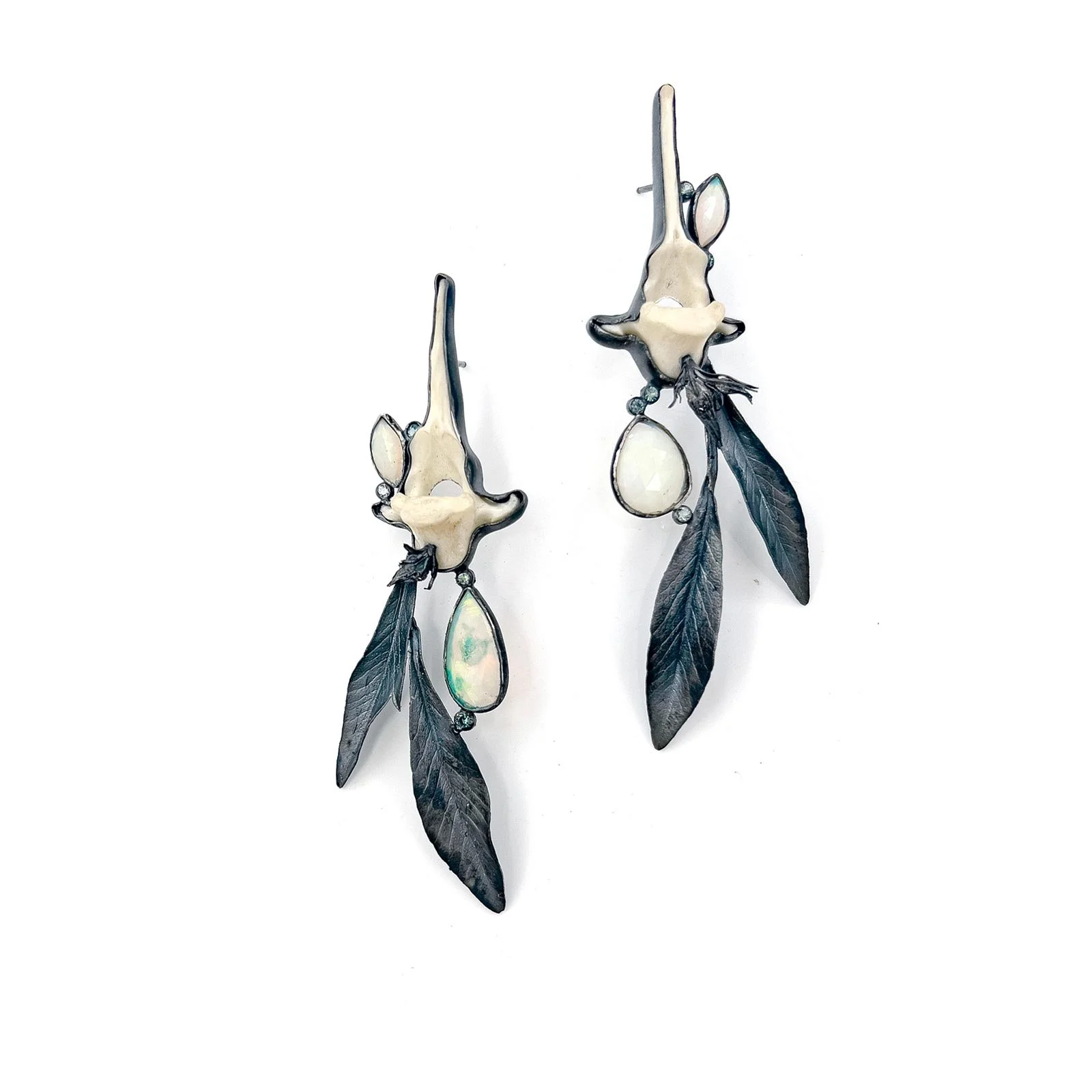
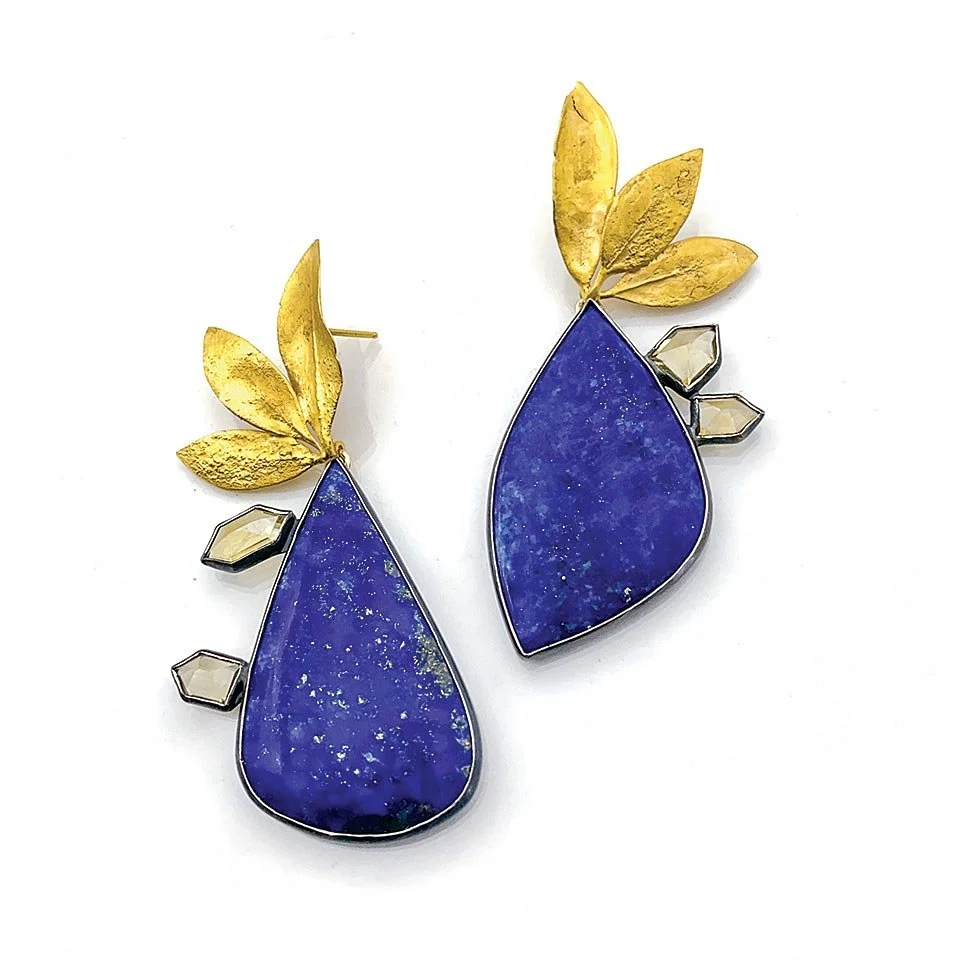
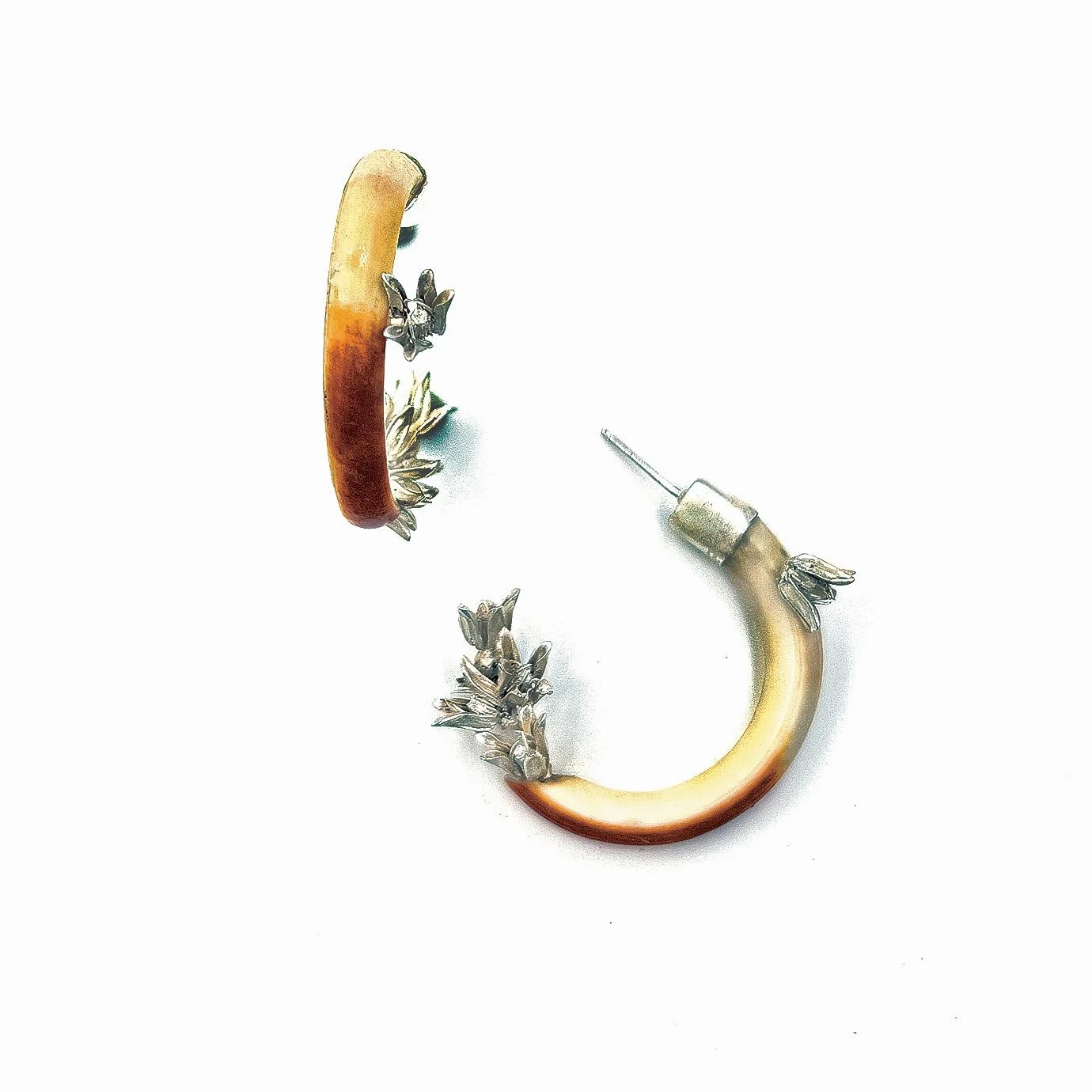
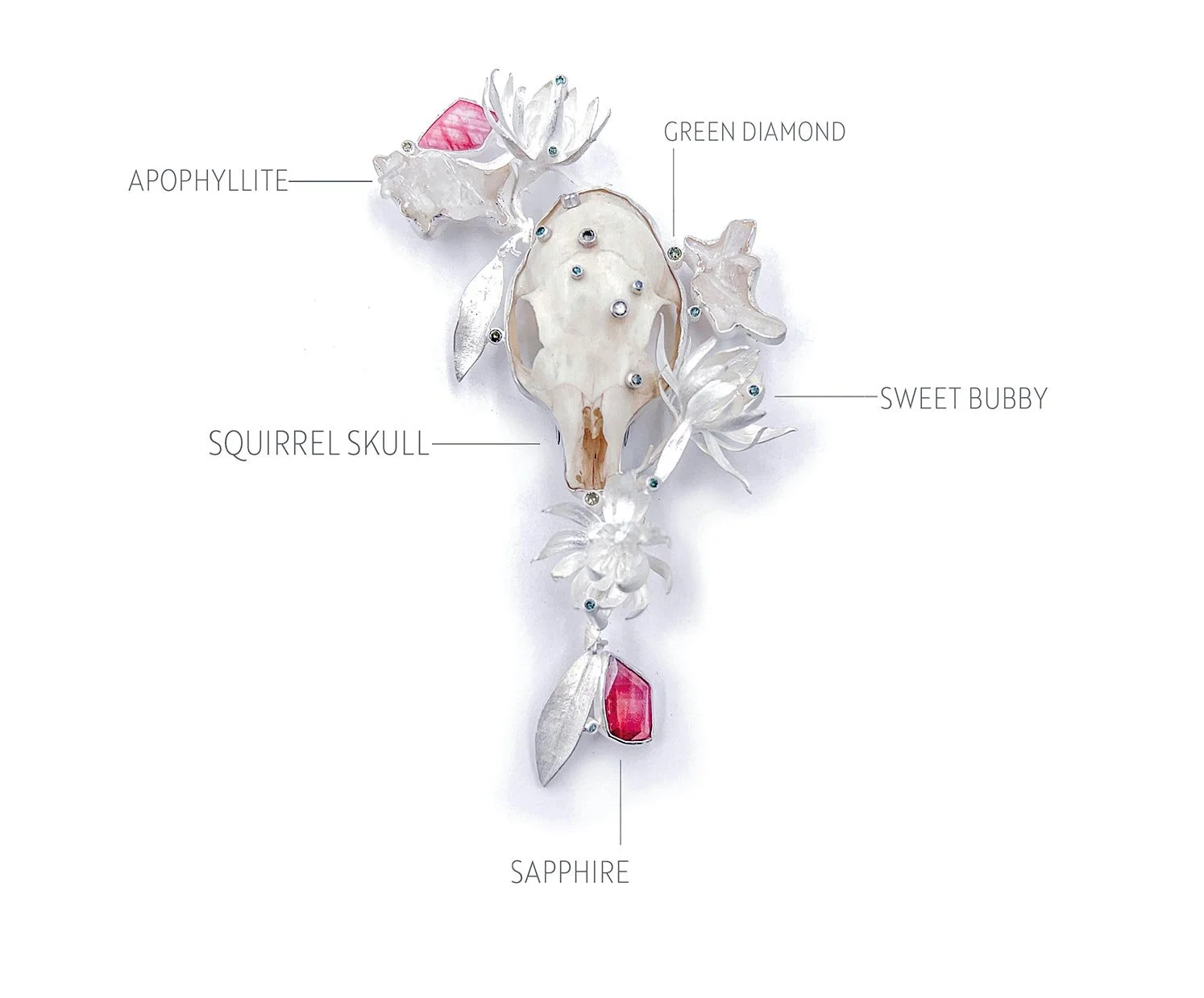
CALYASQUIRE BROOCH (annotated) of squirrel skull, green diamonds, pink sapphires, apophyllite, silver, cast Carolina spice bush, 11.4 x 7.0 x 2.5 centimeters, 2023.
Johnson also adores Art Nouveau design and how the whiplash lines of that style echo the bending taper of a scapula or the swirl of new growth on a vine. She also shares the style’s delight in the strange magnificence of nature and the use of unconventional stones (opal, rutilated quartz, agate, moonstone, amber). For example, her Inciroda Necklace pairs a deep purple-grey rat skull with an irregular slab of shimmering Oregon opal, while individually-set rodent incisors reflect the shape of a gracefully arced lily-of-the-valley stalk cast in blackened silver.
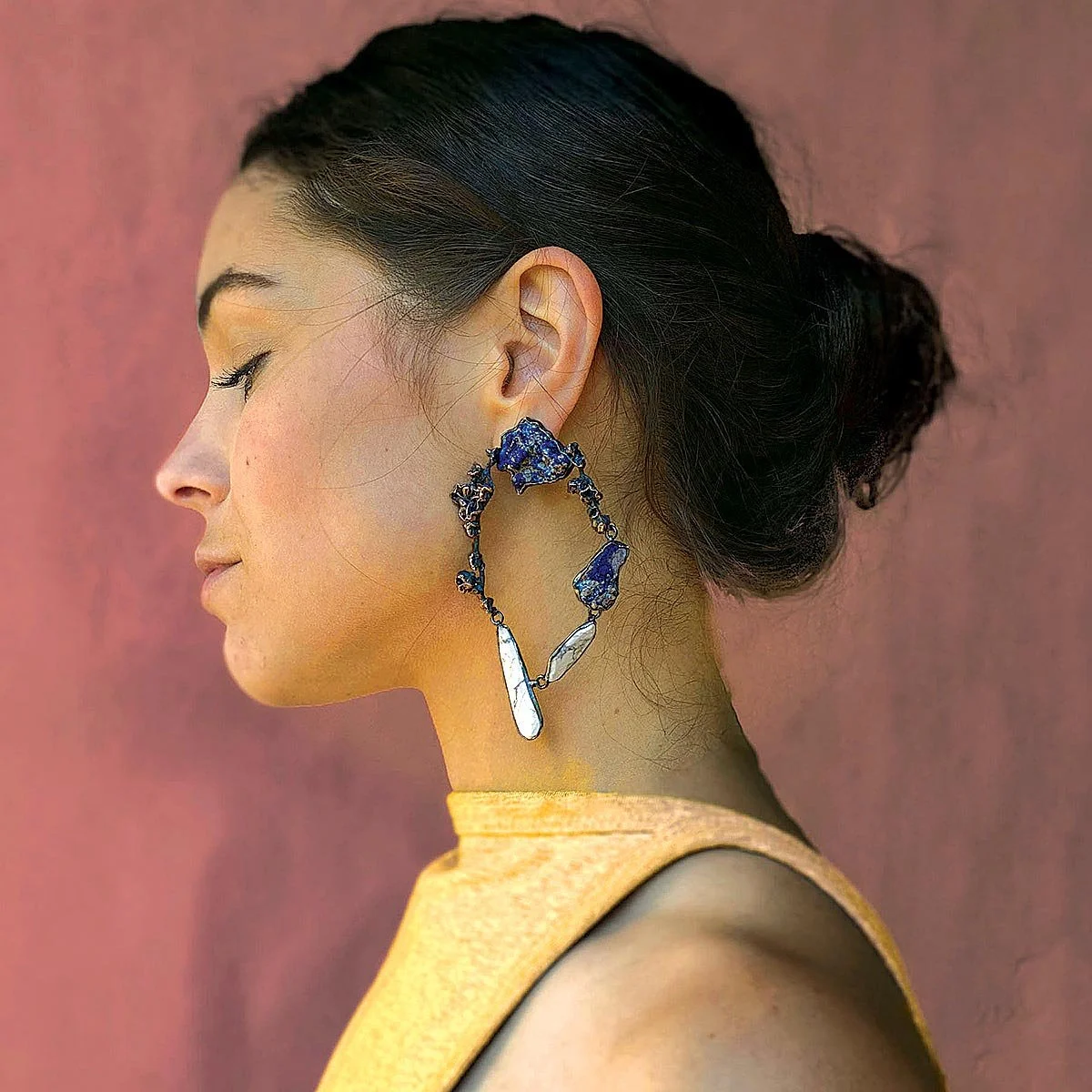
Johnson’s jewelry can be unsettling. For example, some people who are initially attracted by what appear to be pretty, ivory-hued flower blossoms are repelled upon learning they are actually snake vertebrae. Similarly, one pair of earrings at first glance appears to be traditional half hoops scattered with small sterling blooms; the curved shapes, though, which shade from ivory to rust are, unexpectedly, beaver teeth. Most people quickly overcome such initial surprises and join Johnson in recognizing the beauty of the forms, hues, and textures of her compositions and relish the opportunity her jewelry provides to connect with nature.
Johnson’s designs have a quirky, wearable Wunderkammer quality to them. (Her Calyasquire Brooch brings together a white squirrel skull, bright silver cast sweet bubby [Calycanthus floridus], irregular faceted pink sapphires, and apophyllite crystals, all sprinkled with green diamonds.) Many have scientific-sounding names that are often fictional mashups of actual nomenclature associated with the materials in each work—“something that sounds attractive in my head and kind of mirrors the piece.” She arranges objects for visual effect, working intuitively and imbuing her designs with the delight of discovery.
One motif that Johnson reserves for a quasi-production Serpentine Collection is a cast snake. A college friend found old jars of dried out specimens, including a perfectly coiled little snake, in an abandoned high school. Johnson has always loved snakes—she even had a series of pet garter snakes, each named Pee Wee Herman, when she was a kid—“they’re just so fascinating!” She appreciates that they have a rich history of symbolism over time and across cultures, and enjoys that, whether positive or negative, everyone has an opinion about them, “they are iconic.” In her jewelry the little serpents curl and twist around fingers and wrists, ready to quietly slither away.
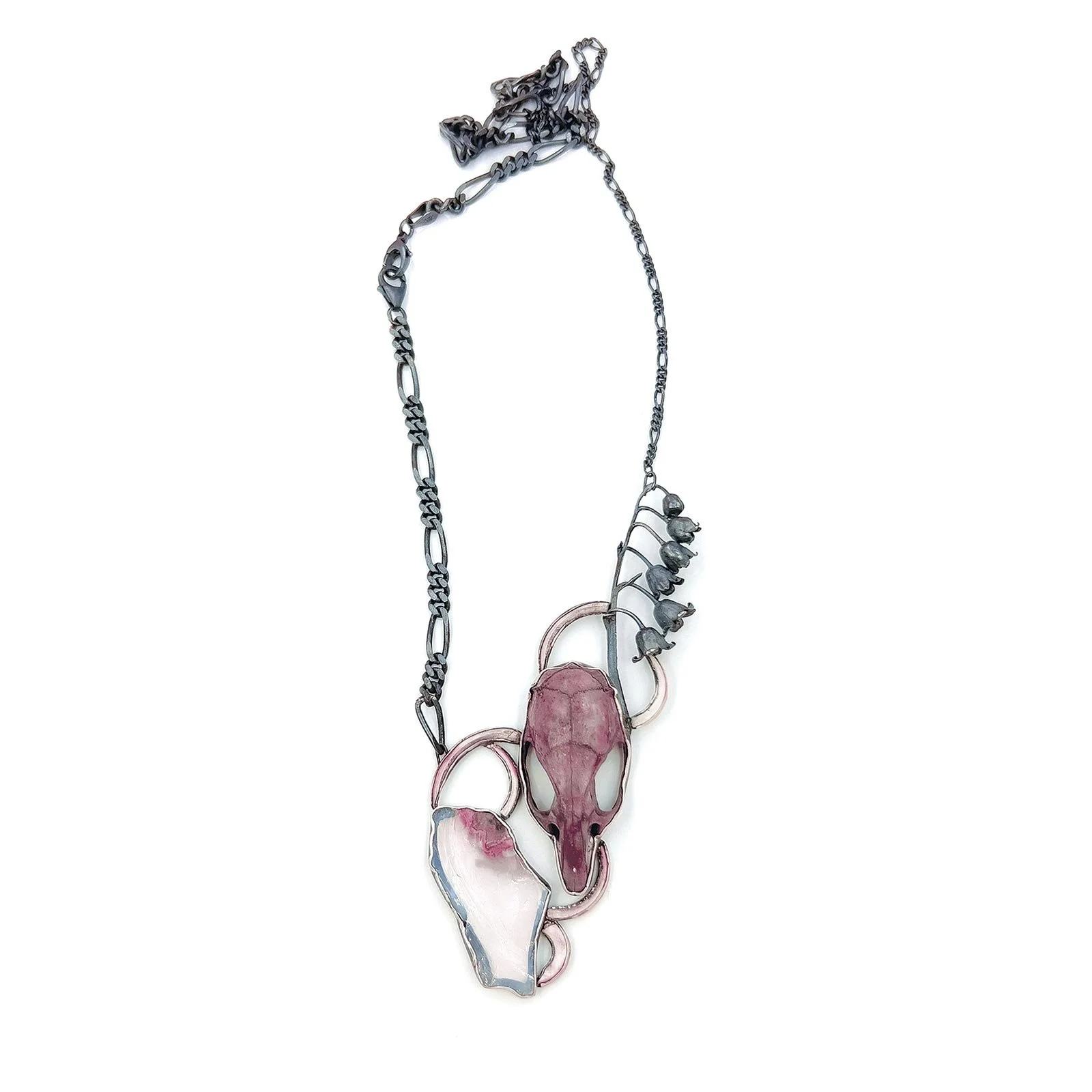
INCIRODA NECKLACE of rat skull, rodent incisors, Oregon opal, silver, cast lily of the valley, 50.1 x 5.5 x 1.3 centimeters, 2024.
A few years ago, Johnson created a necklace for the 38th Annual Benefit Auction at Penland in honor of blacksmith Elizabeth Brim, that year’s Outstanding Artist Educator. An admirer of Brim, whom she describes as “brilliant, talented, kind, and epically badass,” Johnson included pearls (Brim is renowned for wearing pearls at the forge), black diamonds, baroque pearls, auditory bones, cast marigolds, and titled it Domina Sim (Lady-Like) Necklace. Johnson, using her own distinctive visual vocabulary, presents a portrait of Brim, conveying the mix of strength and delicacy that defines Brim’s work.
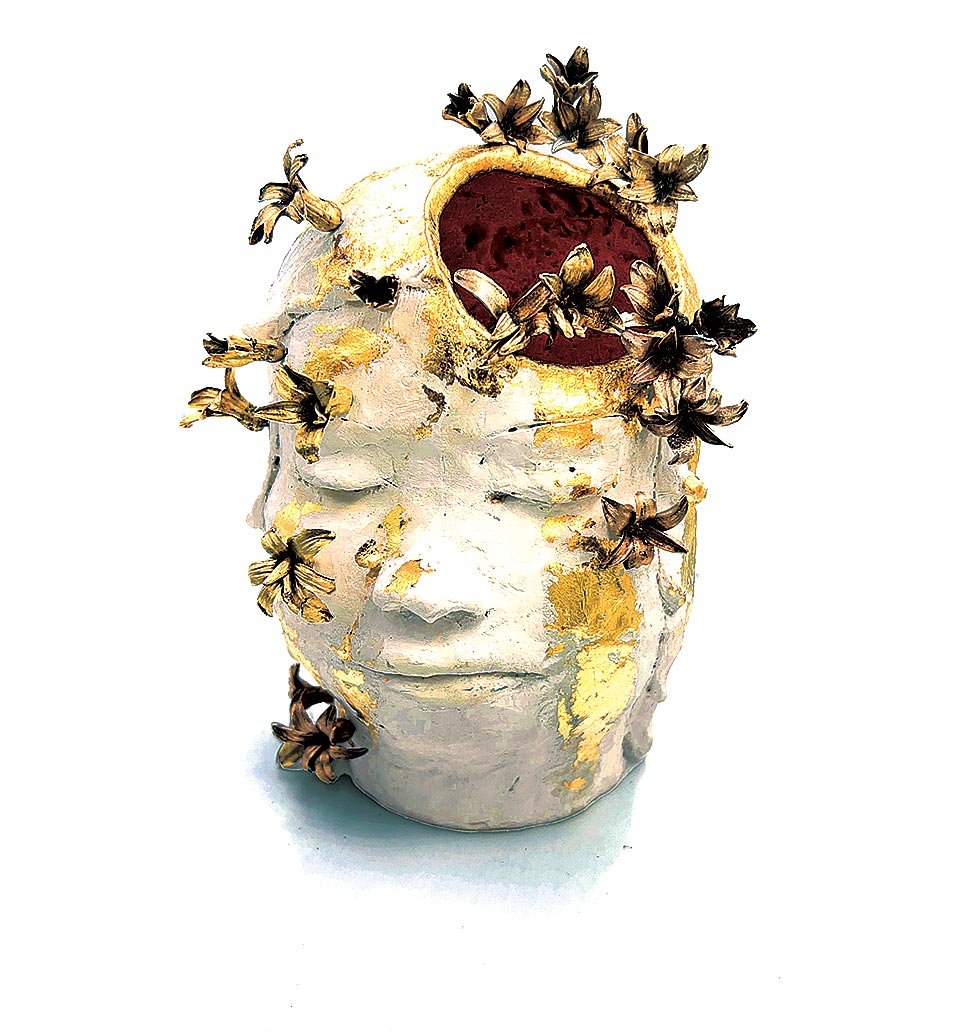
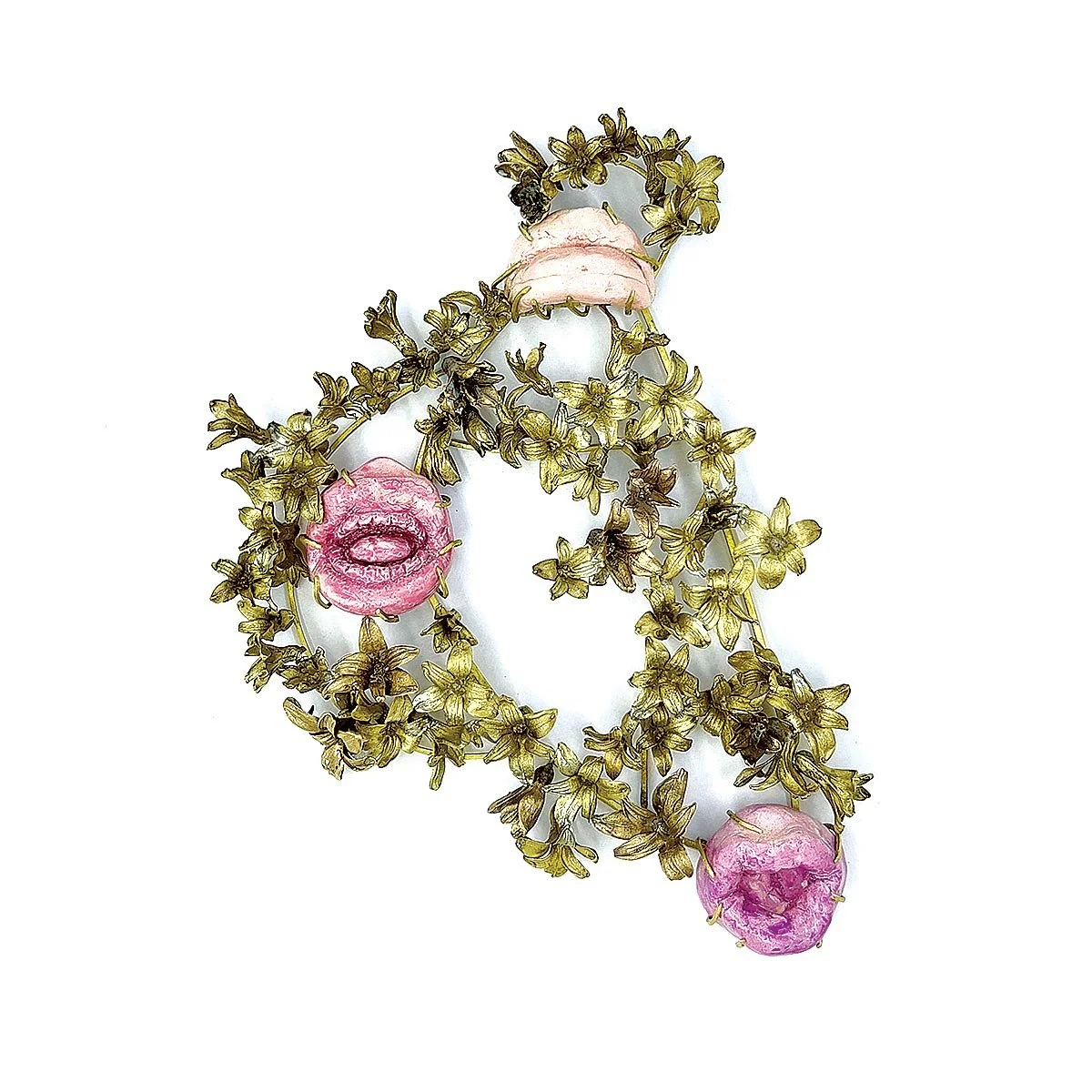
During her residency at Penland, Johnson has been investigating the possibilities of making non-wearable work. “I’ve…found myself imagining forms, materials, and scales that simply aren’t meant to exist on the body.” She sampled that approach through a collaboration in 2024 with ceramist Kensuke Yamada, in which they combined his colorful figural ceramics with her cast flora. “I’m interested in what happens when I allow myself to experiment more freely; to take risks and follow processes or forms that jewelry wouldn’t accommodate…For example, some of my castings, like the gooseneck loosestrife, are too delicate, expansive, or physically cumbersome to function as jewelry, but they feel too alive and exciting to set aside.” Penland, with a beautiful campus nestled in the Blue Ridge Mountains and ample artistic knowledge and camaraderie, offers an ideal setting to foster Johnson’s creative future.
SUGGESTED READING
80 Grit Films, “Abyss of Life: Anna Johnson Jeweler,” 2020, https://vimeo.com/389645176
Jewelry Journey Podcast, “Episode 201, Parts 1 and 2: How Anna Johnson’s Jewelry Connects Wearers to the Natural World,” August 29 and 31, 2023, https://thejewelryjourney.com.
Ammons, Johnathan. “Adorning Oneself with the Remains of the Day.” Asheville Made, April 2, 2021, https://ashevillemade.com/adorning-oneself-with-the-remains-of-the-day/.
Dinoto, Andrea. “Anna Johnson: Honoring Nature through Adornment.” Metalsmith: Vol. 39, No. 3, 2019: 18-19.
Click for Captions

ANNA JOHNSON at the Smithsonian Craft Show in 2025. Photograph by Robert K. Liu.

Ashley Callahan is an independent scholar and curator in Athens, Georgia, with a specialty in modern and contemporary American decorative arts. She has an undergraduate degree from Sewanee and a Master’s degree in the history of American decorative arts from the Smithsonian and Parsons. Callahan admires Anna Johnson’s blending of nature and science. Though Johnson said she sometimes feels like she is “playing scientist,” Callahan believes that her work captures the spirit of a natural history museum because Johnson fills her creations not only with an artist’s knowledge of her materials, but with an archeologist’s understanding of how to prepare bones, a botanist’s awareness of how seasons will affect what is available, and a scientist’s curiosity about how it all fits together. Her publications include Frankie Welch’s Americana: Fashion, Scarves, and Politics (UGA Press, 2022), Southern Tufts: The Regional Origins and National Craze for Chenille Fashion (UGA Press, 2015), and, as co-author, Crafting History: Textiles, Metals, and Ceramics at the University of Georgia (Georgia Museum of Art, 2018).