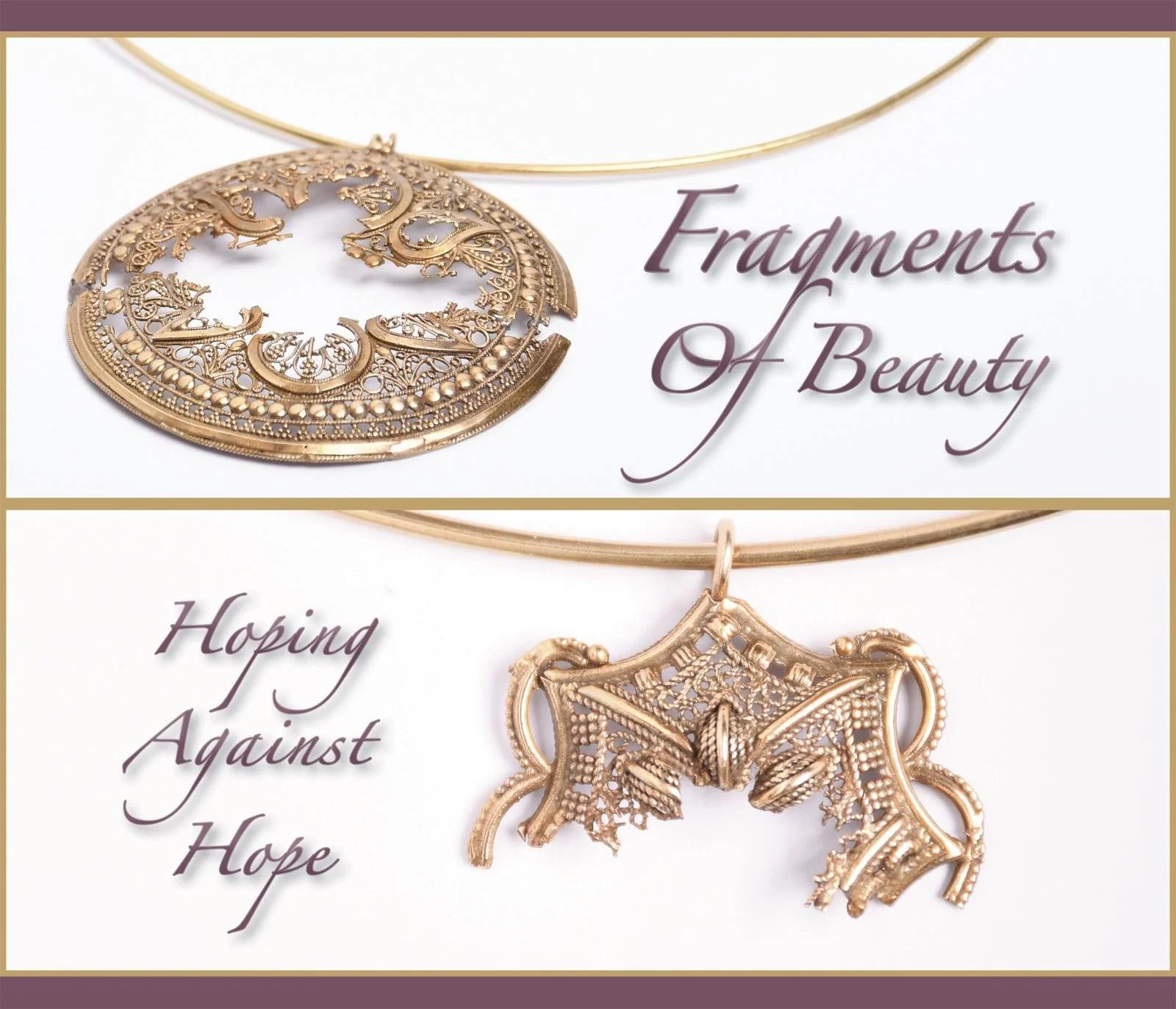
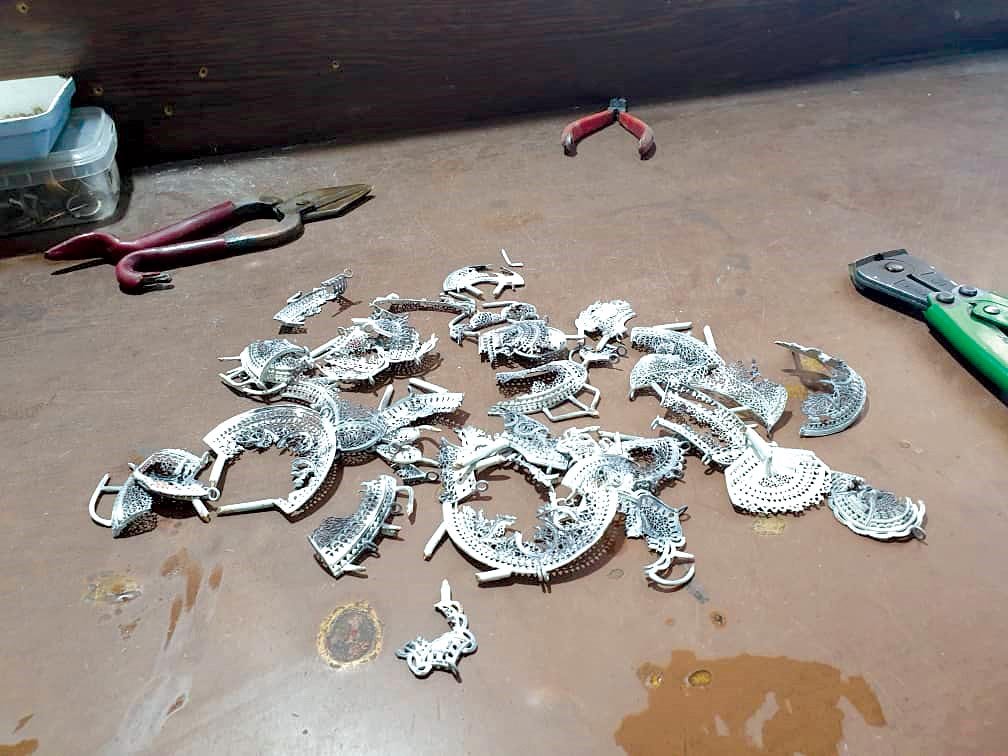
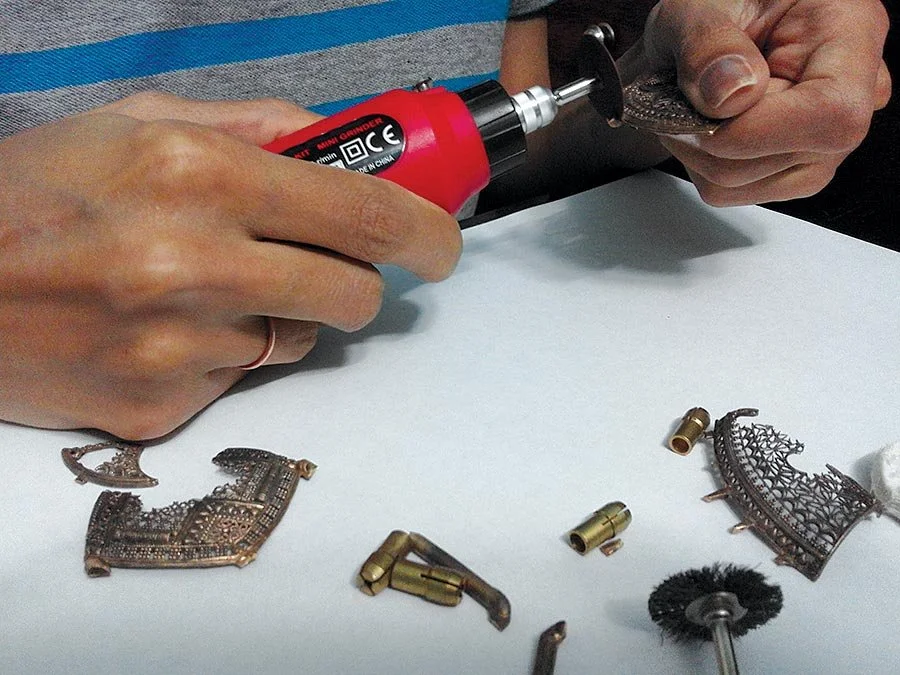
N&B.H.05 MODEL of bronze and brass, 2021. N&B.H.07 MODEL of bronze and brass, 2021. Photographs by H. Khoshandam except where noted.
NAFISEH KHOSHANDAM AND BAHAREH GHADERI.
There is something powerful about the passage of time. It flows like a mighty river, carrying our world along with it, leaving its mark in thousands of different ways. When we take a careful look at humanmade objects that have been weathered by these continual waves that lap at edges and corners, disintegrating spans and leaving debris to dangle in their wake, what is left often strikes us as beautiful. There is a unique poignancy to the knowledge that a person spent effort in creating this thing, whether it is a concrete staircase, a crumbling brick wall or a piece of jewelry, which now by no fault of their own is gradually returning to its base elements.
The work of Nafiseh Khoshandam and Bahareh Ghaderi examines closely the relics of time in Iranian art history and culture. Multimedia artists who have done murals on buildings, public art installations such as kaleidoscopic sleeves fitted to the elbows of trees (reflecting flashes of shadows and light from passing cars and pedestrians) and a series called Art Medals which mimic bronze-age artifacts, Nafiseh and Bahareh use their skills to both beautify and call attention to issues in society. It is a love affair with culture, itself an incomparably vast construct that is the result of hundreds and thousands of years of human beings interacting with each other and their environment. As conscientious inhabitants of this culture, they are both observers and commentators.
Nafiseh and Bahareh possess a sensitive awareness of Iran and its society, stretching back to when the country was known as Persia. Speaking with them reveals a tender appreciation of the many wonderful contributions and facets of Iranian culture. They talk of Nowruz, the celebration of the Iranian New Year which is an ancient holdover from Iran’s past, and a much beloved festival. For Europeans and Americans, the festival could be seen as almost pagan, full of ritual and veneration of nature. Preceding the celebration is a frenzied bout of spring cleaning, a purchasing of new clothes and the procurement of flowers. It is a time to refresh, to throw out the old and bring in the new. The folkloric characters Amu Nowruz and Haji Firuz come alive as performers don costumes and dance in the streets. Amu is perhaps most analogous in the West to our Santa Claus, a kindly, elderly man who brings gifts to the children. Haji Firuz is more akin to the people’s jester; he covers his face with soot, dresses in red and tops himself with a felt hat, capering through boulevards clapping a tambourine. Both ancient figures have as their mission the spreading of good cheer and joy. Nafiseh and Bahareh are keen to share another traditional holiday. “Yalda Night is an ancient Iranian holiday that falls on the longest and darkest night of the year: the winter solstice,” they explain. “As in cultures around the world, it is a celebration of the light that follows darkness as spring follows winter; a time to gather together with friends and family to ward off the privations of the coldest season.”
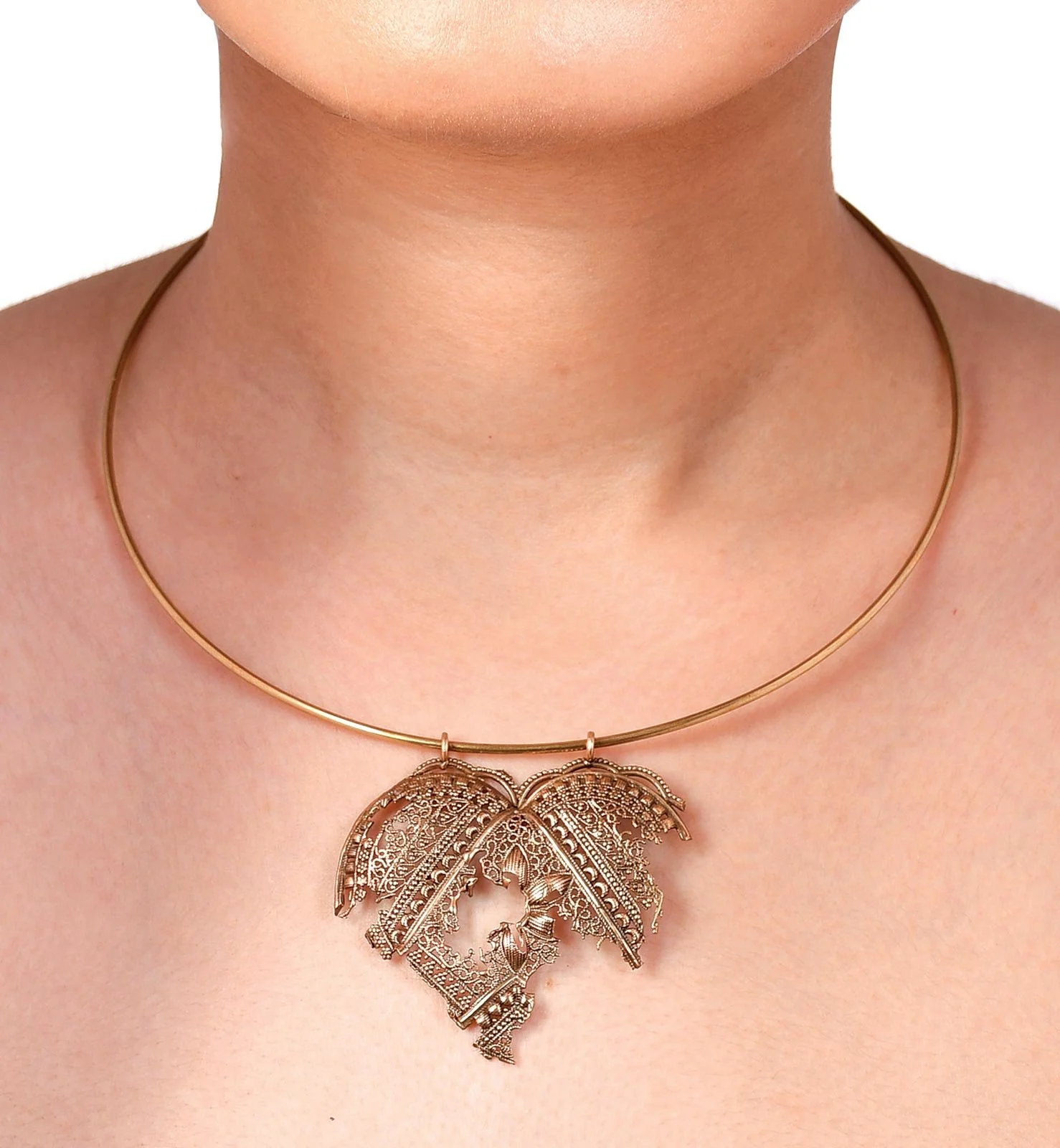
N&B.H.04 MODEL of bronze and brass, 2021.
Yet within their obvious infatuation with Iran’s rich lineage lies a persistent undertone of melancholy and even a bit of grief. They acknowledge the challenges their country faces, and the degradation of the traditions of art, science and society that they hold so dear. It is in this balance of grief and appreciation that their newest series of work, Hoping Against Hope, found its voice. The series marks the first time that the two artists have used jewelry to express their message, which is much like a poem to an estranged lover. Nafiseh and Bahareh are lamenting the decline of Iranian culture, which they identify as both external, in the case of international sanctions and regional wars, and internal, from the restrictions imposed on Iranian society to the acid attacks on women in the city of Isfahan.
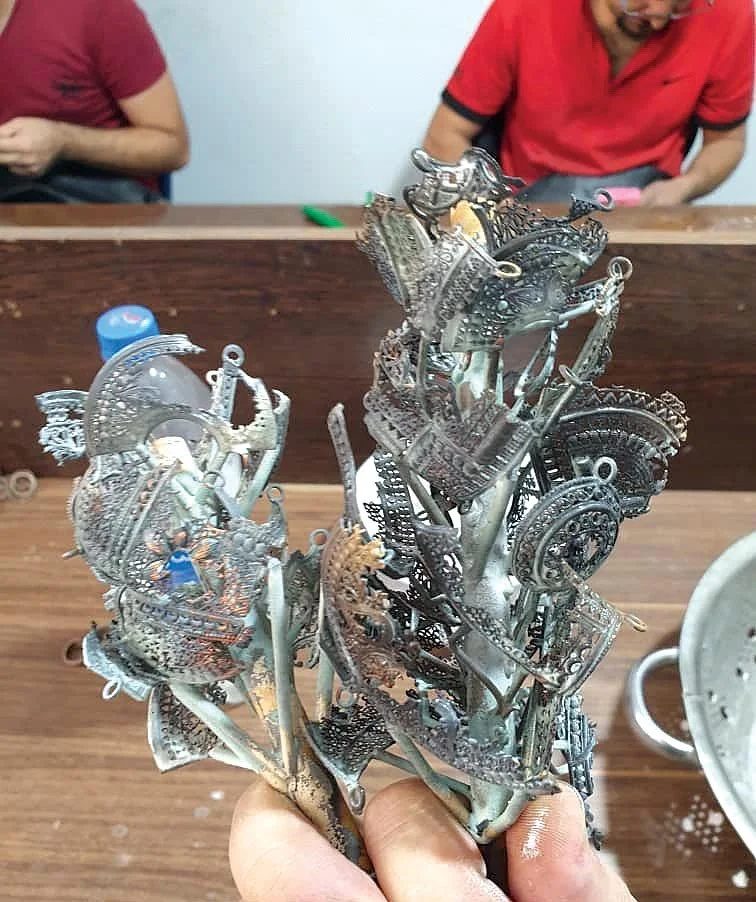
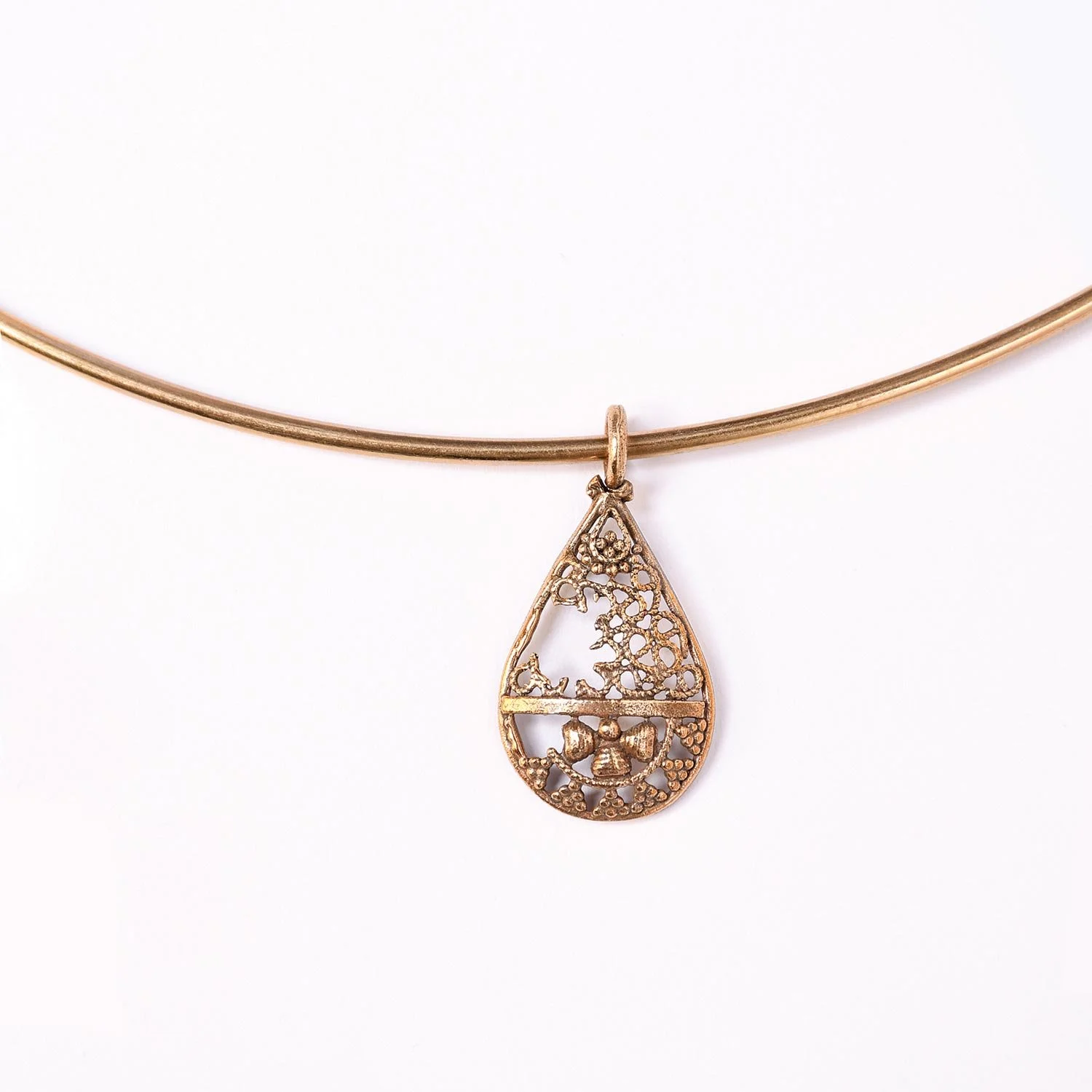
The form this poetry takes are cast, partial reproductions of Middle Eastern jewelry. While traditionally made of gold, the two artists decided to make the series from bronze instead, to reflect a more contemporary interpretation, and cementing the objects as symbolic rather than literal. These fragments are deconstructions, seemingly damaged by the ravages of time rather than intention.
However, in that strange plucking of the heart strings that only art can accomplish, the emotional subtext comes through loud and clear. We recognize the beauty of these objects despite their state of damage and decay. The intricacy of their patterns, the granulation that is so minute, the familiarity of the paisley motifs, the sensual reassurance of stark geometry, all of this is beautiful, and a universal language. When one is quiet and observant, this language comes unbidden, in the form of subtle sensations and emotions that can be easily drowned out by the talkative mind. Yet when we listen to them, a much deeper understanding is reached.
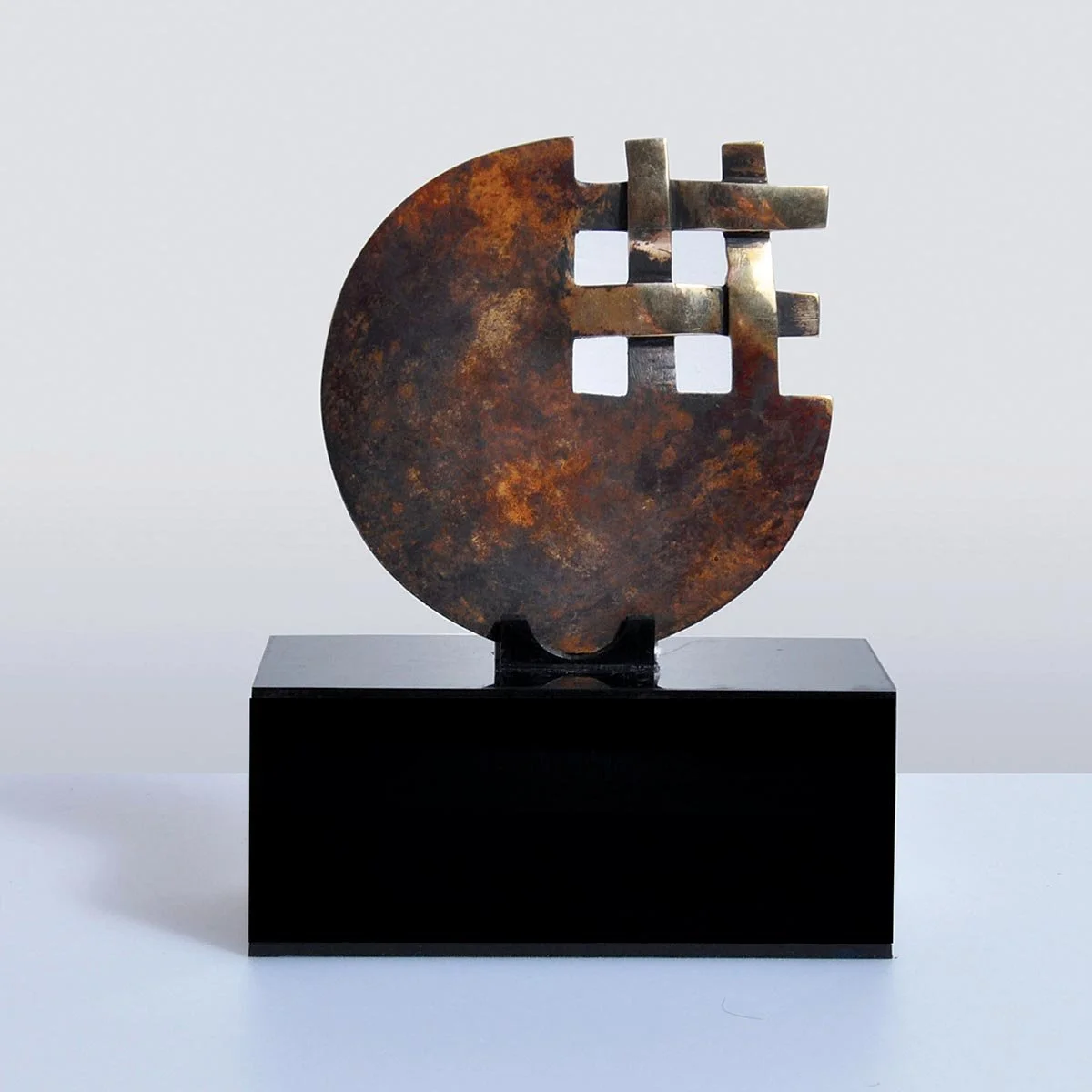
This understated symbology exists also in their Art Medal series, which preceded Hoping Against Hope. The purpose of medals is to commemorate, whether a person, or a piece of history. They are meant to give cause for reflection, to remember a moment that changed a nation, or to remind us of someone’s life whose contributions to the world reverberate still. In Nafiseh and Bahereh’s Art Medals, they instead urge us to reflect on social, cultural and political issues. Take Warp and Woof, a simple and elegant design that feels like an ancient archeology find. The tarnished bronze circle turns into a crisscross of threads in its upper right quadrant. This combined and resonant symbology, of the warp and weft of textiles representing the whole cloth, and the circle itself also conjuring up imagery of wholeness and oneness, is an example of how their design sensibilities come from a careful and measured intellect. On their website, the medal’s entry reads, “Warp and woof are both part and parcel of cloth. This is the time to help for reaching a global consciousness and awareness to remove all kind of physical, political and racist barriers and live peacefully.”
ROOFS AND BONDS, 2018. Photograph by Nafiseh & Bahareh.
N&B.H.37 MODEL of bronze and brass, 2021.
It is not just small objects that are part of Nafiseh and Bahareh’s voice. Mural art is also in their repertoire, involving both traditionally inspired as in their Persian Garden collection, and more contemporary renditions showing a cloudy night sky, with a street lamp shining down on rooftops, branches from flowering trees reaching up into the eaves of the city. They explain, “The garden’s purpose was, and is, to provide a place for protected relaxation in a variety of manners: spiritual, and leisurely, essentially a paradise on earth.” The stylish inspiration is drawn from Persian illuminated manuscripts, which as they describe, “One of the common forms of Iranian art is manuscript and this is one of the Iranian noble arts which in addition to its aesthetic aspect, it carries symbolic concepts of philosophy, mysticism, and logic. We have always been interested in the original and ancient Iranian arts and through the years we have tried to recreate and redesign them with our contemporary expression.”
Their collaboration is an integral element to their creative chemistry. Delving into their complex dialogue and implicit understanding yields the alchemy behind their craft. “As we use different materials and processes we have a variety of perspectives about each art project,” they relate. “To us, it is an undeniable fact that even sometimes the concept or shape are inviting us to determine the material and subject and this is why occasionally we are unable to explain the exact source of the idea. The basis of our teamwork is thinking along with creativity. What is called ideation. In fact, we could use the brainstorming skills and abilities to come up with a better and more valuable solution to our challenges. Methods that led to learning and using different media and materials in our work. This jewelry collection was the perfect answer to the idea of hoping against hope that we had never done before.”
This exploration of new territory is an intimate part of the artistic process. It stretches back to when the earliest humans drew ochre and charcoal across a cave wall, daring to depict their own experiences. Nafiseh and Bahareh pay homage to this long thread of human growth, this expression of human potential. Their contribution to the cultural dialogue art helps to foster is not lost in the noise; it is the noise, the triumphant music of interpretation and imagination that keeps people vibrant and engaged with the world around them. In a thoughtful manner, they draw attention to difficult situations and ask of us to be our better selves. It is this obliqueness, the coaching of realities of hardship and misunderstanding in a common and ancient language, that lets us see things from different perspectives. Beauty, in all its forms, is that common tongue.
Click for Captions
PERSIAN GARDEN, 2020. Photograph by Nafiseh & Bahareh.
Click for Captions

Patrick R. Benesh-Liu is Coeditor of Ornament and a lifelong participant in his parents’ creative journey. From growing up in the Ornament office on La Cienega Boulevard in Los Angeles to his first administrative work in the Vista, California building during high school, Benesh-Liu has had the fortune of being immersed in craft, culture and wearable art. Now as one of the two guiding editors for the magazine, he continues to reflect on the vital work his mother and father have done in advancing the historical chronicling of jewelry and clothing artists for over forty-seven years. One of the strongest memories he holds is of the people who came to visit his parents, whether at the office or at home, and the connections and friendships which they formed. So it was to his great surprise when two Iranian artists contacted Ornament regarding their new jewelry series, which uses fragments of Middle Eastern traditional jewelry to communicate the loss of culture that part of the globe has experienced. He writes on that collection, entitled Hoping Against Hope. In another essay on connections and relationships, he offers his perspective on the Philadelphia Museum of Art Contemporary Craft Show, back in-person this year, and which he very much looks forward to attending.